Random Matrix Theory at Nonzero $\mu$ and $T$
K. Splittorff, J.J.M. Verbaarschot

TL;DR
This paper reviews how random matrix theory helps understand the chiral phase transition in QCD at nonzero temperature and chemical potential, especially addressing the sign problem and eigenvalue behavior.
Contribution
It introduces a novel perspective on the sign problem in QCD at nonzero chemical potential using random matrix theory and eigenvalue analysis.
Findings
Discontinuity in chiral condensate explained without Banks-Casher relation
Sign problem severity analyzed in microscopic QCD domain
Eigenvalue distributions linked to phase transition behavior
Abstract
We review applications of random matrix theory to QCD at nonzero temperature and chemical potential. The chiral phase transition of QCD and QCD-like theories is discussed in terms of eigenvalues of the Dirac operator. We show that for QCD at , which has a sign problem, the discontinuity in the chiral condensate is due to an alternative to the Banks-Casher relation. The severity of the sign problem is analyzed in the microscopic domain of QCD.
Click any figure to enlarge with its caption.
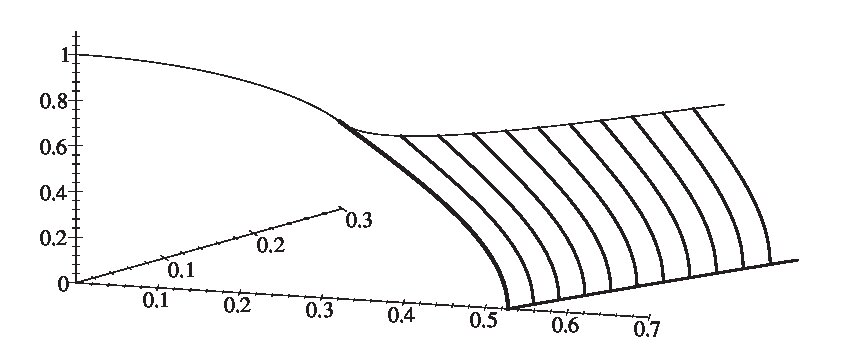 Figure 1
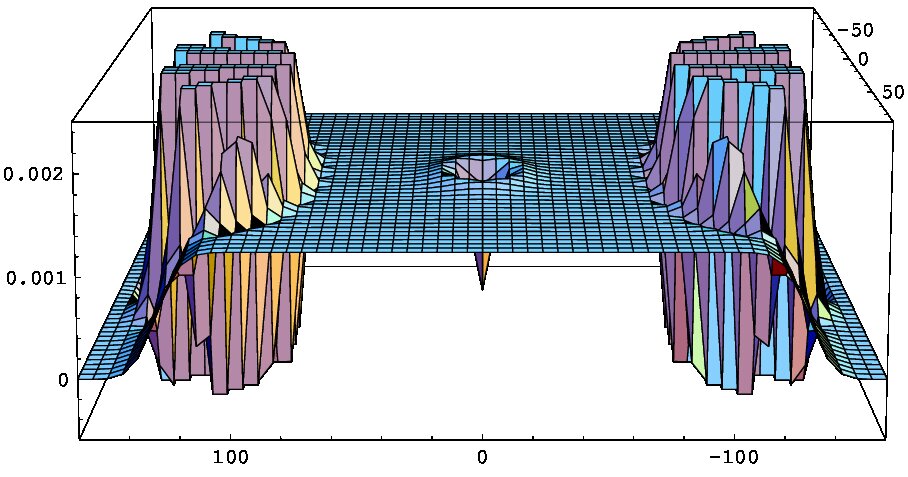 Figure 2
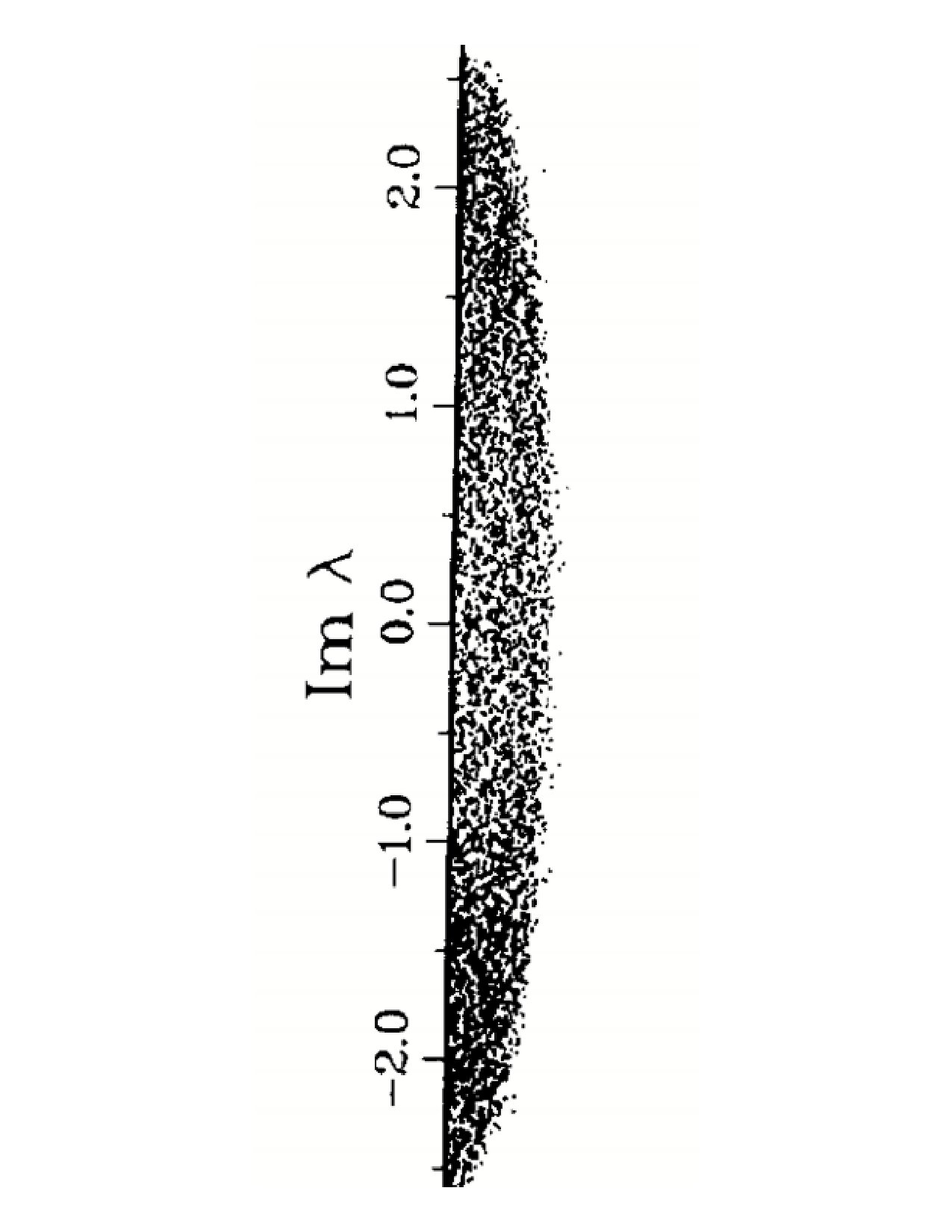 Figure 3
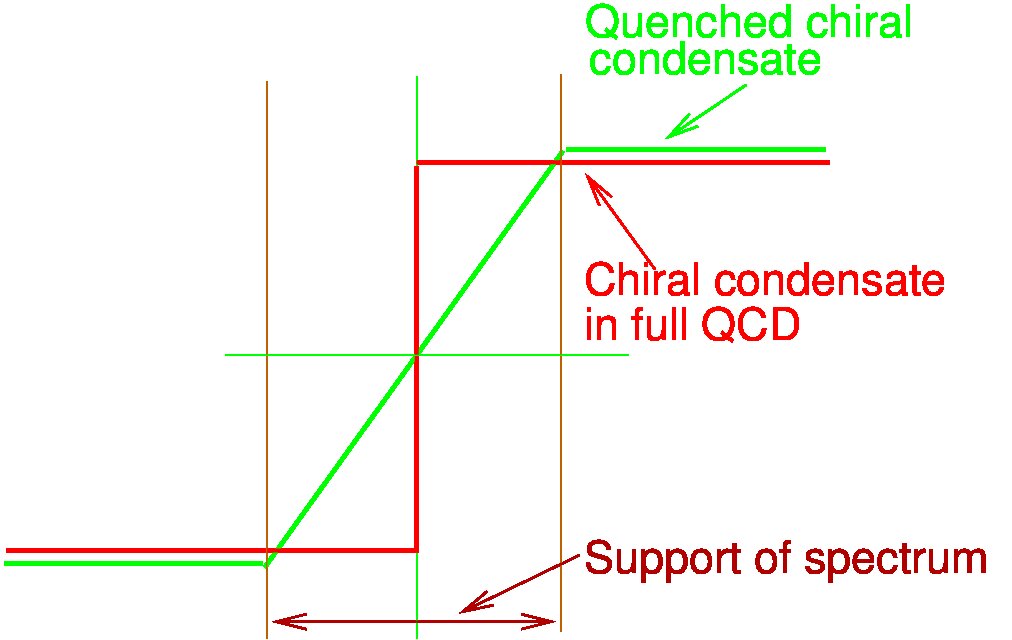 Figure 4
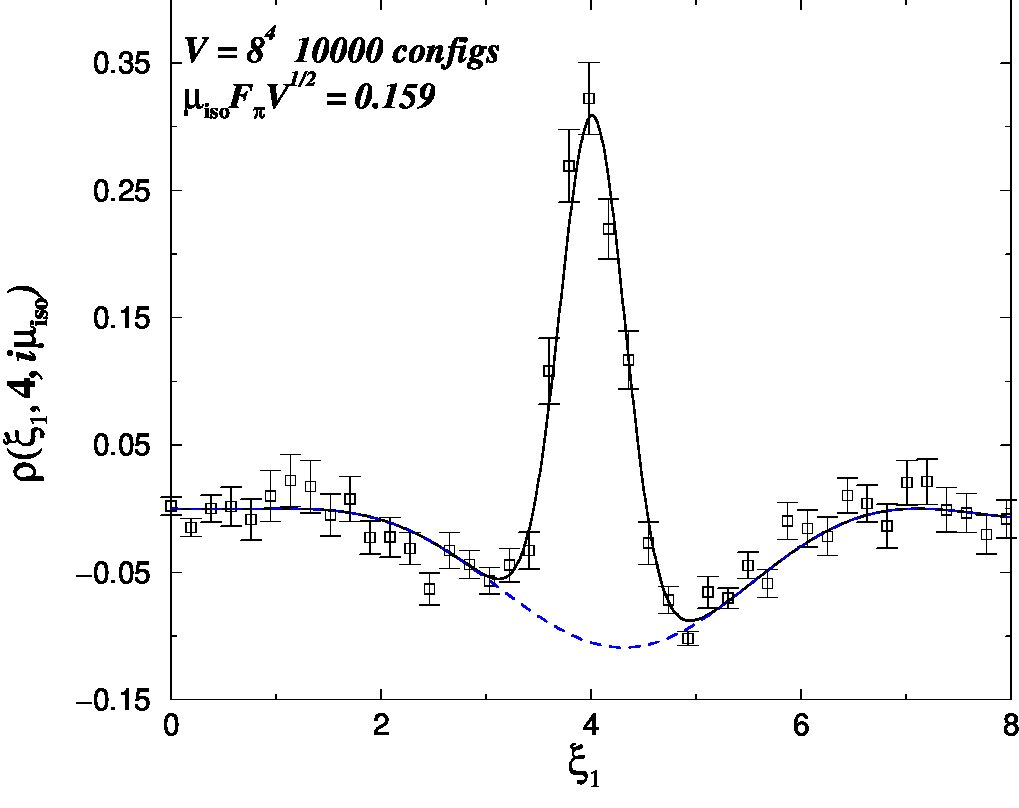 Figure 5
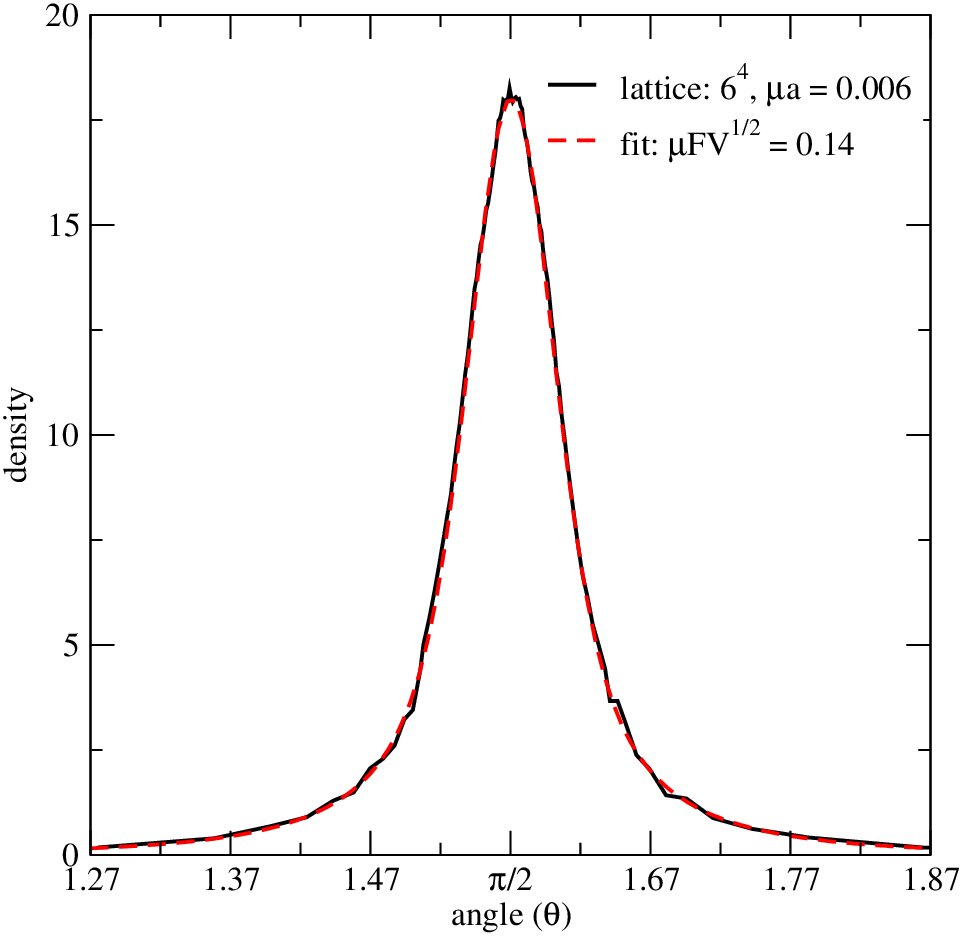 Figure 6
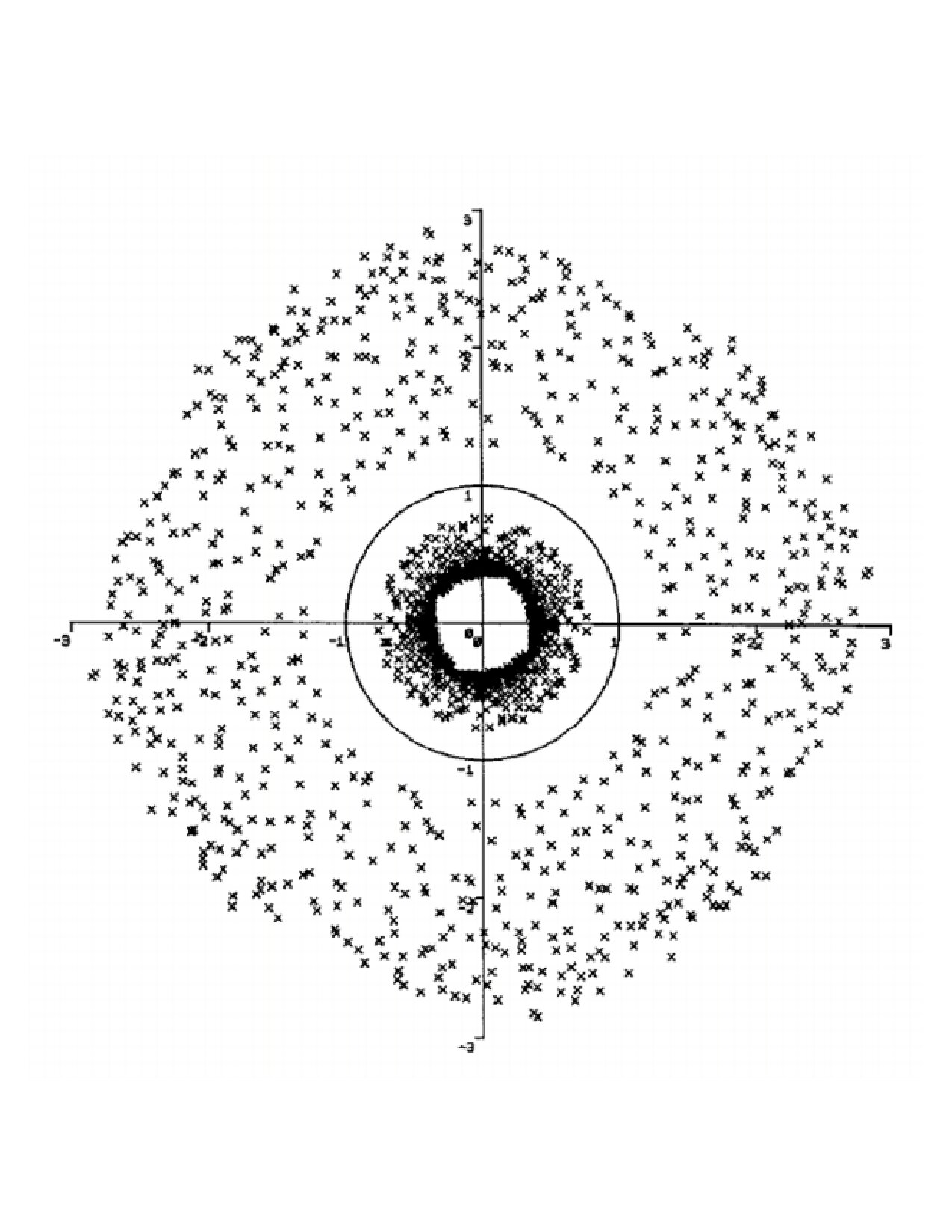 Figure 7
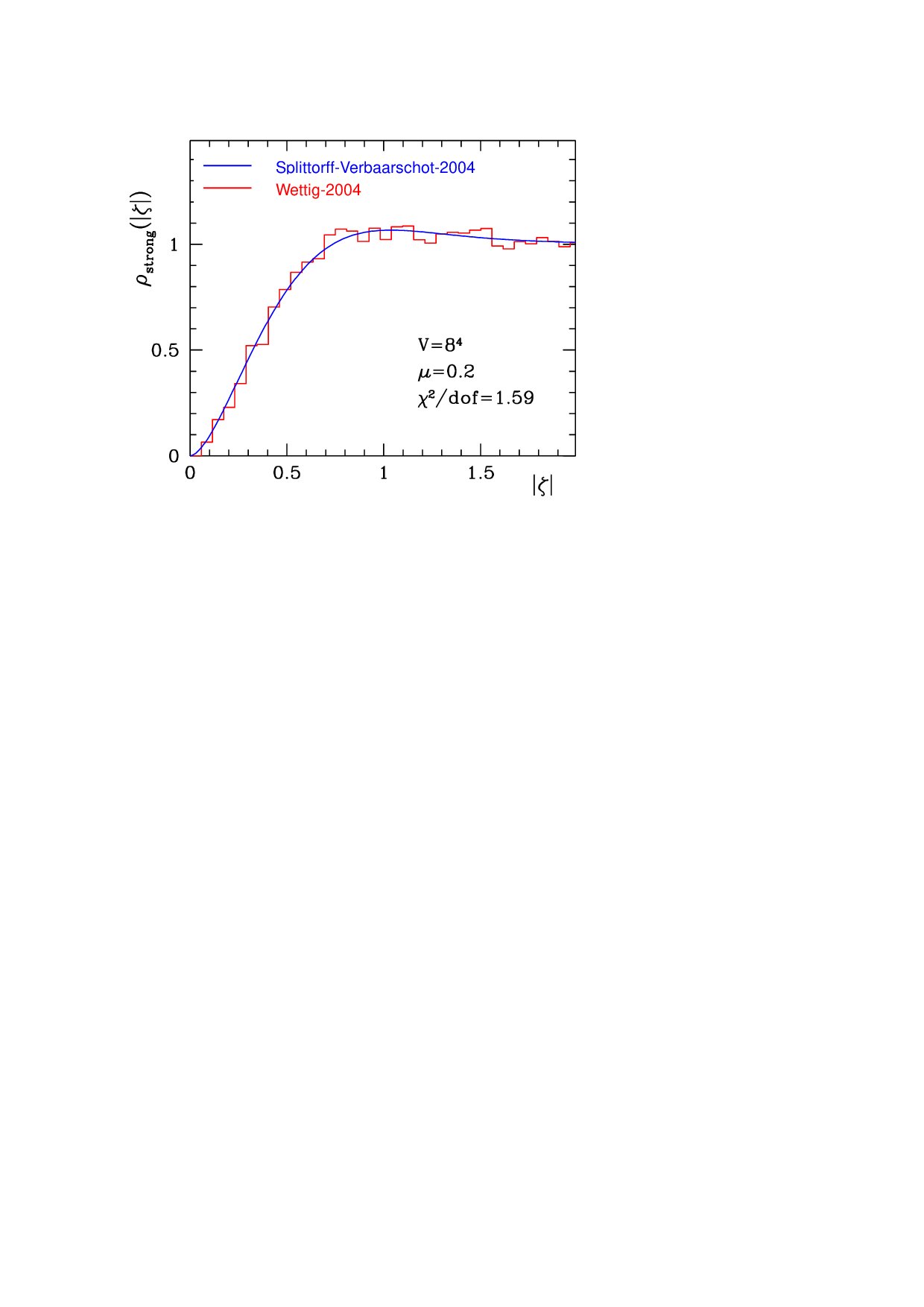 Figure 8
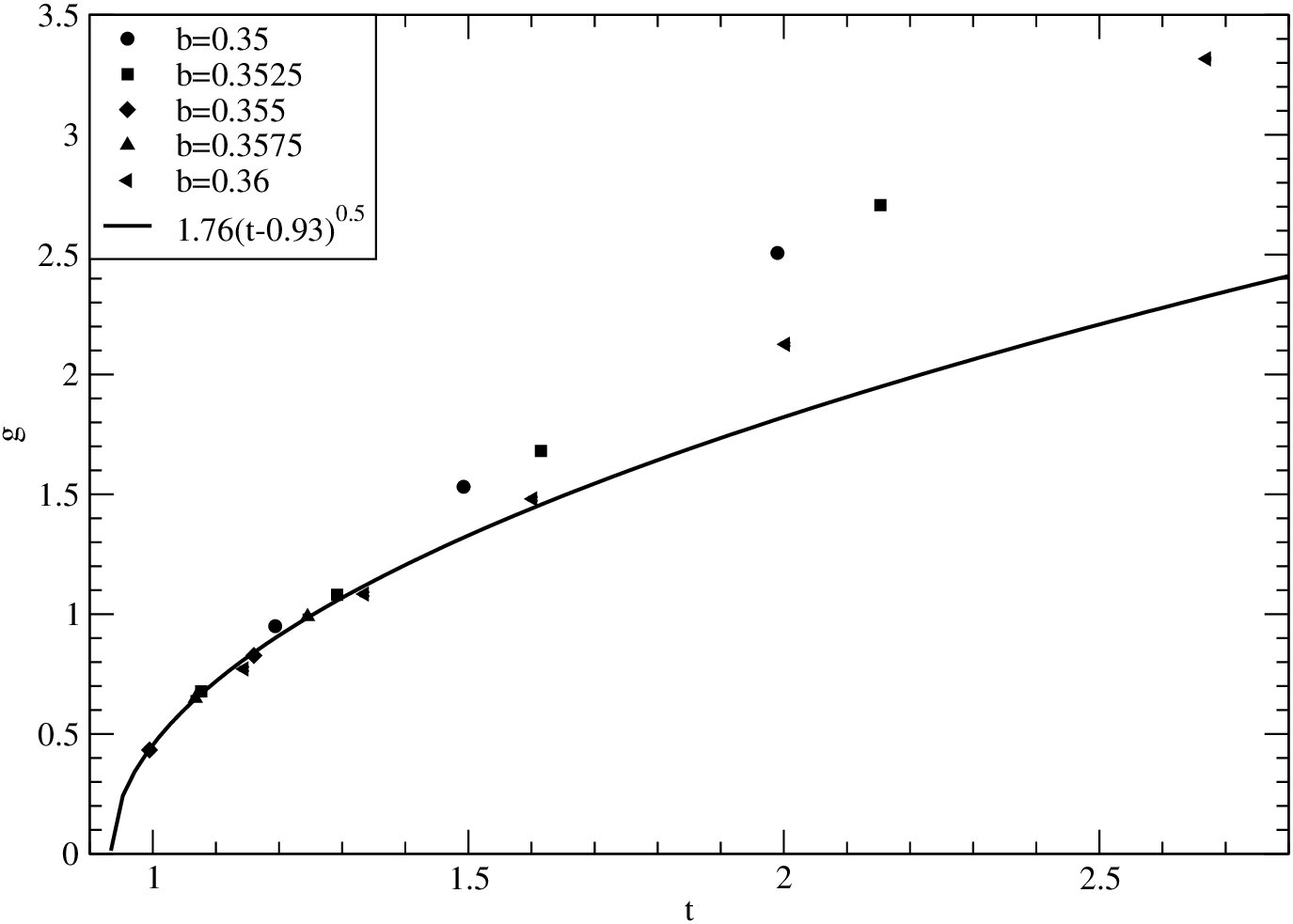 Figure 9
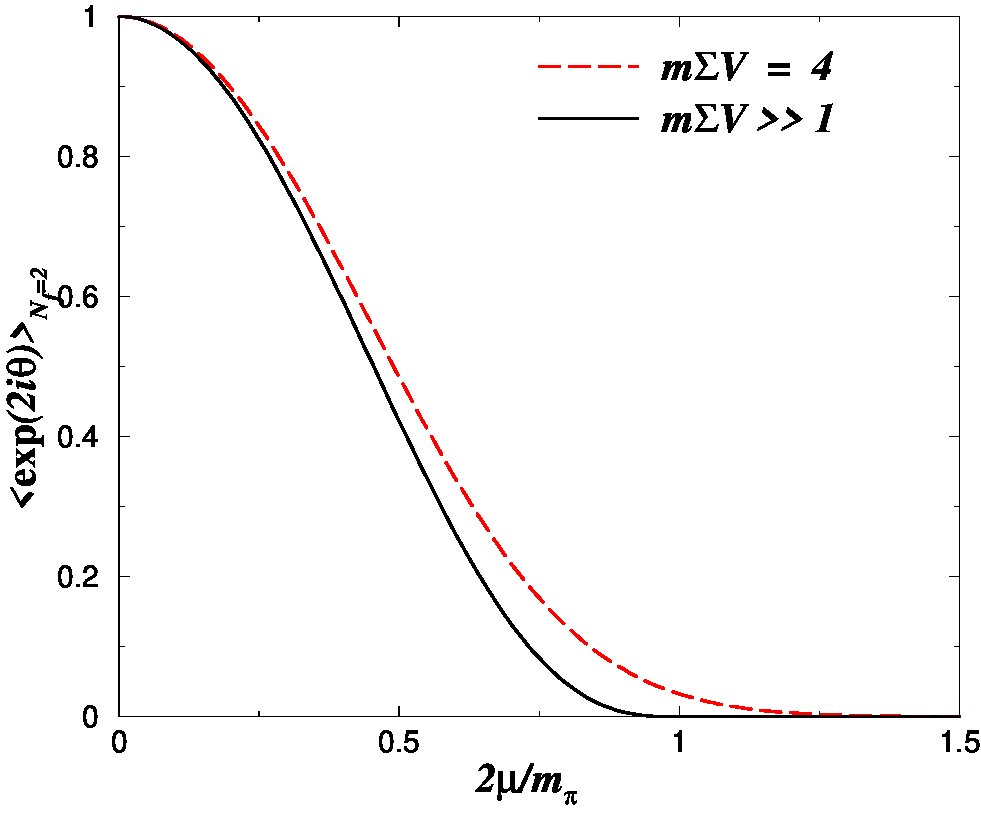 Figure 10
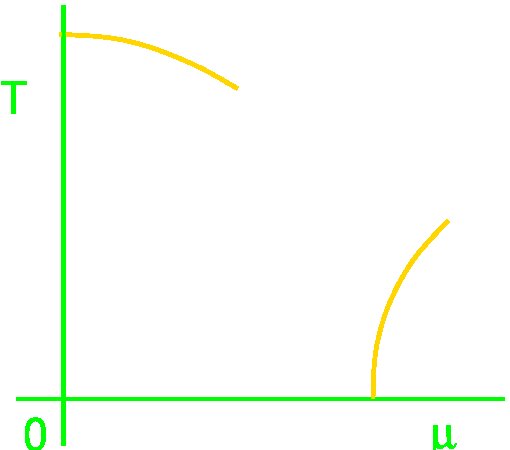 Figure 11
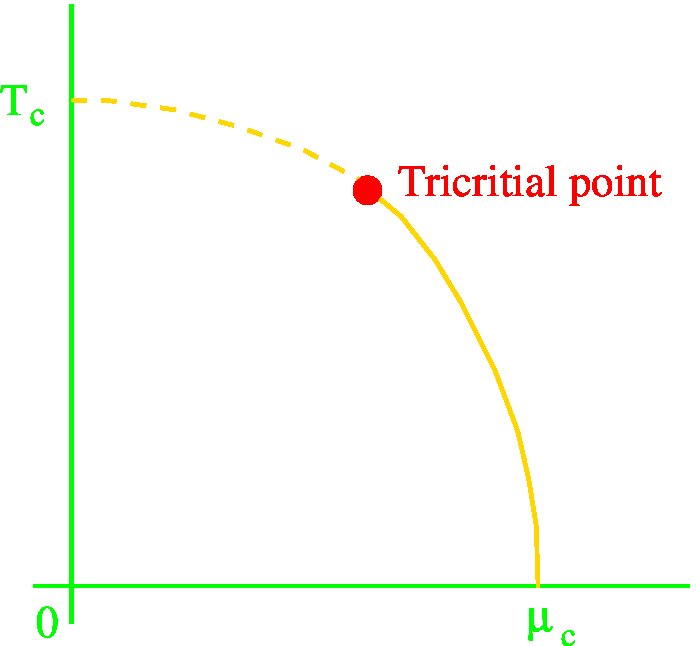 Figure 12
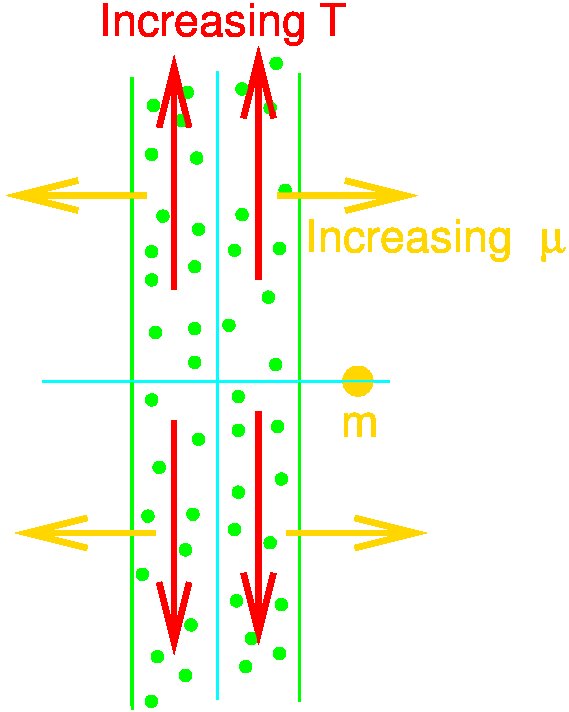 Figure 13
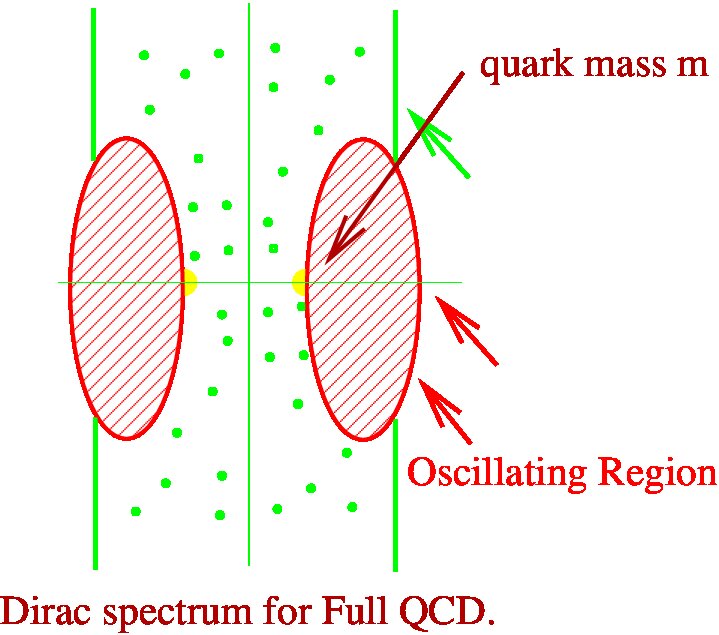 Figure 14
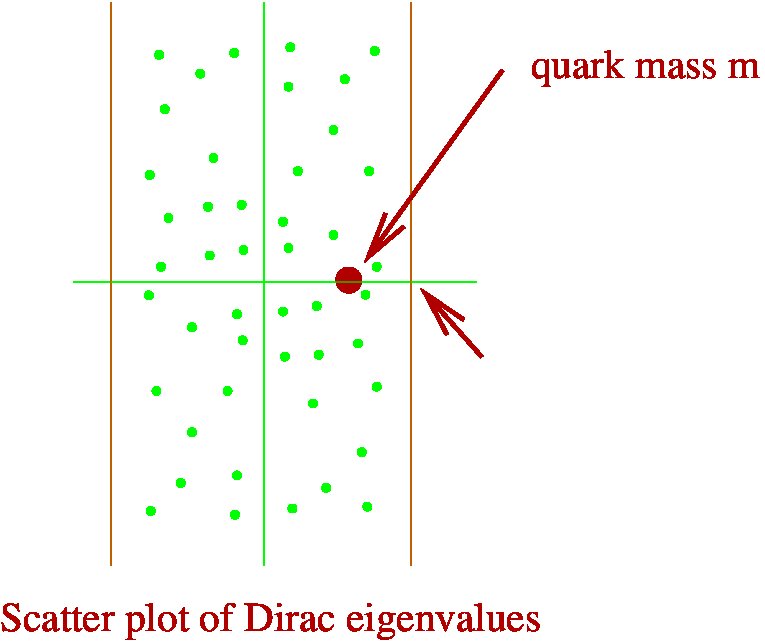 Figure 15
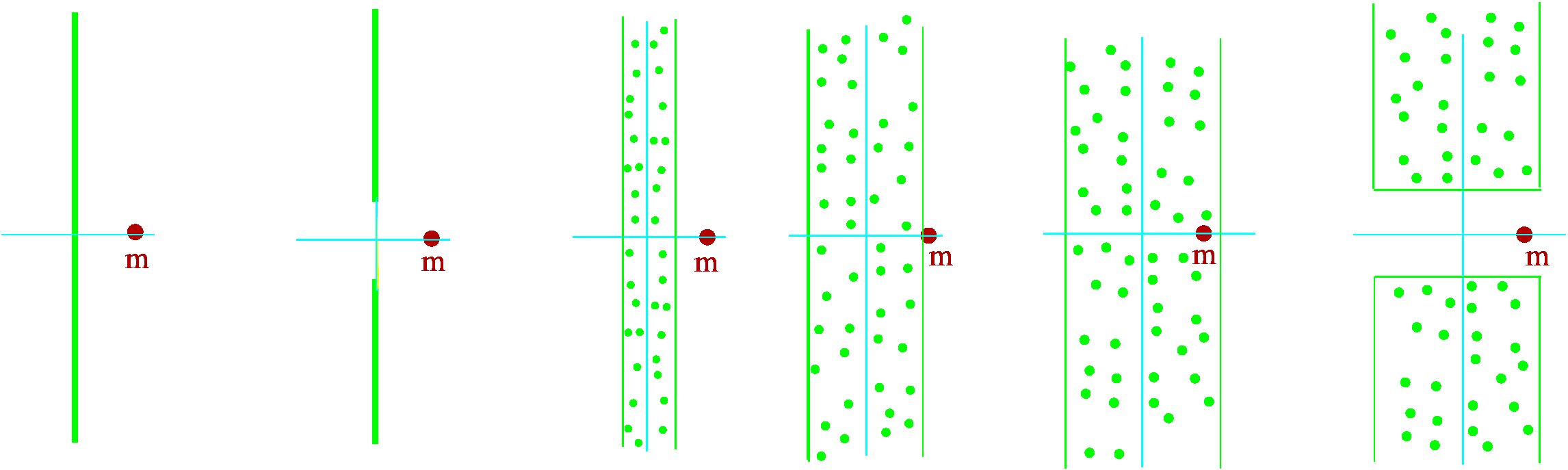 Figure 16
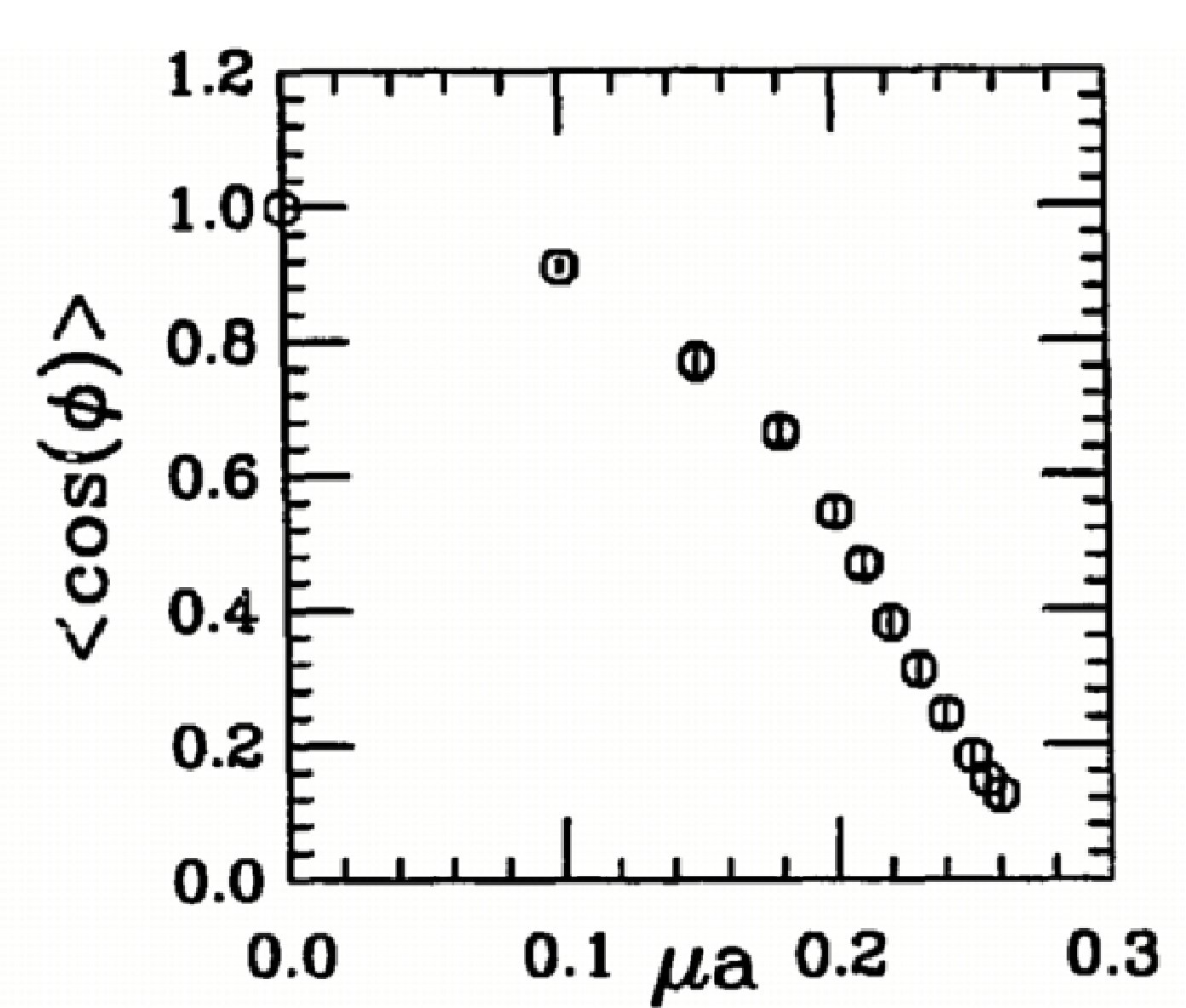 Figure 17
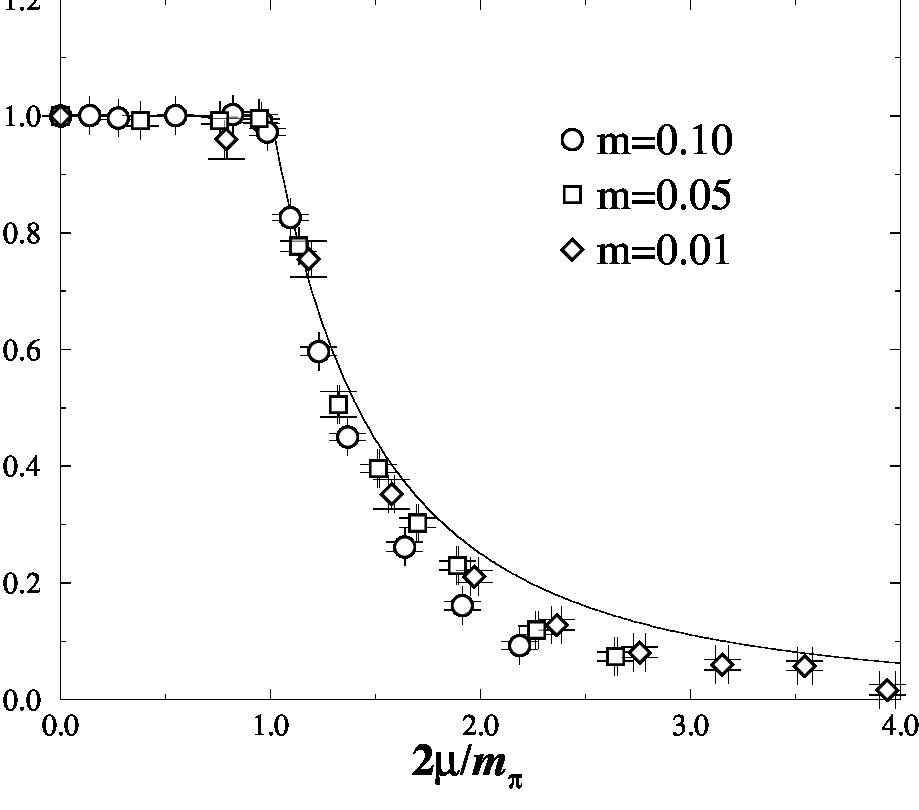 Figure 18
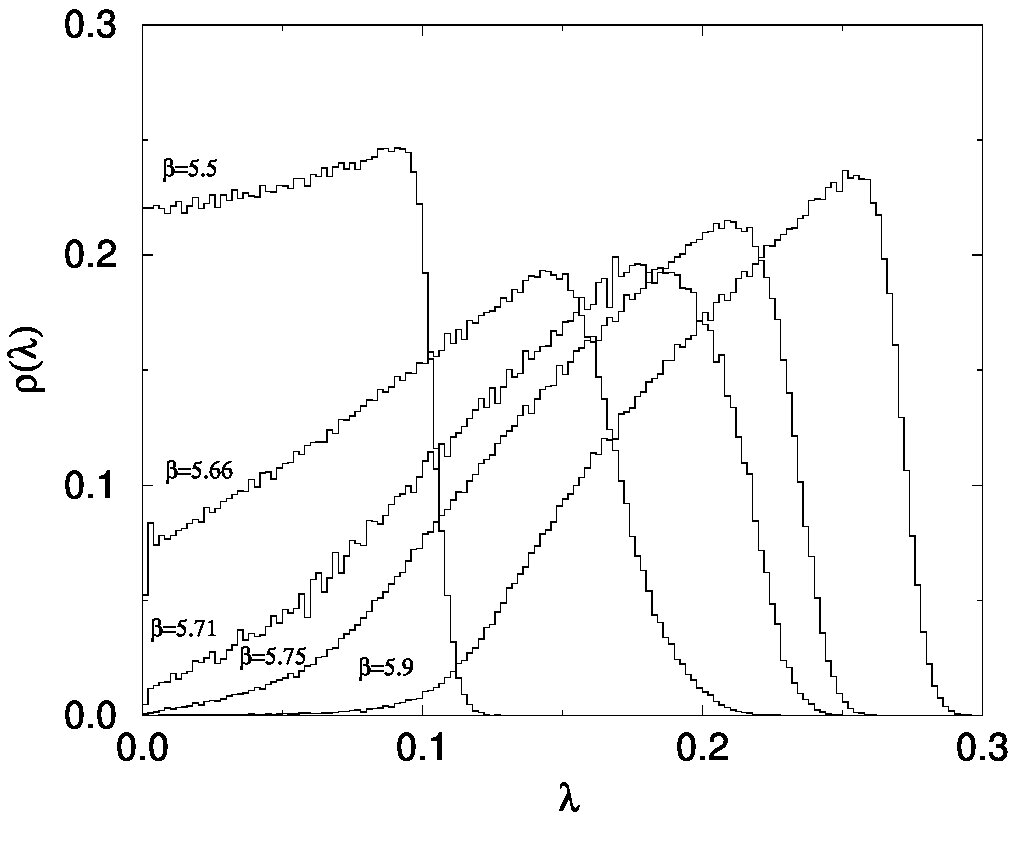 Figure 19
Peer Reviews
No public reviews on file for this paper yet. If you reviewed it on a platform where reviews are public (OpenReview, ICLR, NeurIPS, ICML), you can paste yours below so the community can read it here.
Videos
No videos yet. Explain this paper in a talk, walkthrough, or lecture? Add one.
\nofigureboxrule\notypesetlogo
Random Matrix Theory at Nonzero and
Kim Splittorff*1,*111 e-mail address: [email protected] and Jacobus Johannes Maria Verbaarschot222 e-mail address: [email protected] 1 The Niels Bohr Institute1 The Niels Bohr Institute Blegdamsvej 17 Blegdamsvej 17 DK-2100 DK-2100 Copenhagen Ø Copenhagen Ø Denmark
2 Niels Bohr International Academy Denmark
2 Niels Bohr International Academy Blegdamsvej 17 Blegdamsvej 17 DK-2100 DK-2100 Copenhagen Ø
3 Department of Physics and Astronomy Copenhagen Ø
3 Department of Physics and Astronomy SUNY SUNY Stony Brook Stony Brook New York 11794
New York 11794
Abstract
We review applications of random matrix theory to QCD at nonzero temperature and chemical potential. The chiral phase transition of QCD and QCD-like theories is discussed in terms of eigenvalues of the Dirac operator. We show that for QCD at , which has a sign problem, the discontinuity in the chiral condensate is due to an alternative to the Banks-Casher relation. The severity of the sign problem is analyzed in the microscopic domain of QCD.
1 Introduction
Starting from its introduction in nuclear physics by Wigner [1], random matrix theories have been applied to a wide range of problems ranging from the physics of proteins [2] to quantum gravity (see [3, 4] for a historical review). Three reasons for the ubiquity of random matrix theory come to mind. First, eigenvalues of large random matrices have universal properties determined by symmetries. Second, random matrices are models for disorder present in many physical systems. Third, random matrix theories have a topological expansion which is important for applications to quantum field theory. One of the attractive features of random matrix theory is that analytical information can be obtained for complex systems which otherwise only can be studied experimentally or numerically.
In this review we discuss applications of random matrix theory to QCD at nonzero temperature and chemical potential. Since the order parameter for the chiral phase transition [5, 6] and the deconfining phase transition [7, 8] are determined by the infrared behavior of the eigenvalues of the Dirac operator, these eigenvalues are essential for the phase transitions in QCD. Remarkably, the distribution of the smallest Dirac eigenvalues is given by universal functions [9, 10, 11, 12, 13] that depend only on one or two parameters, the chiral condensate and the pion decay constant. This offers an alternative way to measure these constants on the lattice [14, 15, 16, 17, 18, 19, 20, 21, 22].
2 Random Matrix Theory in QCD
Chiral Random Matrix Theory (chRMT) is a theory with the global symmetries of QCD, but matrix elements of the Dirac operator replaced by random numbers [9, 10]
[TABLE]
This random matrix model has the global symmetries and topological properties of QCD. It is confining in the sense that only color singlets have a nonzero expectation value. It is now well understood that fluctuations of low-lying eigenvalues of the Dirac operator are described by chRMT (see [23, 24, 26, 25, 27, 28] for lectures and reviews). Philosphically, this is important because of the realization that chaotic motion dominates the dynamics of quarks at low energy. Practically, this is important because we can use powerful random matrix techniques to calculate physical observables.
The condition for the applicability of chRMT is that the Compton wavelength of Goldstone bosons associated with the mass scale of these eigenvalues is much larger than the size of the box. With the squared mass of the associated Goldstone boson given by , this condition reads [29]
[TABLE]
The second condition is necessary to factorize the partition function into a contribution from the lightest degrees of freedom and all heavier degrees of freedom. These two conditions determine the microscopic domain of QCD. We stress that is a scale in the Dirac spectrum so that, for sufficiently large volumes, we always have eigenvalues in the domain (4) where eigenvalues fluctuate according to chRMT. This can be shown rigorously from the following two observations [30, 31]. First, the infrared Dirac spectrum follows from a (partially quenched) chiral Lagrangian determined by chiral symmetry, and the inequality (4) is the condition for factorization of the partition function into a factor containing the constant modes and another factor containing the nonzero momentum modes. Second, the factor with the constant modes is equal to the large limit of chiral random matrix theory.
In [32, 33] the condition (4) was imposed on the quark masses and was the bases for a systematic expansion of the chiral Lagrangian known as the expansion.
One feature that underlies universal properties of eigenvalues is that they behave as repulsive confined charges. This follows from the joint probability distribution . It can be shown that eigenvalues correlations at the micrsocopic scale are universal [34]. The reason is spontaneous symmetry breaking and a mass gap so that they can be described in terms of a chiral Lagrangian.
2.1 Chiral Random Matrix Theory at and
A nonzero temperature does not change the fluctuating behavior of the Dirac eigenvalues provided that chiral symmetry remains broken. However, a transition to a different universality class takes place at the critical temperature. A random matrix model that reproduces this universal behavior of QCD is obtained by replacing the off-diagonal elements in (3) by [35]
[TABLE]
This model has been studied elaborately in the literature (see e.g. [35, 36, 37, 38, 39, 40]).
A nonzero chemical potential can be introduced analogously to the quark mass. The requirement is that the small behaviour of the QCD partition function should be reproduced by the random matrix partition function. This achieved by modifying (3) by [41]
[TABLE]
resulting in a nonhermitean Dirac operator with eigenvalues scattered in the complex plane. The prescription (6) is not unique. A random matrix model that has had a strong impact on recent developments is defined by [42]
[TABLE]
where is drawn from a Gaussian ensemble of random matrices. This model is in the same universality class as (6) but is technically simpler since it can be worked out by means of the complex orthogonal polynomial method [44, 45, 46, 42, 43].
There are other types of random matrix models that have been applied to QCD. For example models with random gauge fields such as the Eguchi-Kawai model [47] or its 2-dimensional version [48]. QCD in 1 dimension [49, 50] is a random matrix model as well, with universally fluctuating Dirac eigenvalues. Also models with random Wilson loops [51, 52] have attracted significant interest.
3 Phases of QCD and RMT
QCD-like theories with charged Goldstone bosons have a critical chemical potential equal to . The phase transition to the Bose condensed phase can therefore be described completely in terms of a chiral Lagragian. At the mean field level [53], the kinetic terms of this chiral Lagrangian do not contribute, so that these results can also be obtained from chiral random matrix theory. Indeed, the static part of the chiral Lagrangian [54, 53]
[TABLE]
can also be obtained from the large N limit of the models (6) or (7).
In Fig. 1 we display lattice results for QCD with [55] and phase quenched QCD [56]. They show an impressive agreement with the results from (8) given by the solid curves in both figures.
3.1 Schematic RMT Phase Diagram
The phase transition in QCD with at cannot be analyzed by means of chiral Lagrangians. Because of the sign problem lattice studies are not possible either. In such situation there is long tradition to analyze the same problem in a much simpler theory in the hope of obtaining at least a qualitative understanding of the problem. For example, one dimensional QCD [49, 50], or more recently, super Yang-Mills theory and AdS-CFT duality [57], been explored as toy models for QCD. We will use random matrix theory at and , introduced in (5) and (6) to obtain a qualitive understanding of the QCD phase diagram. Lattice QCD simulations show that the chiral phase transition at is of second order or a steep cross-over. At we expect a first order phase transition at . It is natural that the first order line ends in a critical end point or joins the second order critical line at the tricritical point (see Fig. 2, left). This is indeed what is observed in random matrix theory [58, 59] (see Fig. 2, right). A similar phase diagram has also been obtained from the NJL model [60, 61, 62].
Another scenario that was discovered in RMT is the splitting of the first order line into two at nonzero isospin chemical potential [63]. This behavior was also found in a NJL model [64, 65] but might not be stable against flavor mixing interactions [66].
4 Dirac Spectrum in Theories Without a Sign Problem
Since the spectrum of the Dirac operator determines the chiral condensate, phase transitions in QCD can be understood in terms of its spectral flow. In this section we discuss theories with a positive fermion determinant such as QCD with two colors and phase quenched QCD, where a probabilistic interpretation of the eigenvalue density is possible. The relation between chiral symmetry breaking and Dirac spectra is much more complicated when the fermion determinant is complex and its discussion will be postponed to the next section.
The spectrum of an anti-Hermitean Dirac operator is purely imaginary with an eigenvalue density that is proportional to the volume. If chiral symmetry is broken spontaneously, the chiral condensate becomes discontinuous across the imaginary axis in the thermodynamic limit. Chiral symmetry is restored if such discontinuity is absent for example by the formation of a gap in the Dirac spectrum, see eg.[71] .
For , the Dirac spectrum broadens into a strip of width [49, 67]. The chemical potential becomes critical when the quark mass hits the edge of this strip. At this point the chiral condensate starts rotating into a pion condensate. Chiral symmetry restoration takes place when a gap forms at zero. A schematic picture of the critical behavior of Dirac eigenvalues is shown in Fig. 3 and the spectral flow of the Dirac eigenvalues with respect to increasing and is summarized in Fig. 4.
One conclusion from this behavior is that is a concave function of , and that is a convex function of . The spectral flow discussed in this section is supported by lattice simulations at and (See Fig. 5)
4.1 Dirac spectrum in the -plane
We could equally well have diagonalized the Dirac operator in a representation where is proportional to the identity,
[TABLE]
These eigenvalues are relevant to the baryon number density. A gap in the spectrum develops at (see Fig. 6), and the chemical potential becomes critical, when it hits the inner edge of the domain of eigenvalues.
4.2 Quenched Lattice QCD Dirac Spectra at
Small Dirac eigenvalues at have been computed in quenched QCD. The analytical formulas for the average density of the small Dirac eigenvalues are available [68, 69]. They were first derived [68] by exploiting the Toda lattice hierarchy in the flavor index. Comparisons of random matrix predictions [68] for the radial spectral density and lattice QCD results [75, 76] are shown in the left panel of Fig. 7. In other cases, such as the overlap Dirac operator [77] and QCD with [78], a similar degree of agreement was found.
Both the spectral density and two-point correlations can be derived from the Lagrangian (8), i.e. they are determined by two parameters, and . This can be exploited to extract these low-energy constants. For example, and were determined [19, 21] (see also [20]) from the correlators shown in the two right panels of Fig. 7.
5 Chiral Symmetry Breaking at
The full QCD partition function at which is the average of
[TABLE]
has properties which are drastically different from the phase quenched partition function where the phase factor is absent. In particular, instead of , so that the free energy remains -independent until . For the chiral condensate remains discontinuous at , whereas the chiral condensate of the phase quenched theory approaches zero for (see Fig. 8).
The only difference between the phase quenched partition function and the full QCD partition function is the phase of the fermion determinant. We conclude that the phase factor is responsible for the discontinuity of the chiral condensate. How can this happen if for each configuration the support of the spectrum is approximately the same? This problem known as the “Silver Blaze Problem” [80] was solved in [6].
5.1 Unquenched Spectral Density
The spectral density for QCD with dynamical fermions is given by
[TABLE]
Because of the phase of the fermion determinant, this density is in general complex and can be decomposed as The chiral condensate can then be decomposed as so that the discontinuity in is due to . Asymptotically it behaves as [81]
[TABLE]
and vanishes outside an ellips starting at (see Fig. 9) [6].
In the right part of this figure we show the real part of the spectral density for QCD with one flavor at nonzero chemical potential.
This result explains the mechanism of chiral symmetry breaking at nonzero chemical potential. The phase of the fermion determinant rotates the pion condensate back into a chiral condensate, but it does so in an unexpected way [6]. The same mechanism is at play for 1d QCD at [82].
6 Phase of the Fermion Determinant
The magnitude of the sign problem can be measured by means of the expectation value of the phase factor of the fermion determiant which can be defined in two ways
[TABLE]
The average is with respect to the Yang-Mills action. The sign problem is managable when the average phase factor remains finite in the thermodynamic limit. In the microscopic domain it is possible to obtain exact analytical expressions for the average phase factor by exploiting the equivalence between QCD and RMT in this domain.
For the free energy of both QCD and phase quenched QCD are independent of . This does not imply that the average phase factor is -independent. The -dependence originates from the charged Goldstone bosons with mass , and for flavors the mean field result [83, 84] for reads . The exact result for the average phase factor for is shown in Fig. 10 (right), where lattice results [85] are also shown (left). The exact result has an essential singularity at , but its thermodyanmic limit agrees with the mean result.
7 Conclusions
The equivalence of chiral random matrix theory and QCD has been exploited succesfully to derive a host of analytical results. Among others, eigenvalue fluctuations predicted by chRMT have been observed in lattice simulations, the phases of QCD can be understood in terms of spectral flow, observables can be extracted from the fluctuations of the smallest eigenvalues, the sign problem is not serious when the quark mass is outside the domain of the eigenvalues, and mean field results can be obtained from random matrix theory. Summarizing, chiral random matrix theory is a powerful tool for analyzing the infrared domain of QCD.
Acknowledgements
The YITP is thanked for its hospitality. G. Akemann, J. Osborn and P.H. Damgaard are acknowledged for valuable discussions. This work was supported by US DOE Grant No. DE-FG-88ER40388 (JV), the Villum Kann Rasmussen Foundation (JV), the Danish National Bank (JV) and the Carslberg Foundation (KS).
The reference list from the paper itself. Each links out to its DOI / PubMed record.
- 1[1] E.P. Wigner, Proc. Cam. Phil. Soc. 47 (1951) 790.
- 2[2] M. Sener and K. Schulten, Phys. Rev. E 65, 031916 (2002).
- 3[3] T. Guhr, A. Muller-Groeling and H. A. Weidenmuller, Phys. Rept. 299 , 189 (1998).
- 4[4] P. J. Forrester, N. C. Snaith and J. J. M. Verbaarschot, J. Phys. A 36 , R 1 (2003).
- 5[5] T. Banks and A. Casher, Nucl. Phys. B 169 , 103 (1980).
- 6[6] J. C. Osborn, K. Splittorff and J. J. M. Verbaarschot, Phys. Rev. Lett. 94 , 202001 (2005).
- 7[7] C. Gattringer, Phys. Rev. Lett. 97 , 032003 (2006).
- 8[8] F. Synatschke, A. Wipf and C. Wozar, ar Xiv:hep-lat/0703018.