Spin-orbit coupling effect on the persistent currents in mesoscopic ring with an Anderson impurity
Guo-Hui Ding, Bing Dong

TL;DR
This paper studies how Rashba spin-orbit coupling influences persistent charge and spin currents in a mesoscopic ring with an Anderson impurity, revealing suppression of the Kondo effect and oscillatory behavior of currents.
Contribution
It introduces a detailed analysis of spin-orbit effects on persistent currents in mesoscopic rings with Anderson impurities using the finite U slave boson method.
Findings
Kondo effect reduces persistent current magnitude
Spin-orbit coupling causes oscillations in currents
Persistent spin current can exist without charge current
Abstract
Based on the finite slave boson method, we have investigated the effect of Rashba spin-orbit(SO) coupling on the persistent charge and spin currents in mesoscopic ring with an Anderson impurity. It is shown that the Kondo effect will decrease the magnitude of the persistent charge and spin currents in this side-coupled Anderson impurity case. In the presence of SO coupling, the persistent currents change drastically and oscillate with the strength of SO coupling. The SO coupling will suppress the Kondo effect and restore the abrupt jumps of the persistent currents. It is also found that a persistent spin current circulating the ring can exist even without the charge current in this system.
Click any figure to enlarge with its caption.
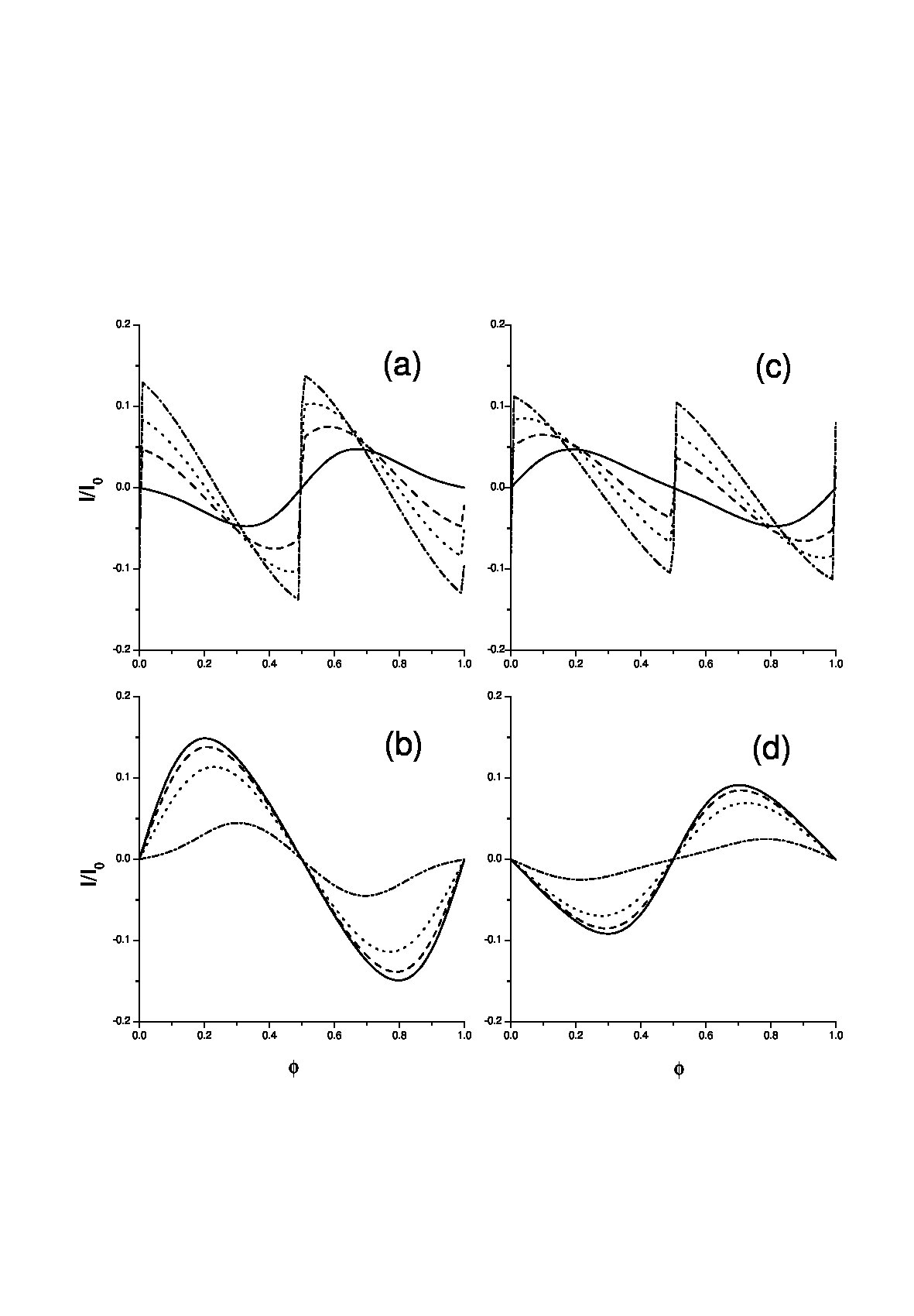 Figure 1
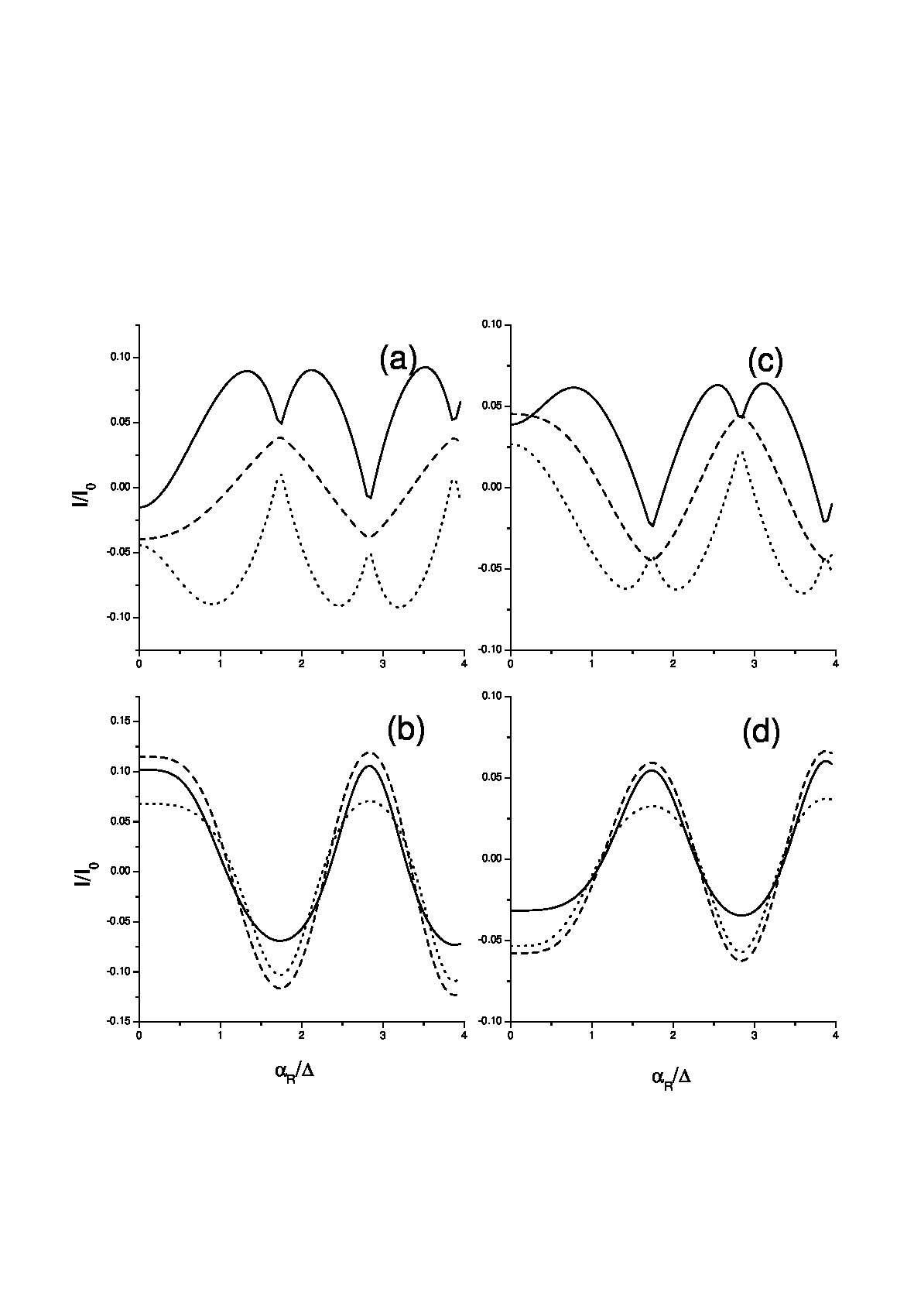 Figure 2
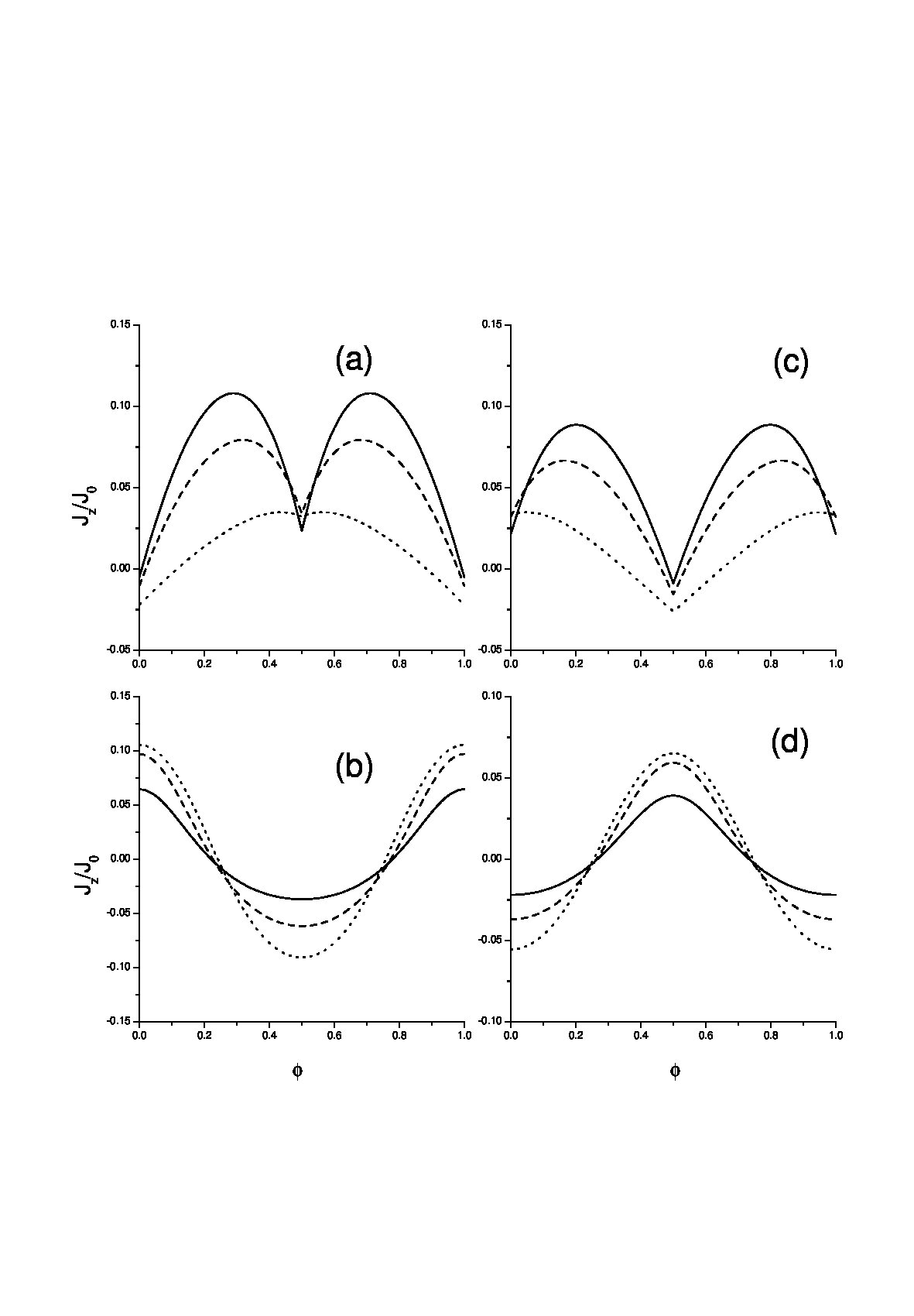 Figure 3
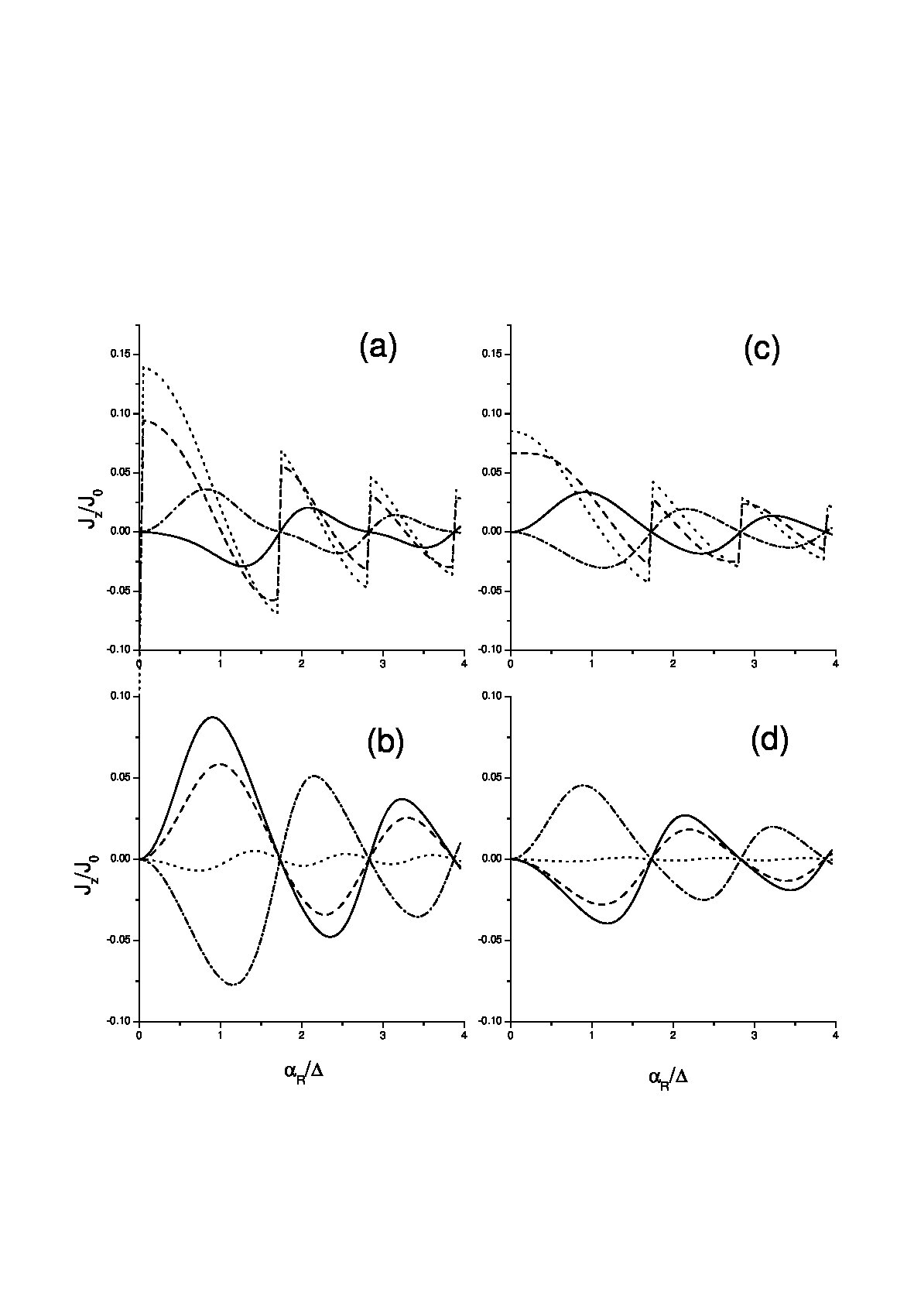 Figure 4
Peer Reviews
No public reviews on file for this paper yet. If you reviewed it on a platform where reviews are public (OpenReview, ICLR, NeurIPS, ICML), you can paste yours below so the community can read it here.
Videos
No videos yet. Explain this paper in a talk, walkthrough, or lecture? Add one.
Spin-orbit coupling effect on the persistent currents in mesoscopic ring with an Anderson impurity
Guo-Hui Ding and Bing Dong
Department of Physics, Shanghai Jiao Tong University, Shanghai, 200240, China
Abstract
Based on the finite slave boson method, we have investigated the effect of Rashba spin-orbit(SO) coupling on the persistent charge and spin currents in mesoscopic ring with an Anderson impurity. It is shown that the Kondo effect will decrease the magnitude of the persistent charge and spin currents in this side-coupled Anderson impurity case. In the presence of SO coupling, the persistent currents change drastically and oscillate with the strength of SO coupling. The SO coupling will suppress the Kondo effect and restore the abrupt jumps of the persistent currents. It is also found that a persistent spin current circulating the ring can exist even without the charge current in this system.
pacs:
73.23.Ra, 71.70.Ej, 72.25.-b
I introduction
Recently the spin-orbit(SO) interaction in semiconductor mesoscopic system has attracted a lot of interest1 . Due to the coupling of electron orbital motion with the spin degree of freedom, it is possible to manipulate and control the electron spin in SO coupling system by applying an external electrical field or a gate voltage, and it is believed that the SO effect will play an important role in the future spintronic application. Actually, various interesting effects resulting from SO coupling have already been predicted, such as the Datta-Das spin field-effect transistor based on Rashba SO interaction2 and the intrinsic spin Hall effect3 .
In this paper we shall focus our attention on the persistent charge current and spin current in mesoscopic semiconductor ring with SO interaction. The existence of a persistent charge current in a mesoscopic ring threaded by a magnetic flux has been predicted decades ago4 , and has been extensively studied in theory5 ; 6 ; 7 ; 8 ; 9 and also observed in various experiments10 ; 11 ; 12 . The reason that a persistent charge current exists may be interpreted as that the magnetic flux enclosed by the ring introduces an asymmetry between electrons with clockwise and anticlockwise momentum, thus leads to a thermodynamic state with a charge current without dissipation. For a mesoscopic ring with a texture like inhomogeneous magnetic field, D. Loss et al.13 predicted that besides the charge current there are also a persistent spin current. The origin of the persistent spin current can be related to the Berry phase acquired when the electron spin precesses during its orbital motion. The persistent spin current has also been studied in semiconductor system with Rashba SO coupling term14 ; 15 ; 16 . Recently it is shown that a semiconductor ring with SO coupling can sustain a persistent spin current even in the absence of external magnetic flux17 .
For the system of a mesoscopic ring with a magnetic impurity, the persistent charge current has been investigated in the context of a mesoscopic ring coupled with a quantum dot18 ; 19 ; 20 ; 21 ; 22 ; 23 ; 24 , where the quantum dot acts as an impurity level and will introduce charge or spin fluctuations to the electrons in the ring. The Kondo effect arising from a localized electron spin interacting with a band of electrons will be essential in the charge transport in the ring. But to our knowledge in these systems the SO effect hasn’t been considered. It might be expected that the interplay between the Kondo effect and the SO coupling in the ring can give new features in the persistent currents. In this paper we shall address this problem and investigate the SO effect on persistent charge and spin currents in the ring system with an Anderson impurity. The Anderson impurity can act as a magnetic impurity when the impurity level is in single electron occupied state and as well as a barrier potential in empty occupied regime.
The outline of this paper is as follows. In section II we introduce the model Hamiltonian of the system and also the method of calculation by finite-U slave boson approach25 ; 26 ; 27 ; 28 . In section III the results of persistent charge current and spin current are presented and discussed. In Section IV we give the summary.
II Mesoscopic ring with an Anderson impurity
The electrons in a closed ring with SO coupling of Rashba term can be described by following Hamiltonian in the polar coordinates14 ; 29
[TABLE]
where , is the radius of the ring. will characterize the strength of Rashba SO interaction. is the external magnetic flux enclosed by the ring, and is the flux quantum.
We can write the above Hamiltonian in terms of creation and annihilation operators of electrons in the momentum space,
[TABLE]
where , ,() with . One can see that the SO interaction causes the mode electrons coupled with and mode electrons and spin-flip process. We consider the system with a side-coupled impurity which can be described by the Anderson impurity model,
[TABLE]
The tunneling between the impurity level and the ring are given by
[TABLE]
Then the total Hamiltonian for the system should be
[TABLE]
In order to treat the strong on-site Coulomb interaction in the impurity level. we adopt the finite-U slave boson approach25 ; 26 . A set of auxiliary bosons is introduced for the impurity level, which act as projection operators onto the empty, singly occupied(with spin up and spin down), and doubly occupied electron states on the impurity, respectively. Then the fermion operators are replaced by , with . In order to eliminate un-physical states, the following constraint conditions are imposed :, and . Therefore, the Hamiltonian can be rewritten as the following effective Hamiltonian in terms of the auxiliary boson and the pesudo-fermion operators :
[TABLE]
where the constraints are incorporated by the Lagrange multipliers and . The first constraint can be interpreted as a completeness relation of the Hilbert space on the impurity level, and the second one equates the two ways of counting the fermion occupancy for a given spin. In the framework of the finite-U slave boson mean field theory25 ; 26 , the slave boson operators and the parameter are replaced by real c numbers. Thus the effective Hamiltonian is given as
[TABLE]
where represents the renormalized tunnel coupling between the impurity and the mesoscopic ring. can be regarded as the wave function renormalization factor. is the renormalized impurity level and is an energy constant.
In this mean field approximation the Hamiltonian is essentially that of a non-interacting system, hence the single particle energy levels can be calculated by numerical diagonalization of the Hamiltonian matrix. Then the ground state of this system can be constructed by adding electrons to the lowest unoccupied energy levels consecutively . By minimizing the ground state energy with respect to the variational parameters a set of self-consistent equations can be obtained as in Ref.[27,28], and they can be applied to determine the variational parameters in the effective Hamiltonian.
III the persistent charge current and spin current
In this section we will present the results of our calculation of the persistent charge current and spin current circulating the mesoscopic ring. Since there is still some controversial in the literature for the definition of the spin current operator in the ring system with SO coupling term30 . We give both the formula of charge and spin currents used in this paper explicitly. It is easy to obtain that the component of electron velocity operator in this SO coupled ring is
[TABLE]
Thereby the charge current operator is define as , and in terms of creation and annihilation operator it can be written as
[TABLE]
At zero temperature, the persistent charge current is given by the expectation value of the above charge current operator in the ground state, , and it can also be calculated from the expression
[TABLE]
where is the ground state energy.
In Fig.1 the persistent charge current vs. the enclosed magnetic flux is plotted for a set of values for the SO coupling strength. Here we have taken the model parameters and the total number of electrons is around . In this case one can obtain the Fermi energy of the system and the level spacing around the Fermi surface. We consider the energy level of the Anderson impurity is well below the Fermi energy( with ), therefore the Anderson impurity is in the Kondo regime. One can see in Fig.1 that the characteristic features of persistent charge current depends on the parity of the total number of electrons(), and can be distinguished by two cases with odd and even. This is attributed to the different occupation patterns of the highest occupied single particle energy level in the mean field effective Hamiltonian. The persistent charge current for the system with electrons is different from that with electrons by a phase shift . In case (I) where the electron number is odd( and ), one electron is almost localized on the impurity level and forming a singlet with electron cloud in the conducting ring. This phenomena leads to the well known Kondo effect. Fig.1 shows that the Kondo effect decreases the magnitude of the persistent charge current, and also makes its curve shape resemble sinusoidal. In the presence of finite SO coupling(), the spin-up and spin-down electrons are coupled and it causes the splitting of the twofold degenerated energy levels in the effective Hamiltonian. It turns out that the Kondo effect is suppressed and the abrupt jumps of the persistent charge current with similarity to that of ideal ring case appears. It is explained in Ref.[14] that the jumps of the persistent charge current in the case of odd number of electrons are due to a crossing of levels with opposite spin. In case (II) where is even ( and ), The Kondo effect is manifested that the magnitude of persistent charge current is significantly suppressed compared with ideal ring case and the rounding of the jumps of persistent charge current due to the level crossing. In the presence of finite SO coupling, the persistent charge current decreases with increasing the SO coupling strength when .
Fig.2 displays the persistent charge current as a function of the SO coupling strength at different enclosed magnetic flux. The persistent charge current exhibits oscillations with increasing the value of for both the systems with even or odd number of electrons. Therefore by tuning the SO coupling strength, the magnetic response of this system can change from paramagnetic to diamagnetic and vice versa. It indicates that SO coupling can play a important role in electron transport in this mesoscopic ring. The curve of the persistent charge current for odd number of electrons shows discontinuity in its derivation, this can be attributed the level crossing in the energy spectrum by changing . It is also noted that the position of this discontinuity for odd also corresponds to the peak or valley in even N case.
Since the electron has the spin degree of freedom as well as the charge, the electron motion in the ring may give rise to a spin current besides the charge current. Now we turn to study the persistent spin current in the ground state. The spin current operator is defined by , which can be written explicitly as
[TABLE]
Therefore the three component of spin current operator in terms of creation and annihilation operators are given by
[TABLE]
[TABLE]
[TABLE]
The expectation value of the spin current .
In our calculation we find that only the component of the spin current is nonzero in the ground state. Fig.3 shows the persistent spin current vs. magnetic flux at different SO coupling strength. The persistent spin current is a periodic function of the magnetic flux , which has the even parity symmetry and also an additional symmetry . It is noted that the persistent spin current has quite different dependence behaviors on magnetic flux compared with the persistent charge current in Fig.1. In the presence of finite SO coupling, the persistent spin current is nonzero both for the systems with odd and even at zero magnetic flux, it indicates that a persistent spin current can be induced solely by SO interaction without accompany a charge current. This phenomena is also shown in Ref.[17] where a SO coupling/normal hybrid ring was considered.
In Fig.4 the persistent spin current as a function of SO coupling strength is plotted. In the absence of SO coupling , the persistent spin current is exactly zero for both even and odd number electron system. In the presence of SO coupling, The persistent spin current becomes nonzero and shows oscillations with increasing . It can change from positive to negative values or vice versa by tuning the SO coupling strength. The sign of the persistent spin current also shows dependence on the enclosed magnetic flux. For the system with odd , there is abrupt jumps in the curve of persistent spin current at certain value of , the reason for the jump is the same as that in the charge current, and is due to the level crossing in the energy spectrum. It is noted that the position of the jump coincides with that of the persistent charge current. This kind of characteristic feature of the persistent currents might provide a useful way to detect the SO coupling effects in semiconductor ring system.
IV conclusions
In summary, we have investigated the Rashba SO coupling effect on the persistent charge current and spin current in a mesoscopic ring with an Anderson impurity. The Anderson impurity leads to the Kondo effect and decreases the amplitude of the persistent charge and spin current in the ring. In the semiconducting ring with SO interaction, the persistent charge current changes significantly by tuning the SO coupling strength, e.g. from the paramagnetic to diamagnetic current. Besides the persistent charge current, there also exists a persistent spin current, which also oscillates with the SO coupling strength. It is shown that at zero magnetic flux a persistent spin current can exist even without the charge current. Since the persistent spin current can generate an electric field31 , one might expect that experiments on semiconductor ring with Rashba SO coupling can detect the persistent spin current.
Acknowledgements.
This project is supported by the National Natural Science Foundation of China, the Shanghai Pujiang Program, and Program for New Century Excellent Talents in University (NCET).
The reference list from the paper itself. Each links out to its DOI / PubMed record.
- 1(1) I. Zutic, J. Fabian, and S. Das Sarma, Rev. Mod. Phys. 76 , 323 (2004).
- 2(2) S. Datta and B. Das, Appl. Phys. Lett. 56 , 665(1990).
- 3(3) S. Murakami, N. Nagaosa, and S. C. Zhang, Science 301 , 1348 (2003); J. Sinova, D. Culcer, Q. Niu, N. A. Sinitsyn, T.Jungwirth, and A. H. Mac Donald, Phys. Rev. Lett., 92 , 126603(2004).
- 4(4) M. B u ¨ ¨ 𝑢 \ddot{u} ttiker, Y. Imry, and R. Landauer, Phys. Lett. 96A , 365 (1983).
- 5(5) H. F. Cheung, Y. Gefen, E. K. Riedel, and W. H. Shih, Phys. Rev. B 37 , 6050 (1988).
- 6(6) D. Loss and P. Goldbart, Phys. Rev. B 43 , 13762 (1991).
- 7(7) G. Montambaux, H. Bouchiat, D. Sigeti, and R. Friesner, Phys. Rev. B 42 , 7647 (1990).
- 8(8) Y. Meir, Y. Gefen, and O. Entin-Wohlman, Phys. Rev. Lett. 63 , 798 (1989).