Effects of Dirac sea on pion propagation in asymmetric nuclear matter
Subhrajyoti Biswas, Abhee K. Dutt-Mazumder

TL;DR
This paper investigates how the Dirac sea influences pion propagation in asymmetric nuclear matter, comparing non-chiral and chiral models, and providing analytical results for effective pion masses and dispersion relations.
Contribution
It introduces a comprehensive analysis of Dirac sea effects on pion propagation in ANM using both non-chiral and chiral effective theories with analytical solutions.
Findings
Mode splitting for charged pions in ANM
Dirac sea significantly affects pion effective masses
Analytical dispersion relations derived under HNL approximation
Abstract
We study pion propagation in asymmetric nuclear matter (ANM). One of the interesting consequences of pion propagation in ANM is the mode splitting for the different charged states of pions. First we describe the pion-nucleon dynamics using the non-chiral model where one starts with pseudoscalar (PS) N coupling and the pseudovector (PV) representation is obtained via suitable non-linear field transformations. For both of these cases the effect of the Dirac sea is estimated. Subsequently, we present results using the chiral effective Lagrangian where the short-distance behavior (Dirac vacuum) is included by re-defining the field parameters as done in the modern effective field theory approach developed recently. The results are compared with the previous calculations for the case of symmetric nuclear matter (SNM). Closed form analytical results are presented for the effective pion…
Click any figure to enlarge with its caption.
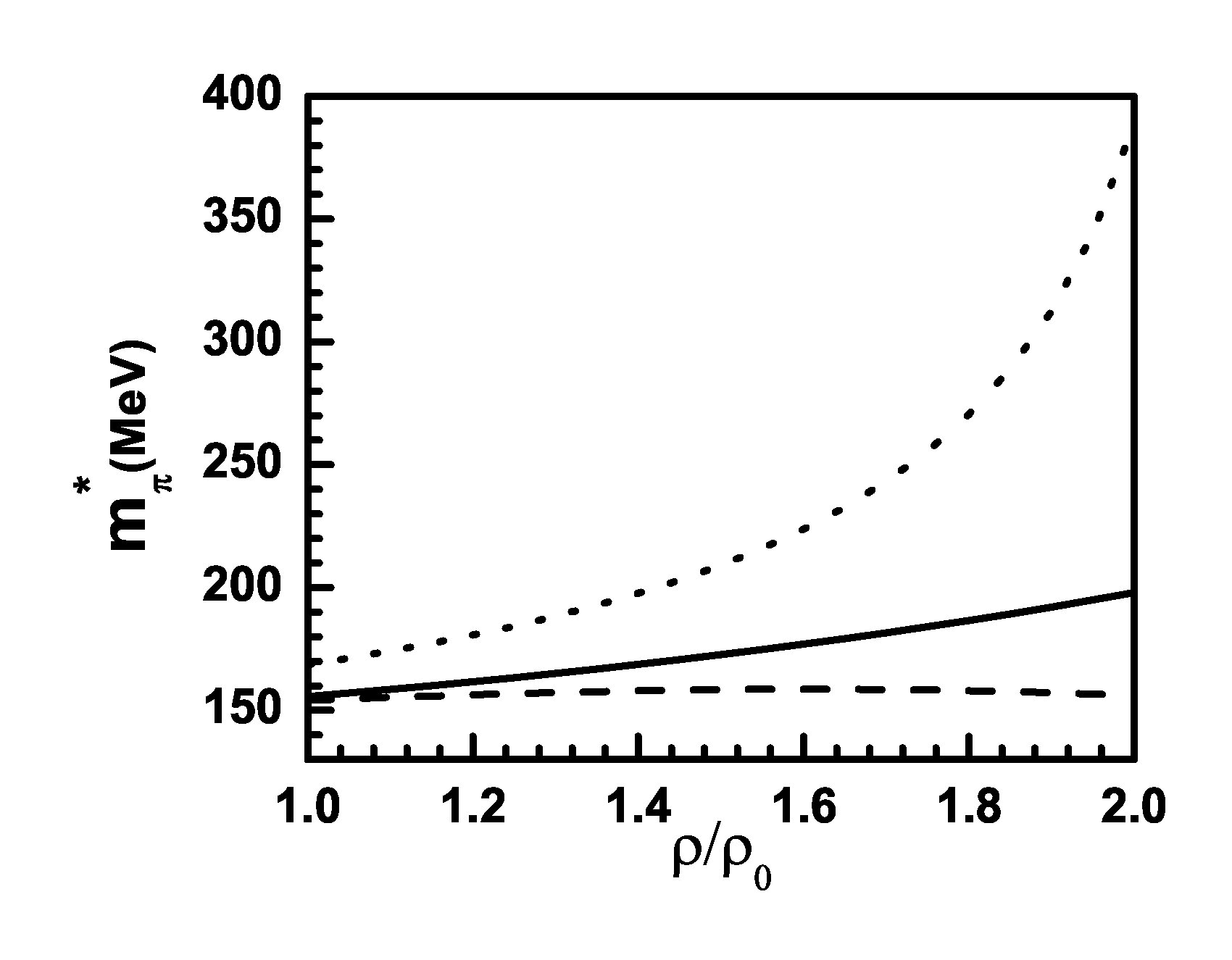 Figure 1
 Figure 2
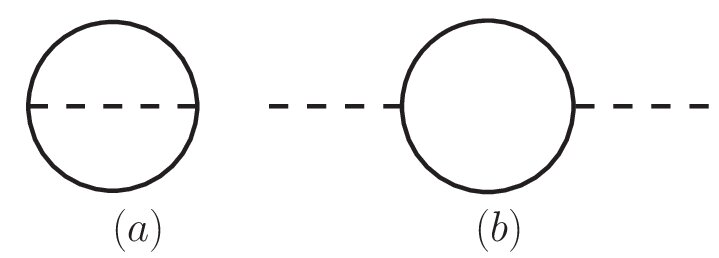 Figure 3
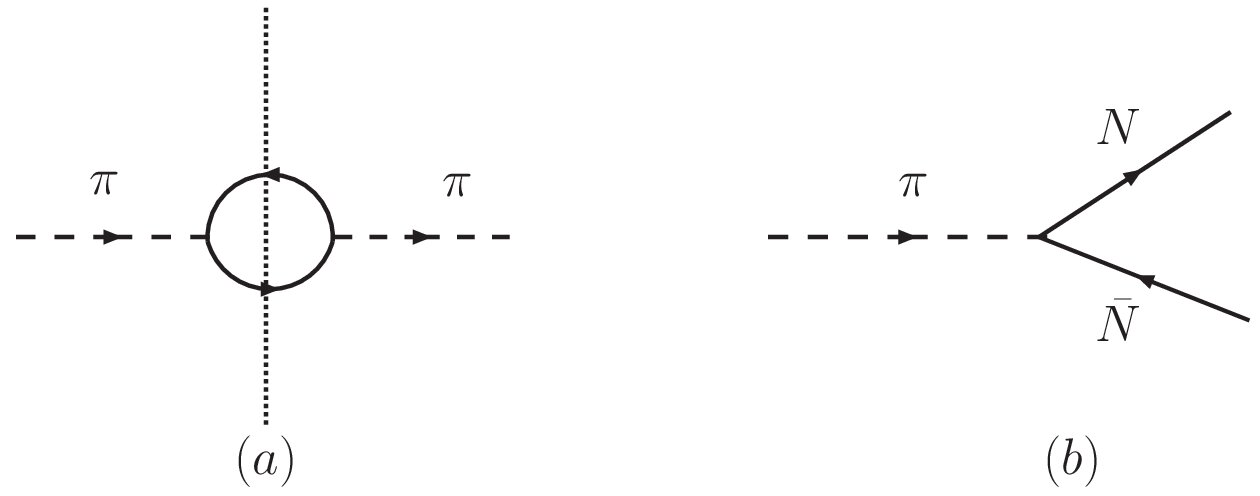 Figure 4
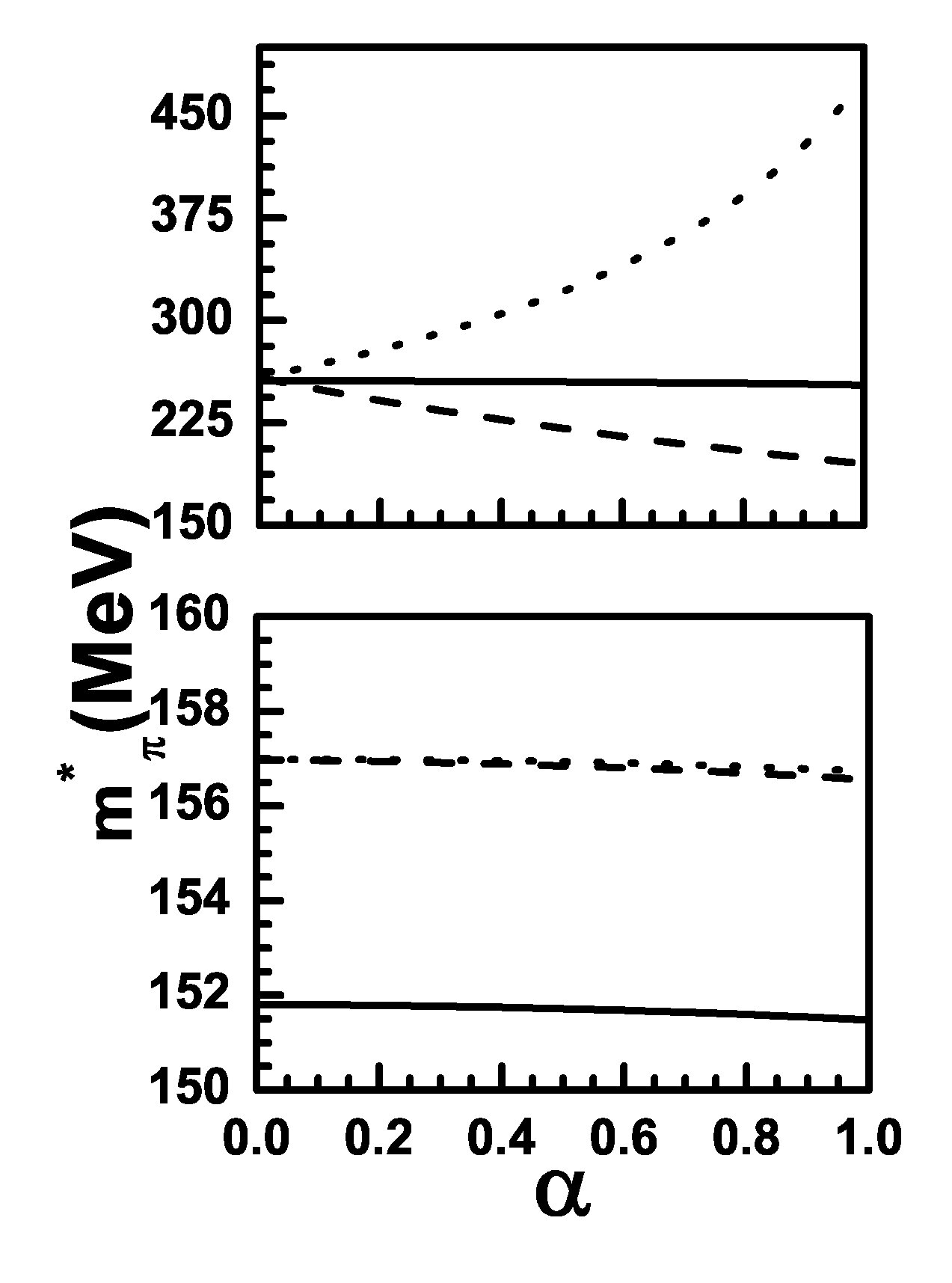 Figure 5
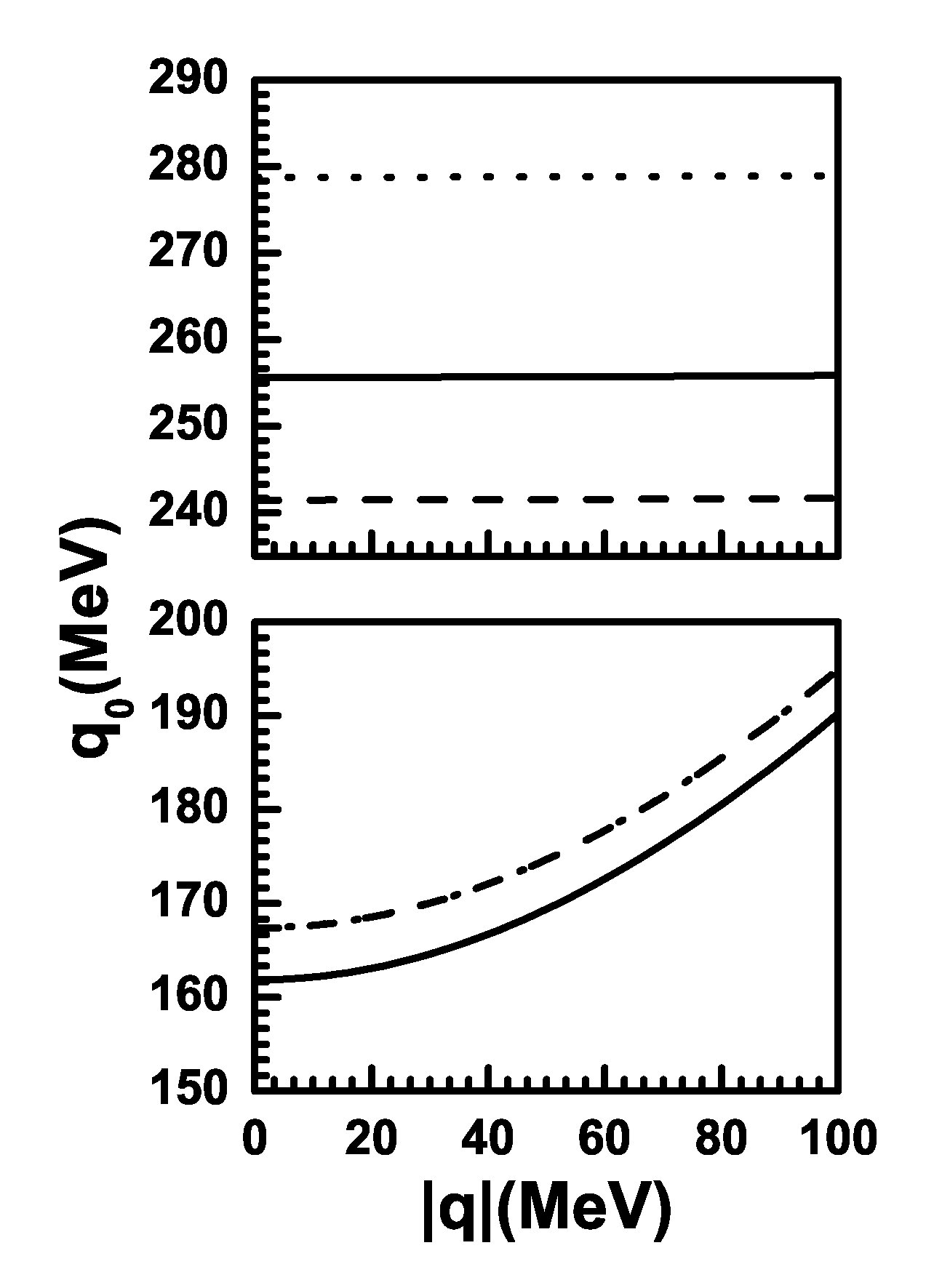 Figure 6
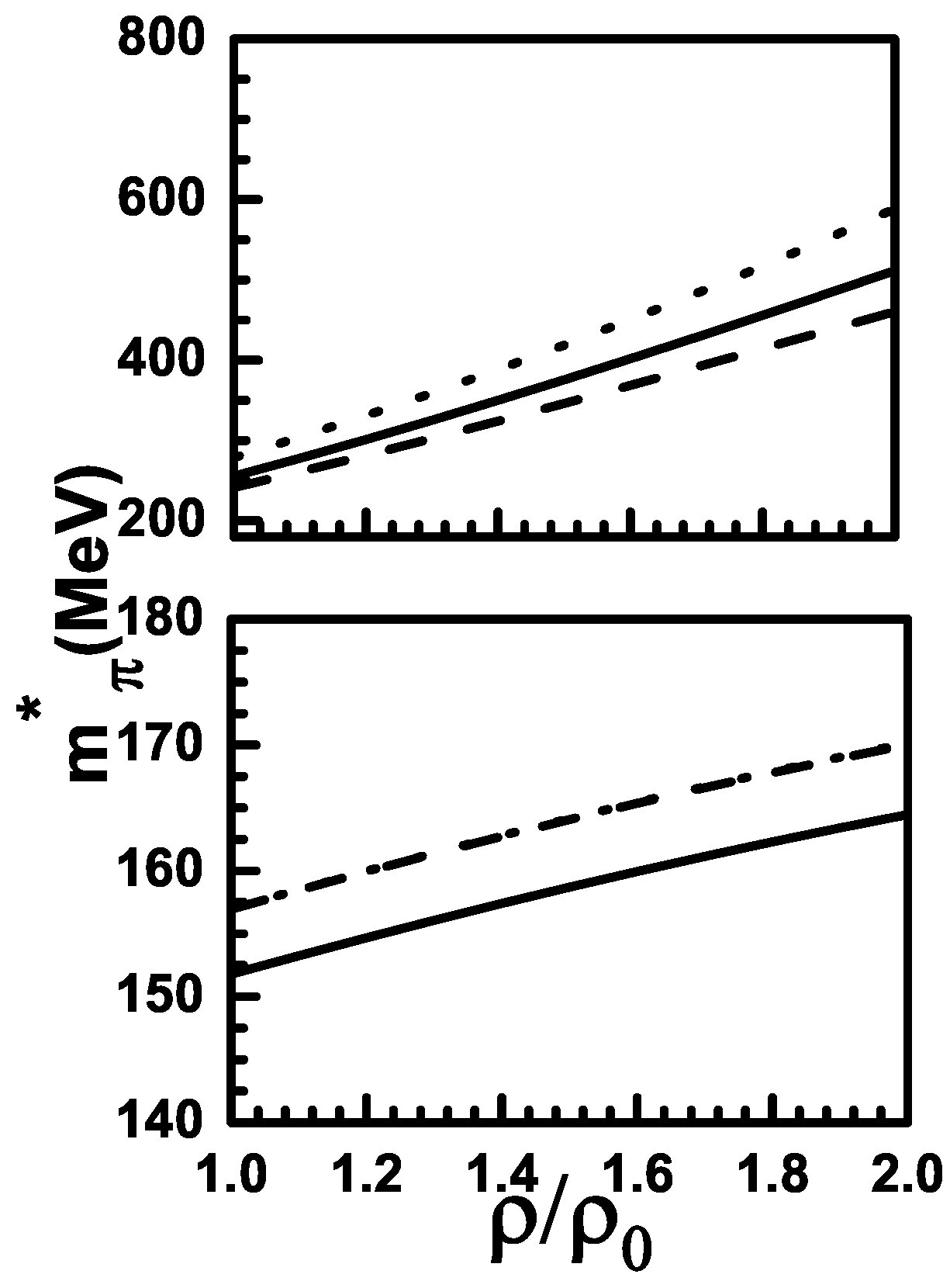 Figure 7
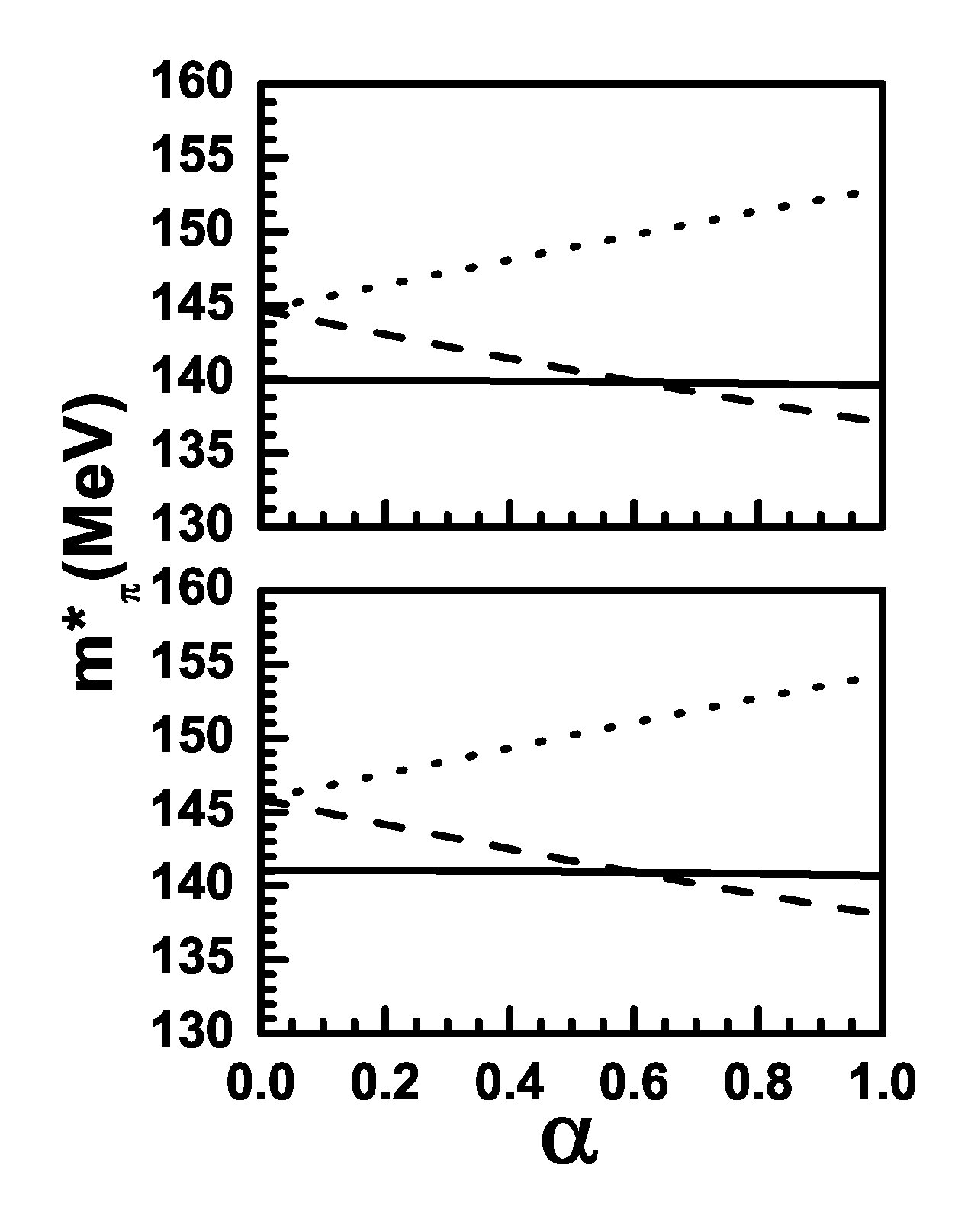 Figure 8
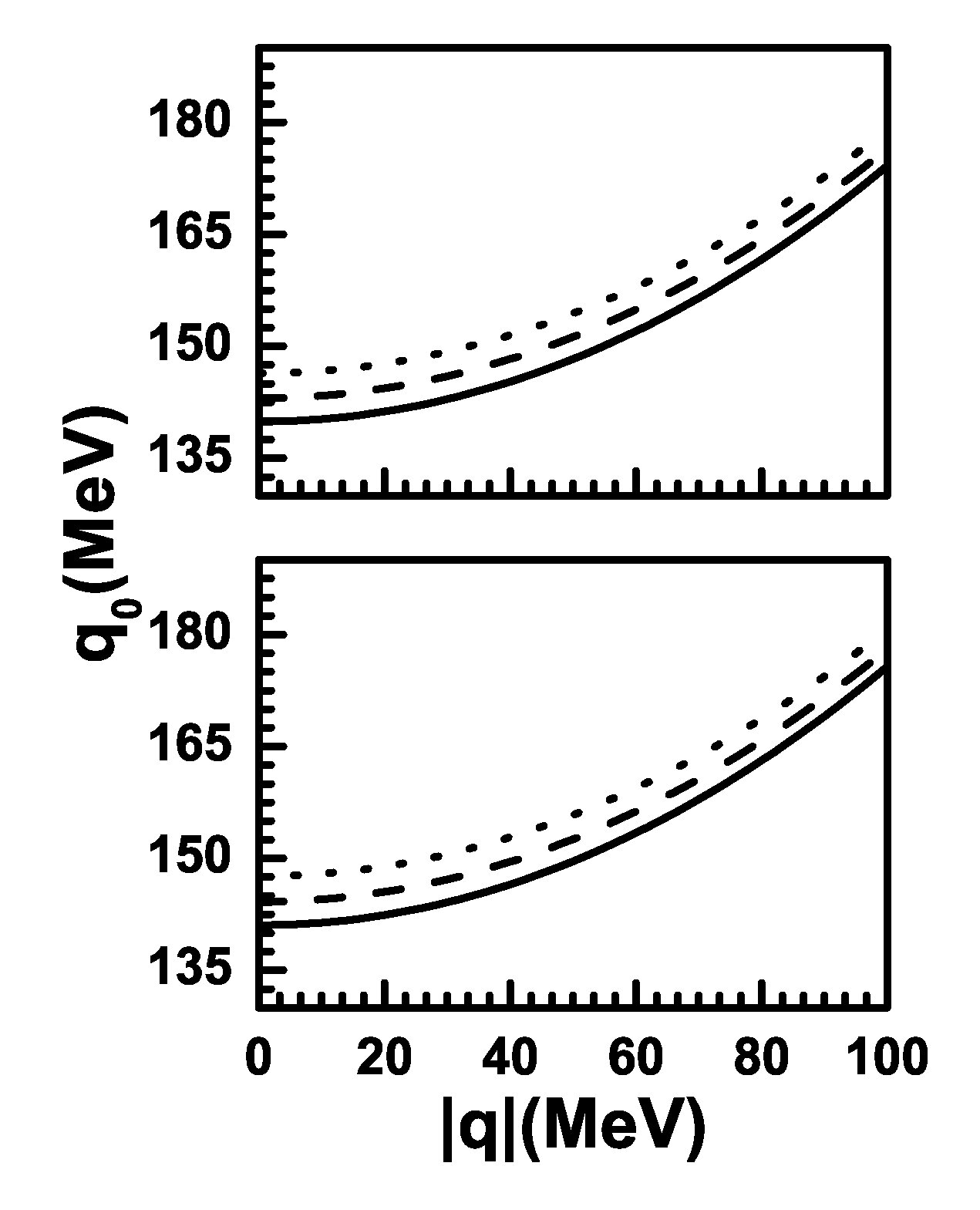 Figure 9
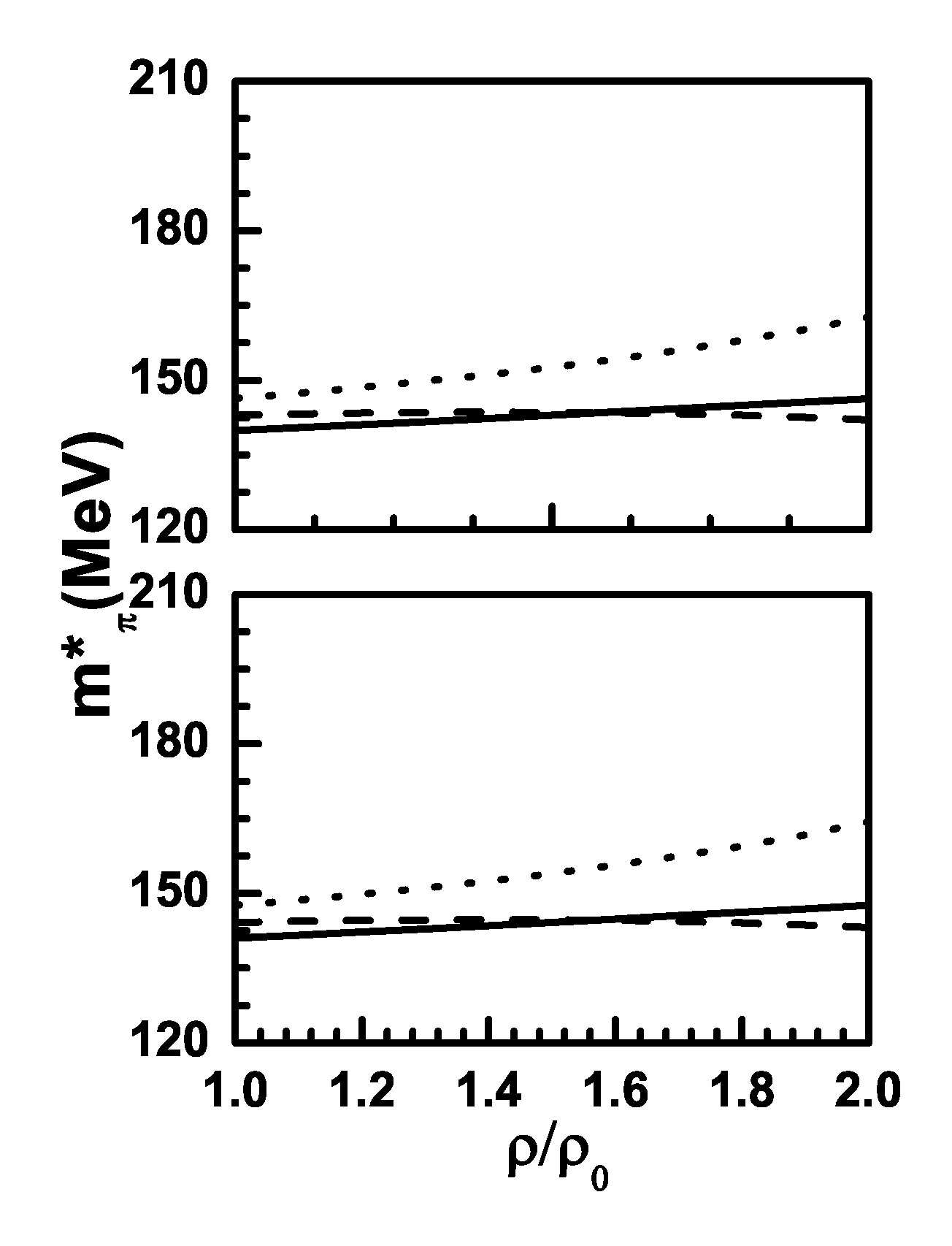 Figure 10
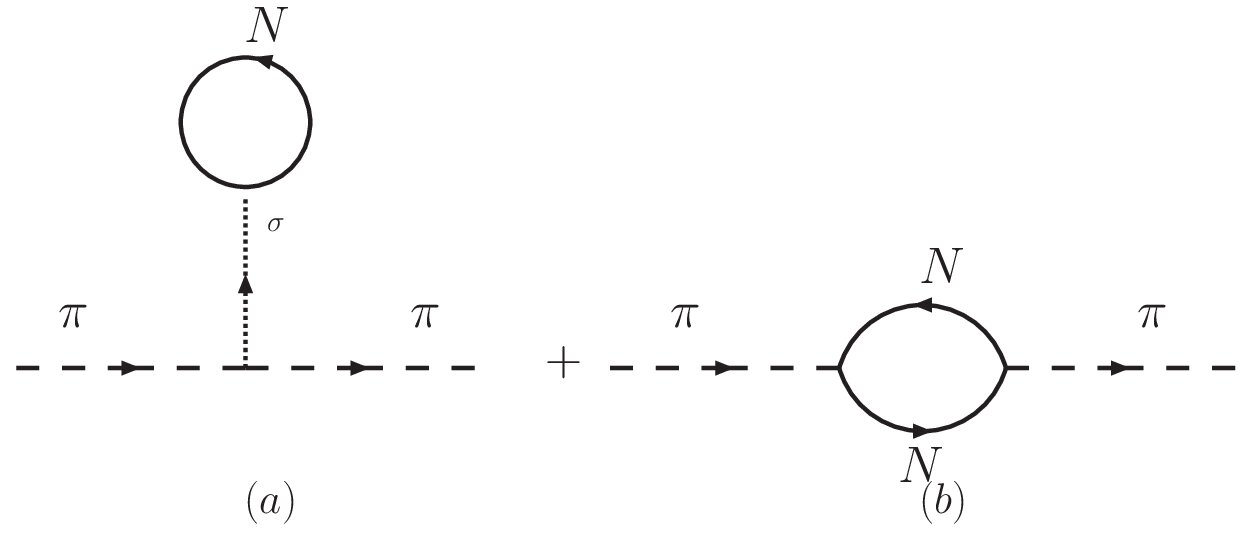 Figure 11
| MFT | ||
|---|---|---|
| Kapusta | ||
| BDM |
Peer Reviews
No public reviews on file for this paper yet. If you reviewed it on a platform where reviews are public (OpenReview, ICLR, NeurIPS, ICML), you can paste yours below so the community can read it here.
Videos
No videos yet. Explain this paper in a talk, walkthrough, or lecture? Add one.
Effects of Dirac sea on pion propagation in asymmetric nuclear matter
Subhrajyoti Biswas and Abhee K. Dutt-Mazumder
Saha Institute of Nuclear Physics, 1/AF Bidhannagar, Kolkata-700 064, INDIA
Abstract
We study pion propagation in asymmetric nuclear matter (ANM). One of the interesting consequences of pion propagation in ANM is the mode splitting for the different charged states of pions. First we describe the pion-nucleon dynamics using the non-chiral model where one starts with pseudoscalar (PS) N coupling and the pseudovector (PV) representation is obtained via suitable non-linear field transformations. For both of these cases the effect of the Dirac sea is estimated. Subsequently, we present results using the chiral effective Lagrangian where the short-distance behavior (Dirac vacuum) is included by re-defining the field parameters as done in the modern effective field theory approach developed recently. The results are compared with the previous calculations for the case of symmetric nuclear matter (SNM). Closed form analytical results are presented for the effective pion masses and dispersion relations by making hard nucleon loop (HNL) approximation and suitable density expansion.
Dirac sea, isospin, symmetry, collective modes
pacs:
21.65.+f, 13.75.Cs, 13.75.Gx, 21.30.Fe
I introduction
Pions in nuclear physics assume a special status. It is responsible for the spin-isospin dependent long range part of the nuclear force. In addition, there are variety of physical phenomena related to the pion propagation in nuclear matter. One of the fascinating ideas in relation to the pion-nucleon dynamics in nuclear matter is the pion condensation [Migdal78]. This might happen if there exists space like zero energy excitation of pionic modes. The short-range correlation, on the other hand, removes such a possibility at least at densities near the saturation densities. In the context of relativistic heavy ion collisions (RHIC), the importance of medium modified pion spectrum was discussed by Mishustin, where it was shown that due to the lowering of energy, pion, in nuclear matter, might carry a bulk amount of entropy [Mishustin80]. Subsequently, Gyulassy and Greiner studied pionic instability in great detail in the context of RHIC [Gyulassy77]. The production of pionic modes in nuclear collisions was also discussed in [Brown89].
In experiments medium dependent pion dispersion relation can also be probed via the measurements of dilepton invariant mass spectrum. The lepton pairs produced with invariant mass near the pole are sensitive to the slope of the pion dispersion relation in matter [Xia88]. Particularly the softening of momentum dependence of the pion dispersion relation in matter leads to higher yield of dileptons. Gale and Kapusta were first to realize that the in-medium pion dynamics can be studied by measuring lepton pair productions [Gale87]. Most of the earlier studies of in-medium pion properties were performed in the non-relativistic frame work [Oset82, Migdal90, Dmitriev85]. A quasi-relativistic approach was taken in [Henning94, Korpa95, Helgesson95] where the calculations were extended to finite temperature. In particular, [Helgesson95] discusses various non-collective modes with the possibility of pion condensation. In [Xia88], on the other hand, the dilepton production rates were calculated using non-relativistic pion dispersion relations. Ref.[Liu97] treated the problem relativistically but free Fermi gas model was used, while in [Herbert92] pion propagation was studied by extending the Walecka model [Walecka74] including delta baryon. In recent years, there has been significant progress to calculate dilepton production rates involving pionic properties in a more realistic framework [Helgesson95, Xia88, Rapp00, Gale87, Wong94, Chanfray93].
In the present paper we study pion dispersion relations in ANM using relativistic models. This is important as most of the calculations, as mentioned above, are either restricted to SNM or performed in the non-relativistic framework. Here we focus on the propagating modes of various charged states of pions which are non degenerate in ANM. The importance of relativistic corrections and density dependent pion mass splitting in ANM in the context of deriving pion-nucleus optical potential was discussed in [Weise01]. The formalism adopted in [Weise01] was that of chiral perturbation theory. Recently, in the context of astrophysics, pionic properties in ANM has also been studied by involving Nambu-Jona-Lasinio model [Costa03, Costa04]. Motivated by [Weise01] present authors revisited the problem in ref.[Biswas06] where not only the static self-energy responsible for the mass splitting but the full dispersion relations for the various charged states of pions were calculated after performing relevant density expansion in terms of the Fermi momentum. However, in our previous work [Biswas06], pions were included via straight forward PV coupling in the Walecka model [Walecka74] which renders the theory non-renormalizable. Although the problem of non-renormalizibility could be avoided by considering the PS N coupling. This, on the other hand, fails to account for the pion-nucleon phenomenology.
Historically, the extension of the Walecka model to include the isovector and meson for the realistic description of dense nuclear matter (DNM) while retaining the renormalizibility of the theory was first made by Serot [Serot79]. However, in this work, the calculation was restricted only to the mean field level which gives to rise tachyonic mode for pions even at density as low as , where denotes normal nuclear matter (NNM) density [Kapusta81]. Such a non-propagating mode for the pions can be removed by extending the calculation beyond the mean field level as showed by Kapusta [Kapusta81]. This, in effect, means inclusion of the - loop while calculating the in-medium dressed propagator for the pion. This model has an added advantage because of the presence of - coupling in addition to the usual PS coupling of the pion with the nucleons which is responsible for the generation of small s-wave pion nucleon interaction in vacuum. This is consistent with the observed characteristics of the pion-nucleon interaction which is dominated by the p-wave scattering while the -wave scattering length is almost zero. In matter, however, as argued in [Kapusta81, Matsui82], such subtle cancellation does not occur resulting in a unrealistically large mass for the pions in matter. To circumvent this problem it was suggested in [Kapusta81] to use the pseudovector coupling even though it makes the theory non-renormalizable.
The theoretical challenge, therefore, is to construct a model with N PV interaction which preserves the renormalizibility of the theory. This was accomplished in ref. [Matsui82] following the technique developed by Weinberg [Weinberg67, Weinberg68, Weinberg79] and Schwinger [Schwinger67]. Here one starts with the PS coupling and subsequently invokes non-linear field transformations to obtain PV representation. Unlike straight forward inclusion of PV interaction in this method one requires only finite number of counter terms which makes the theory renormalizable. We, here, start with this model developed by Matsui and Serot [Matsui82] to study the pion propagation in ANM. Clearly, the model adopted here is different from what we had invoked in our previous work [Biswas06]. Furthermore, in [Biswas06], for the determination of pion self-energy in matter only the scattering from the Fermi sphere was considered and the vacuum part was completely ignored. The latter gives rise to a large contribution to the pion self-energy in presence of strong scalar density ().
The above mentioned model has various shortcomings too. In fact, the ref.[Matsui82] itself discusses its limitations in describing many body dynamics. For example, the successful description of the saturation properties of nuclear matter in this scheme requires higher scalar mass which gives rise to larger in-medium nucleon mass compared to the MFT. In addition, it also fails to account for the observed pion-nucleus scattering length at finite density [Matsui82]. In the same work, chiral - model has also been discussed to which we shall come later. In the end, we present results calculated using this non-chiral model together with what we obtain from a chirally invariant Lagrangian.
In [Biswas06] we have discussed another interesting possibility of the density driven - mixing in ANM. However, quantitatively, the mixing was found to be a higher order effect and does not affect the pion dispersion relations at the leading order in density. Hence in the present paper we neglect - mixing.
The plan of the paper is as follows. In section II we present the formalism, where we start with PS coupling in subsection A. In II B we invoke non-linear field transformation [Matsui82] and subsequently report results involving PV coupling. In section III we present results using recently developed chiral effective model in the context of nuclear many body problem [Serot97, Hu07]. Finally, section IV presents the summary and conclusion. Detailed derivations for the Dirac part of the pion self-energy for PS and PV couplings have been relegated to appendix A and B respectively.
II Formalism
II.1 Model with pseudoscalar interaction
We start with the following interaction Lagrangian given by [Matsui82],
[TABLE]
where,
[TABLE]
Here, , , , and represents the nucleon, pion, sigma, rho and omega fields respectively and their masses are denoted by , , , and . This model successfully reproduces the saturation properties of nuclear matter and yields accurate results for closed shell nuclei in the Dirac-Hartree approximation [Horowitz81].
It is to be noted that in Eq.(1) the pion-nucleon dynamics is described by
[TABLE]
where, is the pion-nucleon coupling constant with [Engel96]. This apart, the interaction Lagrangian of Eq.(1) also has another term involving the coupling of pions with the scalar meson given by
[TABLE]
Here, is the coupling constant of the scalar to pion field. The N scattering amplitude would now involve both nucleon and sigma meson in the intermediate state causing sensitive cancellation between the two that gives reasonable value of the -wave scattering length [Kapusta81] as mentioned before. At the self-energy level Eq.(3) and (4) will generate the exchange and the tadpole diagram as shown in Fig.1b and 1a.
First we consider the tadpole diagram whose contribution to the self-energy is given by where, and . Here represents scalar density given by
[TABLE]
The effective nucleon mass as appears in Eq.(5) can be determined from the following self-consistent condition [Serot86].
[TABLE]
It is clear from Eq.(6) that as the nucleon masses are modified by scalar mean field [Serot86] which does not distinguish between and . Here, for the moment we neglect explicit symmetry breaking (- mass difference) i.e. .
It is to be noted that in the mean field theory (MFT), only Fig.(1a), i.e. the tadpole diagram contributes, while Fig.(1b) is neglected. The origin of tachyonic mode can now easily be understood. The pion mass in matter due to the tadpole is given by [Kapusta81]
[TABLE]
The second term of the last equation is quite large even at densities far below density viz. for .
Fig.1b would involve various combinations of and depending upon the various charged states of pions as shown in Fig.(2a) and Fig.(2b).
[TABLE]
where the subscript denotes either (proton) or (neutron). is the vertex factor. or for PS and PV coupling respectively. Explicitly,
[TABLE]
where,
[TABLE]
Here, and represent the free and the density dependent part of the propagator. In Eq.(10) is the nucleon momentum; denotes the Fermi momentum and is the in-medium nucleon mass modified due to scalar mean field [Serot86]. We, from now onward, use and to denote the proton and neutron Fermi momentum respectively.The nucleon energy is .
Note that the total self-energy is given by . Using Eq.(9) and Eq.(10), the expression for self-energy given in Eq.(LABEL:self0) takes the following form :
[TABLE]
Here is for (PV) coupling. For the coupling constant (or ) gets replaced by . The values of the coupling constants and are determined experimentally from N and NN scattering data. is the trace factor which consists of four parts :
[TABLE]
Detailed expressions for , and will be discussed later. Here the term contains the product of two delta functions () which put both the loop-nucleons on shell implying the cut in the loop (Fig.3a). This means that pion can decay into nucleon-antinucleon (Fig.3b) pair which happens only in the high momentum limit i.e and also where is the Fermi energy for proton (or neutron). Under this conditions only contributes to the self-energy. But in the present calculation, we investigate low momentum (of pion) collective excitations only [Chin77]. Therefore (i.e ) is neglected.
Thus, the pion self-energy can now be written as:
[TABLE]
The self-energies for different charged states of pion are calculated using the one-loop diagram shown in the Fig.(2b). The first term of Eq.(13) is same as the pion self-energy in vacuum with . This part is divergent.
[TABLE]
Here factor 2 that appears in , i. e. in Eq.(14), follows from isospin symmetry for . The part of self-energy for PS coupling is calculated from Eq.(13) by substituting and it is denoted by .
[TABLE]
From Eq.(15) it is observed that is quadratically divergent. To eliminate these divergences we need to renormalize . Here we adopt the dimensional regularization [Hooft73, Peskin, Cheng] technique to regularize with the following results (details are discussed in appendix A).
[TABLE]
It is found that the result given in Eq.(16) is finite and no divergences appear further. In the appropriate kinematic regime it might generate imaginary part:
[TABLE]
If we consider that is small enough then the term of Eq.(16) can be approximated to and the last term of Eq.(16) can be easily evaluated to give
[TABLE]
where,
[TABLE]
The trace of (FD+DF) part for ,
[TABLE]
and for ,
[TABLE]
The part of the self-energy for and can be written as
[TABLE]
where,
[TABLE]
with . We restrict ourselves in the long wavelength limit i.e. when the pion momentum is small compared to the Fermi momentum of the system where the many body effects manifest strongly. In this case particle propagation can be understood in terms of collective excitation [Chin77] of the system which permits analytical solutions of the dispersion relations [Chin77, Akdm03]. But in the short wavelength limit i.e. when the pion momentum is much larger than the Fermi momentum , particle dispersion approaches to that of the free propagation. Note that for SNM implying .
In the long wavelength limit we neglect the term compared to the term from the denominator of both and in Eqs.(24) and (25). Explicitly, after a straight forward calculation we get,
[TABLE]
and
[TABLE]
where , and . The approximate results of Eqs.(26) and(27) are given below.
[TABLE]
where,
[TABLE]
The self-energy for PS coupling:
[TABLE]
The dispersion relations can be found by solving Dyson-Schwinger equation.
[TABLE]
Here are the masses of and . The dispersion relations without the effect of Dirac sea for :
[TABLE]
The effective masses without Dirac sea are
[TABLE]
where,
[TABLE]
Now we presents the dispersion relations for with the effect of Dirac sea.
[TABLE]
The effective masses with Dirac sea for different charged states of pion are given by
[TABLE]
where,
[TABLE]
The PS coupling the asymmetry driven mass splitting is of . The terms and are non-vanishing in ANM and responsible for the pion mass splitting.
In Fig.4 and 5 we present the density () and asymmetry parameter () dependent effective masses for the various charged states of pion. In the top panel we present the results without vacuum correction (Dirac sea). Here we include both the tadpole and - loop.
It is evident that the inclusion of (1b) removes the tachyonic mode but gives rise to effective pion masses which are unrealistically large as discussed by Kaputa [Kapusta81] as shown in the top panel of Fig.4.
It is to be noted that the inclusion of the vacuum part reduces the effective pion masses and gives reasonable value for the density dependent pion masses in matter at NNM density. The reason for this could be understood from the Table 1 which enumerates expressions for the effective pion masses that we obtain in three different cases. The top row represents effective pion masses for the case considered in [Serot79] which gives rise to the tachyonic mode, the second row corresponds to the case discussed by Kapusta [Kapusta81] and in the last row we present results of the present work as by BDM. The presence of the additional term somewhat tames the dispersion curve bringing the masses down compared to [Kapusta81]. This can be noted that at the MFT level involves sum of the scalar densities and . Therefore, in MFT, as expected, the masses are insensitive to asymmetry parameter .
For Pb-like nuclei (), , and with vacuum correction.
The dispersion relation for various charged states of pion are shown in the Fig.6 where upper and lower panel present the dispersion curves without and with the Dirac sea including the tadpole contribution. In the presence of Dirac sea and dispersion curves are indistinguishable.
II.2 Renormalizible model with pseudovector coupling
To obtain the pseudovector representation from the starting Lagrangian given by Eq.(1), one gives following nonlinear chiral transformation [Matsui82],
[TABLE]
The last two equations (LABEL:ncpi) and (39c) are used to express the old fields and in terms of new fields and .
[TABLE]
The transformed Lagrangian is
[TABLE]
We see from the Eq. LABEL:TLag that the - PS coupling has disappeared and instead the pion-nucleon dynamics is now governed by the last term of the above mentioned equation. At the leading order one obtains the usual PV coupling represented by,
[TABLE]
Here is the pseudovector coupling constant and [Ericson88]. First we discuss the FF part where the trace factor is given by
[TABLE]
Now the part of the self-energy for coupling is denoted by . From Eq.(13) and Eq.(LABEL:pvself0) we get,
[TABLE]
Direct power counting shows that the term is divergent. The appropriate renormalization scheme for the present model has been developed in ref[Matsui82]. We first consider a simple subtraction scheme described in Appendix B to obtain
[TABLE]
Now can be approximated to
[TABLE]
where,
[TABLE]
On the other hand borrowing results from [Matsui82] one has,
[TABLE]
where,
[TABLE]
It might be mentioned, although are different from , their effect on the effective pion masses and corresponding dispersion relations are found to be marginal as we discuss later.
The FF part can also develop imaginary part as given by
[TABLE]
It is observed from Eq.(LABEL:apvimaginary) that is non-vanishing only if .
The trace of the (FD+DF) part for ,
[TABLE]
and for ,
[TABLE]
In pure neutron (or proton) matter one of the terms of Eq.(52) viz for the charged pion states. The same argument holds true for the neutral pion where only two terms would contribute which can be observed from Eq.(LABEL:pvfdpi00). In case of pure neutron (or proton) matter appears as the intermediate state. Now the part of the self-energy for and can be written as
[TABLE]
where
[TABLE]
In the long wavelength limit considering collective excitations near the Fermi surface, part of the pion-self energy can be evaluated analytically. In this case we can neglect the term compared to the term from the denominator of and in Eqs. (55) and (56). This is called hard nucleon loop (HNL) approximation [Akdm03]. Explicitly, after a straight forward calculation, we get,
[TABLE]
and
[TABLE]
The approximate results of Eqs.(57) and (58) are
[TABLE]
where,
[TABLE]
The total pion self-energy for coupling is
[TABLE]
The approximate dispersion relations and the effective pion masses of different charged states in ANM without and with the Dirac sea effect are presented below.
The dispersion relations for without the effect of Dirac sea are as follows,
[TABLE]
where is the effective pion masses without Dirac sea effect:
[TABLE]
where,
[TABLE]
These results are the same as that of [Biswas06] with some notational difference such as , , and . In (67) and (64), and are responsible for the asymmetry parameter dependent mass splitting, where and are the neutron and proton density respectively. Clearly for SNM and vanish.
The dispersion relations for including the effect of Dirac sea are given by,
[TABLE]
The effective masses of different charged states of pion are found from Eq.(LABEL:pvdis) in the limit .
[TABLE]
where,
[TABLE]
This is to be noted that, if one use Eq.(48) instead of Eq.(46); and will be replaced by and respectively. will vanish. Numerically,as mentioned before, Eq.(46) and Eq.(48) give results very close to each other. Clearly from Eq.(61), indicates that the asymmetry driven mass splitting is of for coupling.
To quote typical values of the pion mass shifts for PV coupling at normal nuclear density for Pb-like nuclei which are , and with vacuum correction and the corresponding values are , and without vacuum correction.
In Fig.7 we show results for the density dependence of effective pion masses for various charge states at . It is observed that the mass increases in matter while decreases at higher density. The mass splitting is quite significant even at density . In the lower panel we present results with vacuum corrections. Evidently the effect of vacuum corrections is found to be small.
It should however be mentioned that the vacuum correction part for PV coupling is rather small. For loops involving heavy baryons it could be quite high. For detailed discussion we refer the readers to [Furnstahl89, Furnstahl95]. In present case we take only the nucleon loop in presence of the scalar mean field.
We also present results of asymmetry parameter dependence effective masses for different charge states of pion in Fig.8 at normal nuclear matter density. The upper and lower panel present the effective pion masses without and with vacuum correction. It can be observed that the asymmetry parameter dependent pion mass splitting is insensitive to the vacuum correction. The pion dispersions in medium for various charge states of pion are presented in Fig.9 for PV coupling.
III Modern Technique
In the previous sections we have discussed pion propagation in ANM using both the PS and PV interaction within the framework of non-chiral model. However, the interactions as represented by Eq.1 and Eq.LABEL:TLag, fail to describe in-medium dynamics as shown in [Matsui82]. It was also observed that the chirally symmetric model (linear) has also various limitations [Matsui82]. For example, as mentioned before, it fails to account for the pion-nucleus dynamics in nuclear matter both in the PS and PV representations. In fact, it gives too strong pion nucleon interaction in matter which cannot be adjusted by fixing the s-wave - interaction in free space even in PV case. In this context the Dirac vacuum involving baryon loops was found to play a significant role. If one uses the chiral model and breaks the symmetry explicitly, the results are found to be very sensitive to the renormalization scheme [Matsui82]. In [Furnstahl93] it was shown that the relativistic chiral models with a light scalar meson appear to provide an economical marriage of successful relativistic MFT and chiral symmetry. It, however, fails to reproduce observed properties of finite nuclei, such as spin-orbit splittings, shell structure, charge densities and surface energies. Since then, there has been series of attempts to construct a model which has the virtue of describing both the properties of nuclear matter and finite nuclei [Furnstahl87, Furnstahl93A, Furnstahl95, Furnstahl96, Serot97, Hu07]. Currently, the non-linear chiral effective field theoretic approach seems to be quite successful in this respect. It might be recalled here, that, in such a framework, the explicit calculation of the Dirac vacuum is not required, rather, on the contrary, here, the short distance dynamics are absorbed into the parameters of the theory adjusted phenomenologically by fitting empirical data [Furnstahl89, Serot97, Hu07]. Now we proceed to calculate the effective pion masses in ANM in this approach.
By retaining only the lowest order terms in the pion fields, one obtains the following Lagrangian from the chirally invariant Lagrangian[Hu07] :
[TABLE]
The terms and contain, respectively the nonlinear terms of the meson sector and all of the counterterms. The explicit expressions for and can be found in [Hu07].
It is to be noted that the meson self-energy can be found by differentiating the energy density [Hu07] at the two-loop level with respect to the meson propagator as indicated in Fig 10. One may therefore, identify the , and parts of the self-energy with the vacuum-fluctuation(VF), Lamb-shift(LS) and exchange (EX) contributions to the self-energy respectively. The VF and LS terms are related to the short-range physics while EX part is related to the long-range physics. The detailed discussion about this short and long distance separation can be found in [Furnstahl89, Serot97, Hu07]. The diverging part of the self-energy and LS can be expressed as a sum of terms which already exists in the effective field theoretical Lagrangian and can be absorbed into the counter terms. The short distance physics, as shown in [Hu07], while calculating exchange energies, are either removed by field redefinitions or the coefficients are determined by fitting with the empirical data. The long-range part is computed explicitly that produce modest corrections to the nuclear binding energy curve. This can be compensated by a small adjustment of the coupling parameters.
Recently in ref.[Hu07] the exchange energy contributions of pion has been calculated within this theoretical framework. We adopt the same parameter set as designated by MOA in [Hu07] to calculate the self-energy explicitly. The corresponding results are presented in Fig.11. Here we simply depict the final results as the expressions, at this order, for the pion self-energy and density dependent masses of and remain same as those of Eq.67 except for the coupling parameters. Quantitatively, it is found that, for the lower density, i.e , the effective masses for , and states are comparable with that of PV coupling (Fig.7), while at higher density the mass splitting is significantly enhanced. The charged states, i.e. show stronger density dependence compared to PV coupling. We also observe that the density dependence of is rather weak.
IV Summary and conclusion
In the present paper pion propagation in ANM has been studied within the framework of relativistic hadrodynamics in presence of the scalar mean field. We start with the model developed in [Matsui82] and present analytical results for the pion dispersion relations in ANM by making HNL approximation and suitable density expansion. Subsequently, we invoke the chirally invariant Lagrangian [Furnstahl97, Furnstahl98] by retaining only the lowest order terms in pion field and compare the results with non-chiral model calculations performed in section II.
The splitting of the various charged states of pion even at normal nuclear matter density is found to be quite significant. Such mode splittings in ANM is, infact, a generic feature of all the isovector mesons. Therefore, it would be interesting to estimate similar splitting for the meson and other isovector states. It is to be noted that the mass splitting is related to the pion-nucleus optical potential [Weise01, Biswas06]. As for the dispersion relations, we restricted our calculation only to the time-like region which can also be extended to study the space like modes both for the pions and rho mesons.
Acknowledgment : The authors gratefully thank Pradip Roy and Kausik Pal for valuable comments and suggestions.
Appendix A
After using Feynman parametrization, the term in Eq.(15) can be written as
[TABLE]
Here and is an arbitrary scaling parameter. is the Euler-Mascheroni constant and . The imaginary part of can easily be found by simply replacing with where is an arbitrarily small parameter and the term comes from the denominator of when Feynman parametrization is performed considering in the denominator of the propagator.
Here the term has branch cut only for and it begins at i.e. the threshold condition for nucleon-antinucleon pair production. So the limit of x-integration changes from to where and we used . Now,
[TABLE]
Now the imaginary part of is,
[TABLE]
It is clear from the expression of Eq.(70) that the second term is divergent in the limit (as ). To remove the divergences we need to add the counterterms [Matsui82] in the original Lagrangian interaction . The diverging part of Eq.(70) is
[TABLE]
In Eq.(73) we substitute the effective nucleon mass where is the nucleon mass and is the vacuum expectation value of the scalar field . The expression given in Eq.(73) tells us that we need to be added four counter terms [Matsui82] with the original interaction Lagrangian to remove the divergences from . Therefore the counter term Lagrangian [Matsui82] is denoted as
[TABLE]
The value of the counterterms , , and are determined by imposing the appropriate renormalization conditions.
[TABLE]
Here and are the wave function and pion mass renormalization counterterms respectively while and are the vertex renormalizaton counterterms for the vertex and vertex respectively. The conditions of Eq.(75)-(76) implies that the pion propagator reproduces the physical mass of pions in free space. The counterterm determines the strength of coupling of the vertex. In fact is found by simply replacing with in Eq.(70). We can set to minimize the effects of many-body forces in the nuclear medium [Matsui82] which is consistent with the renormalization scheme for scalar meson. Using the conditions given in Eqs.(75)-(78) the following results are found :
[TABLE]
Now the renormalized is
[TABLE]
Substituting from Eq.(70) and , , , from Eqs.(LABEL:psbeta1)-(LABEL:psbeta4) in Eq.(83) it is found that divergences in are completely eliminated by the counterterms. After simplification reduces to
[TABLE]
Appendix B
After Feynman parametrization Eq.(LABEL:pvff0) reduces to
[TABLE]
The imaginary part of can be found as
[TABLE]
It is clear from Eq.(LABEL:pvimaginary) that vanishes for . With the same argument as stated for coupling, we excluded the imaginary part. The diverging part of is
[TABLE]
Here we use simple subtraction method to remove the divergence. So, the finite FF part of the self-energy is
[TABLE]
The reference list from the paper itself. Each links out to its DOI / PubMed record.
- 1[1] Migdal 78 A. B. Migdal, Rev. Mod. Phys. 50 (1978) 107.
- 2[2] Mishustin 80 I. M. Mishustin, F. Myhrer and P. J. Siemens, Phys. Lett. B 95 (1980) 361.
- 3[3] Gyulassy 77 M. Gyulassy and W. Greiner, Ann. Phys. 109 (1977) 485.
- 4[4] Brown 89 G. E. Brown, E. Oset, M. Vicente Vacas and W. Weise, Nucl. Phys. A 505 (1989) 823.
- 5[5] Xia 88 L. H. Xia, C. M. Ko, L. Xiong and J. Q. Wu, Nucl. Phys. A 485 (1988) 721.
- 6[6] Gale 87 C. Gale and J. I. Kapusta, Phys. Rev. C 35 (1987) 2107.
- 7[7] Oset 82 E. Oset, H. Toki and W. Weise, Phys. Rep. 83 (1982) 281.
- 8[8] Migdal 90 A. B. Migdal, E. E. Saperstein, M. A. Troitsky and D. N. Voskresensky, Phys. Rep. 192 (1990) 179.