Dimers on surface graphs and spin structures. II
David Cimasoni, Nicolai Reshetikhin

TL;DR
This paper extends the geometric understanding of dimer models on surface graphs by generalizing spin structures to surfaces with boundary and exploring their implications in quantum field theory reformulations.
Contribution
It generalizes the correspondence between edge orientations and spin structures to surfaces with boundary and analyzes how cutting and gluing affect the partition function.
Findings
Extended spin structure correspondence to surfaces with boundary.
Described how cutting and gluing operations modify spin structures.
Reformulated the dimer model as a quantum field theory.
Abstract
In a previous paper, we showed how certain orientations of the edges of a graph G embedded in a closed oriented surface S can be understood as discrete spin structures on S. We then used this correspondence to give a geometric proof of the Pfaffian formula for the partition function of the dimer model on G. In the present article, we generalize these results to the case of compact oriented surfaces with boundary. We also show how the operations of cutting and gluing act on discrete spin structures and how they change the partition function. These operations allow to reformulate the dimer model as a quantum field theory on surface graphs.
Click any figure to enlarge with its caption.
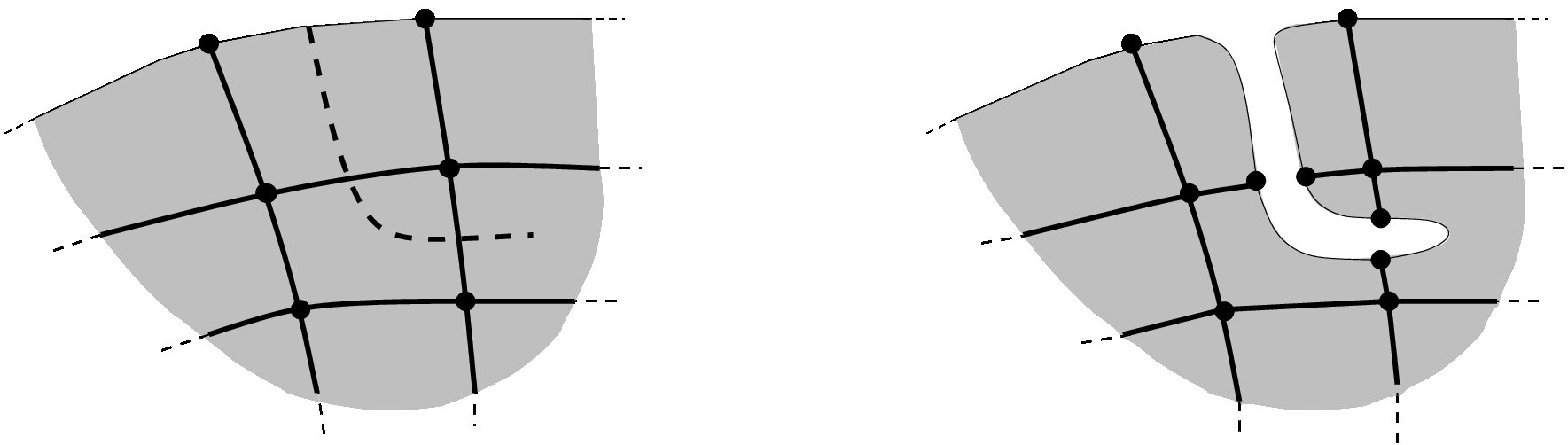 Figure 1
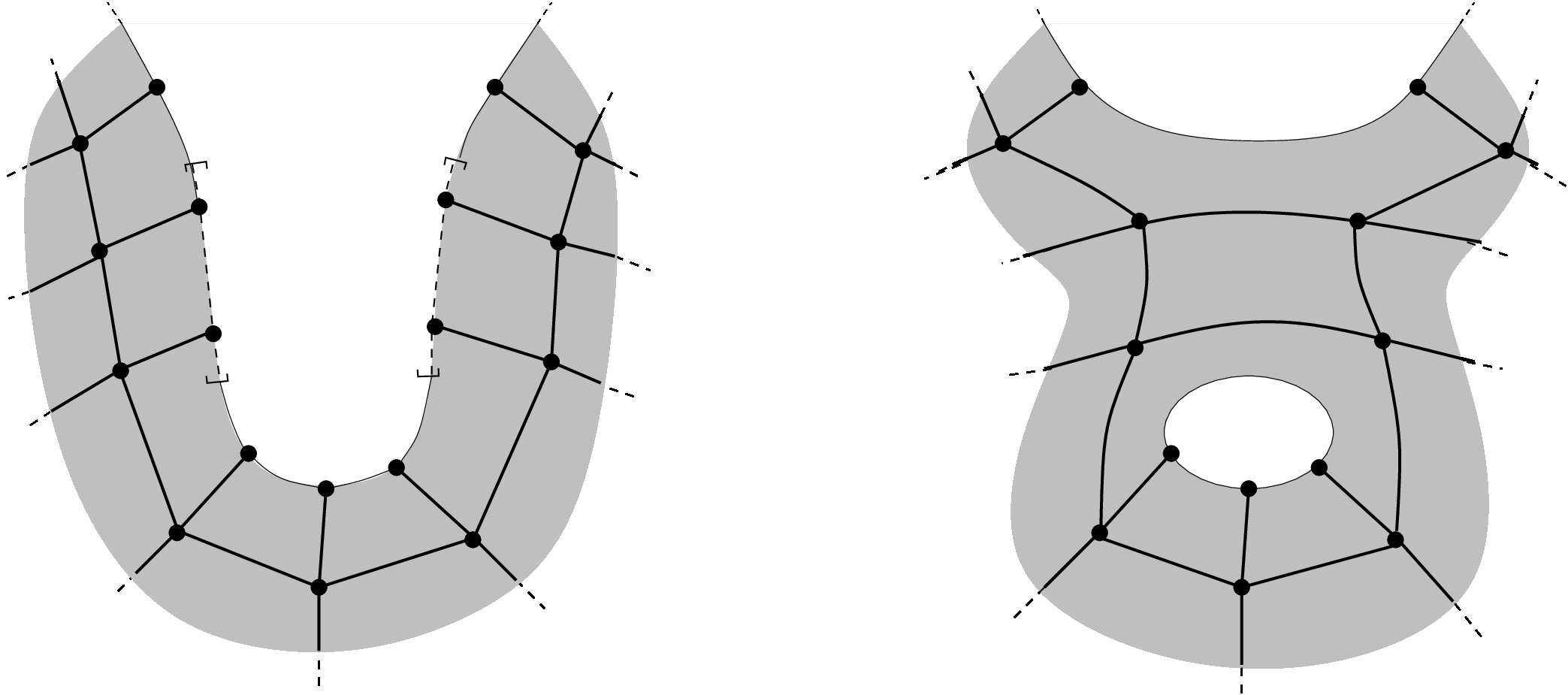 Figure 2
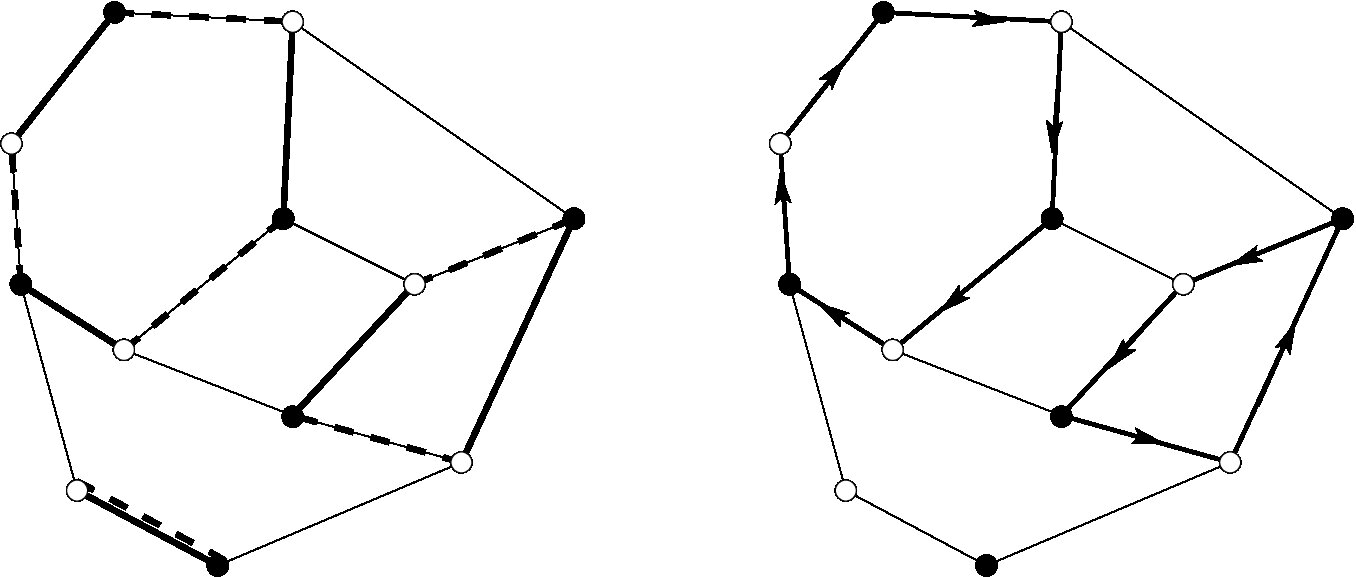 Figure 3
Peer Reviews
No public reviews on file for this paper yet. If you reviewed it on a platform where reviews are public (OpenReview, ICLR, NeurIPS, ICML), you can paste yours below so the community can read it here.
Videos
No videos yet. Explain this paper in a talk, walkthrough, or lecture? Add one.
Dimers on surface graphs and spin structures. II
David Cimasoni
Department of Mathematics, UC Berkeley, 970 Evans Hall, Berkeley, CA 94720, USA
and
Nicolai Reshetikhin
Abstract.
In a previous paper [3], we showed how certain orientations of the edges of a graph embedded in a closed oriented surface can be understood as discrete spin structures on . We then used this correspondence to give a geometric proof of the Pfaffian formula for the partition function of the dimer model on . In the present article, we generalize these results to the case of compact oriented surfaces with boundary. We also show how the operations of cutting and gluing act on discrete spin structures and how they change the partition function. These operations allow to reformulate the dimer model as a quantum field theory on surface graphs.
1991 Mathematics Subject Classification:
Primary: 82B20; Secondary: 57R15
Contents
Introduction
A dimer configuration on a graph is a choice of a family of edges of , called dimers, such that each vertex of is adjacent to exactly one dimer. Assigning weights to the edges of allows to define a probability measure on the set of dimer configurations. The study of this measure is called the dimer model on . Dimer models on graphs have a long history in statistical mechanics [6, 12], but also show interesting aspects involving combinatorics, probability theory [10, 4], real algebraic geometry [9, 8], etc…
A remarkable fact about dimer models was discovered by P.W. Kasteleyn in the 60’s: the partition function of the dimer model can be written as a linear combination of Pfaffians of matrices, where is the number of vertices in the graph and the genus of a closed oriented surface where the graph can be embedded. The matrices are signed-adjacency matrices, the sign being determined by an orientation of the edges of called a Kasteleyn orientation. If the graph is embedded in a surface of genus , there are exactly equivalence classes of Kasteleyn orientations, defining the matrices. This Pfaffian formula for the partition function was proved by Kasteleyn in [6] for the cases , and only stated for the general case [7]. A combinatorial proof of this fact and the exact description of coefficients for all oriented surfaces first appeared much later [11, 14].
The number of equivalence classes of Kasteleyn orientations on a graph embedded in is also equal to the number of equivalence classes of spin structures on . An explicit construction relating a spin structure on a surface with a Kasteleyn orientation on a graph with dimer configuration was suggested in [10]. In [3], we investigated further the relation between Kasteleyn orientations and spin structures. This allows to understand Kasteleyn orientations on a graph embedded in as discrete spin structures on . We also used this relation to give a geometric proof of the Pfaffian formula for closed surfaces. Our final formula can be expressed as follows: given a graph embedded in a closed oriented surface of genus , the partition function of the dimer model on is given by
[TABLE]
where denotes the set of equivalence classes of spin structures on , is the Arf invariant of the spin structure , and is the matrix given by the Kasteleyn orientation corresponding to .
The first part of the present paper is devoted to the extension of the results obtained in [3] to dimer models on graphs embedded in surfaces with boundary (Sections 1 and 2). We then show how the operations of cutting and gluing act on discrete spin structures and how they change the partition function (Section 3). These operations define the structure of a functorial quantum field theory in the spirit of [2, 13], as detailed in Section 4. We then give two equivalent reformulations of the dimer quantum field theory: the “Fermionic” version, which describes the partition function of the dimer model as a Grassman integral, and the “Bosonic” version, the equivalent description of dimer models on bipartite surface graphs in terms of height functions. This special case of bipartite graphs is the subject of Section 5.
Throughout this paper, is a compact surface, possibly disconnected and possibly with boundary, endowed with the counter-clockwise orientation. All results can be extended to the case of non-orientable surfaces, which will be done in a separate publication. We refer to [14] for a combinatorial treatment of dimer models on non-orientable surface graphs.
Acknowledgements
We are grateful to J. Andersen, M. Baillif, P. Teichner and A. Vershik for inspiring discussions. We also thankfully acknowledge the hospitality of the Department of Mathematics at the University of Aarhus. The work of D.C. was supported by the Swiss National Science Foundation. This work of N.R. was partially supported by the NSF grant DMS–0307599, by the CRDF grant RUM1–2622, by the Humboldt foundation and by the Niels Bohr research grant.
1. The dimer model on graphs with boundary
1.1. Dimers on graphs with boundary
In this paper, a graph with boundary is a finite graph together with a set of one valent vertices called boundary vertices. A dimer configuration on a graph with boundary is a choice of edges of , called dimers, such that each vertex that is not a boundary vertex is adjacent to exactly one dimer. Note that some of the boundary vertices may be adjacent to a dimer of , and some may not. We shall denote by this partition of boundary vertices into matched and non-matched. Such a partition will be called a boundary condition for dimer configurations on .
A weight system on is a positive real valued function on the set of edges of . It defines edge weights on the set of dimer configurations on by
[TABLE]
where the product is taken over all edges occupied by dimers of .
Fix a boundary condition . Then, the Gibbs measure for the dimer model on with weight system and boundary condition is given by
[TABLE]
where
[TABLE]
the sum being on all such that .
Let denote the set of vertices of . The group
[TABLE]
acts on the set of weight systems on as follows: , where and are the two vertices adjacent to the edge . Note that and , both products being on the set of vertices of matched by . Therefore, the Gibbs measure is invariant under the action of the group .
Note that the dimer model on with boundary condition is equivalent to the dimer model on the graph obtained from by removing all edges adjacent to non-matched boundary vertices.
Given two dimer configurations and on a graph with boundary , let us define the -composition cycles as the connected components of the symmetric difference . If , then is a 1-cycle in with -coefficients. In general, it is only a 1-cycle .
1.2. Dimers on surface graphs with boundary
Let be an oriented compact surface, not necessarily connected, with boundary . A surface graph with boundary is a graph with boundary embedded in , so that and the complement of in consists of open 2-cells. These conditions imply that the graph is the -skeleton of a cellular decomposition of .
Note that any graph with boundary can be realized as a surface graph with boundary. One way is to embed the graph in a closed surface of minimal genus, and then to remove one small open disc from this surface near each boundary vertex of the graph.
A dimer configuration on a surface graph with boundary is simply a dimer configuration on the underlying graph with boundary . Given two dimer configurations and on a surface graph , let denote the homology class of in . We shall say that two dimer configurations and are equivalent if . Note that given any three dimer configurations , and on , we have the identity
[TABLE]
in .
Fix a homology class , a dimer configuration and a boundary condition . The associated partial partition function is defined by
[TABLE]
where the sum is taken over all such that and .
The equality (1) implies that
[TABLE]
Furthermore, the relative homology class lies in the image of the canonical homomorphism . Hence,
[TABLE]
where the sum is taken over all such that , and
[TABLE]
Therefore the computation of the partition function boils down to the computation of with . We shall give a Pfaffian formula for this latter partition function in the next section (see Theorem 2.4).
2. Kasteleyn orientations on surface graphs with boundary
2.1. Kasteleyn orientations
Let be an orientation of the edges of a graph , and let be an oriented closed curve in . We shall denote by the number of times that, traveling once along following its orientation, one runs along an edge in the direction opposite to the one given by .
A Kasteleyn orientation on a surface graph with boundary is an orientation of the edges of which satisfies the following condition: for each face of , is odd. Here is oriented as the boundary of , which inherits the orientation of .
Using the proof of [3, Theorem 3.1], one easily checks that if is non-empty, then there always exists a Kasteleyn orientation on . More precisely, we have the following:
Proposition 2.1**.**
Let be a connected surface graph, possibly with boundary, and let be the boundary components of with the induced orientation. Finally, let be [math]’s and ’s. Then, there exists a Kasteleyn orientation on such that for all if and only if
[TABLE]
where is the number of vertices of .
Proof.
First, let us assume that there is a Kasteleyn orientation on such that for all . Let be the closed surface obtained from by pasting a 2-disc along each boundary component . Let be the surface graph obtained from as follows: for each such that , add one vertex in the interior of and one edge (arbitrarily oriented) between this vertex and a vertex of . The result is a Kasteleyn orientation on , with closed. By [3, Theorem 3.1], the number of vertices of is even. Hence,
[TABLE]
Conversely, assume is a surface graph with . Paste -discs along the boundary components of as before. This gives a surface graph with closed and even. By [3, Theorem 3.1], there exists a Kasteleyn orientation on . It restricts to a Kasteleyn orientation on with for all . ∎
Recall that two Kasteleyn orientations are called equivalent if one can be obtained from the other by a sequence of moves reversing orientations of all edges adjacent to a vertex. The proof of [3, Theorem 3.2] goes through verbatim: if non-empty, the set of equivalence classes of Kasteleyn orientations on is an affine -space. In particular, there are exactly equivalence classes of Kasteleyn orientations on .
2.2. Discrete spin structures
As in the closed case, any dimer configuration on a graph allows to identify equivalence classes of Kasteleyn orientations on with spin structures on . Indeed, [3, Theorem 4.1] generalizes as follows.
Given an oriented simple closed curve in , let denote the number of vertices in whose adjacent dimer of sticks out to the left of in . Also, let be the number of boundary vertices in not matched by , and such that the interior of lies to the right of at .
Theorem 2.2**.**
Fix a dimer configuration on a surface graph with boundary . Given a class , represent it by oriented simple closed curves in . If is a Kasteleyn orientation on , then the function given by
[TABLE]
is a well-defined quadratic form on .
Proof.
Fix a dimer configuration on and a Kasteleyn orientation on . Let be the surface (homeomorphic to ) obtained from by adding a small closed collar to its boundary. For every vertex of that is not matched by a dimer of , add a vertex near in the interior of the collar and an edge between and . Let us denote by the resulting graph in . Putting a dimer on each of these additional edges, and orienting them arbitrarily, we obtain a perfect matching and an orientation on . Although is not strictly speaking a surface graph, all the methods of [3, Section 4] apply. Indeed, Kuperberg’s vector field defined near clearly extends continuously to the collar. As in the closed case, it also extends to the faces with even index singularities. Using the perfect matching on , we obtain a vector field with even index singularities, which determines a spin structure on . Johnson’s theorem [5] holds for surfaces with boundary, so this spin structure defines a quadratic form on . If is a simple close curve in , then as in the closed case. The proof is completed using the equalities and . ∎
Since Johnson’s theorem holds true for surfaces with boundary and [3, Proposition 4.2] easily extends, we have the following corollary.
Corollary 2.3**.**
Let be a surface graph, non-necessarily connected, and possibly with boundary. Any dimer configuration on induces an isomorphism of affine -spaces
[TABLE]
from the set of equivalence classes of Kasteleyn orientations on onto the set of spin structures on . Furthermore, is equal to the Poincaré dual of . In particular, if and only if and are equivalent dimer configurations.∎
2.3. The Pfaffian formula for the partition function
Let be a graph, not necessarily connected, and possibly with boundary, endowed with a weight system . Realize as a surface graph , and fix a Kasteleyn orientation on it. The Kasteleyn coefficient associated to an ordered pair of distinct vertices of is the number
[TABLE]
where the sum is on all edges in between the vertices and , and
[TABLE]
One also sets . Let us fix a boundary condition and enumerate the matched vertices of by . Then, the corresponding coefficients form a skew-symmetric matrix called the Kasteleyn matrix.
Let be a dimer configuration on with , given by edges matching vertices and for . Let be the permutation , and set
[TABLE]
where denotes the sign of . Note that does not depend on the choice of , but only on the dimer configuration .
Finally, recall that the Arf invariant of a (possibly degenerate) quadratic form on is defined by
[TABLE]
If there is a component of such that , then one easily checks that . On the other hand, if for all boundary components of , then takes the values or .
Theorem 2.4**.**
Let be a surface graph, not necessarily connected, and possibly with boundary. Let denote the dimension of , and let denote the genus of . Then,
[TABLE]
for any , and
[TABLE]
where both sums are over the equivalence classes of Kasteleyn orientations on . Furthermore, does not depend on .
Proof.
First note that if the theorem holds for two surface graphs, then it holds for their disjoint union. Therefore, it may be assumed that is connected. The first formula follows from Theorem 2.2: the proof of Theorem 4 and the first half of the proof of Theorem 5 of [3] generalize verbatim to the case with (possible) boundary. The second formula can be obtained from the first one by summing over all . However, this requires some cumbersome computations, so let us give another proof of this equality. As mentioned in Section 1, the dimer model on with boundary condition is equivalent to the dimer model on the graph obtained from by removing all edges adjacent to non-matched boundary vertices. Let denote the restriction of to . If is a surface graph with boundary, then is a surface graph, where is the closed oriented surface obtained from by gluing discs along all boundary components. By [3, Theorem 5.3],
[TABLE]
the sum being on all equivalence classes of Kasteleyn orientations on . Such a Kasteleyn orientation extends uniquely to a Kasteleyn orientation on such that for all boundary component of . Furthermore, and . Since for all other Kasteleyn orientations, the theorem follows. ∎
3. Cutting and gluing
3.1. Cutting and gluing graphs with boundary
Let be a graph with boundary, and let us fix an edge of . Let denote the graph with boundary obtained from as follows: cut the edge in two, and set , where and are the new one valent vertices. Iterating this procedure for some set of edges leads to a graph with boundary , which is said to be obtained by cutting along .
Note that a dimer configuration induces an obvious dimer configuration : cut in two the dimers of that belong to .
A weight system on induces a family of weight systems on indexed by , as follows: if is an edge of which does not belong to , set ; if is cut into two edges of , set and . Note that this family of weight systems is an orbit under the action of the subgroup of consisting of elements such that for all and whenever come from the same edge of .
Let us now formulate how the cutting affects the partition function. The proof is straightforward.
Proposition 3.1**.**
Fix a boundary condition on and a set of edges of . Then, given any parameter ,
[TABLE]
where the sum is taken over all subsets of and is the boundary condition on induced by and : a vertex of is matched in if and only if it is matched in or it comes from an edge in . ∎
The operation opposite to cutting is called gluing: pick a pair of boundary vertices of , and glue the adjacent edges along these vertices into a single edge . In order for the result to be a graph, it should be assumed that and are different edges of . We shall denote by the graph obtained by gluing according to a pairing of several vertices of .
Note that a dimer configuration induces a dimer configuration if and only if the boundary condition on is compatible with , i.e: relates matched vertices with matched vertices. Obviously, a dimer configuration is compatible with the pairing which glues back the edges of , and on .
An edge weight system on induces an edge weight system on as follows:
[TABLE]
If is a set of edges of and is the pairing which glues back these edges, then for any .
The effect of gluing on the partition function is best understood in the language of quantum field theory. We therefore postpone its study to Section 4.
3.2. Cutting and gluing surface graphs with boundary
Let be a surface graph with boundary. Let be a simple curve in which is “in general position” with respect to , in the following sense:
- (i)
it is disjoint from the set of vertices of ; 2. (ii)
it intersects the edges of transversally; 3. (iii)
its intersection with any given face of is connected.
Let be the surface with boundary obtained by cutting open along . Also, let be the graph with boundary obtained by cutting along the set of edges of which intersect , as illustrated in Figure 1.
Obviously, is a surface graph with boundary. We will say that it is obtained by cutting along . Abusing notation, we shall write for the weight system on .
A class induces via
[TABLE]
Here denotes a neighborhood of in , the first homomorphism is induced by inclusion, and the second one is the excision isomorphism. Note that given any two dimers configurations and on , in .
This easily leads to the following refinement of Proposition 3.1.
Proposition 3.2**.**
Fix , , and a boundary condition on . Then, given any parameter ,
[TABLE]
where the sum is taken over all subsets of and is the boundary condition on induced by and .∎
Let us now define the operation opposite to cutting a surface graph with boundary. Pick two closed connected subsets of , which are not points, and satisfy the following properties:
- (i)
and is disjoint from ; 2. (ii)
the intersection of each given face of with is connected; 3. (iii)
there exists an orientation-reversing homeomorphism which induces a bijection such that for all in , and are not adjacent to the same edge of .
Let be obtained from the surface graph by identifying and via and removing the corresponding vertices of . This is illustrated in Figure 2. By the conditions above, the pair remains a surface graph. It is said to be obtained by gluing along .
Note that any surface graph obtained by cutting along some curve in general position with respect to satisfies the conditions listed above. Furthermore, , where is the obvious homeomorphism identifying the two closed subsets of coming from . Conversely, if denotes the curve in given by the identification of and via , then it is in general position with respect to , and .
3.3. Cutting and gluing discrete spin structures
Let be a surface graph with boundary, and let be a simple curve in in general position with respect to . As noted above, any dimer configuration on induces a dimer configuration on . If two dimer configurations are equivalent, then are equivalent as well:
[TABLE]
A Kasteleyn orientation on induces a Kasteleyn orientation on as follows. Let be equal to on all edges of coming from edges of . For all the new edges of , there is a unique orientation which satisfies the Kasteleyn condition, since each face of is crossed at most once by . One easily checks that if and are equivalent Kasteleyn orientations, then and are also equivalent. Hence, there is a well-defined operation of cutting discrete spin structures on a surface with boundary.
This is not a surprise. Indeed, the inclusion induces a homomorphism . The assignment defines a map from the quadratic forms on to the quadratic forms on , which is affine over the restriction homomorphism . By Johnson’s theorem, it induces an affine map between the sets of spin structures . By Corollary 2.3, there is a unique map which makes the following diagram commute:
[TABLE]
This map is nothing but .
Now, let be a Kasteleyn orientation on a surface graph , and let be an orientation-reversing homeomorphism between two closed connected subsets in , as described above. We shall say that a Kasteleyn orientation on is compatible with if the following conditions hold:
- (i)
whenever two edges of are glued into a single edge of , the orientation agrees on and , giving an orientation on ; 2. (ii)
the induced orientation is a Kasteleyn orientation on .
The Kasteleyn orientation on is said to be obtained by gluing along .
Given any Kasteleyn orientation on , the induced orientation on is compatible with the map such that ; furthermore, is equal to . Conversely, if is a Kasteleyn orientation on which is compatible with , and denotes the curve in given by the identification of and via , then is equal to . With these notations, any dimer configuration on which is compatible with satisfies . Therefore, diagram (2) gives
[TABLE]
where both horizontal maps are affine over . Understanding the gluing of Kasteleyn orientations (up to equivalence) now amounts to understanding the restriction homomorphism . Using the exact sequence of the pair , one easily checks the following results:
- –
The restriction homomorphism is injective, unless and are disjoint and belong to the same connected component of . In this case, the kernel of has dimension 1.
- –
The homomorphism is onto unless is a 1-cycle and the corresponding connected component of is not closed. In this case, the cokernel of has dimension 1.
This leads to the four following cases. Fix a Kasteleyn orientation on .
- (1)
If is an isomorphism, then there exist a Kasteleyn orientation equivalent to which is compatible with . Furthermore, the assignment gives a well-defined map between and . 2. (2)
If is onto but not injective, then there exist which are compatible with , inducing two distinct well-defined maps and between and . 3. (3)
If is injective but not onto, then is a 1-cycle, oriented as part of the boundary of . There exist which is compatible with if and only if the following condition holds:
[TABLE]
(Note that this condition only depends on the equivalence class of .) In this case, it induces a well-defined class in . 4. (4)
Finally, assume is neither onto nor injective. If satisfies the condition above, then there exist which are compatible with , inducing two well-defined maps and . On the other hand, if does not satisfy the condition above, then it does not contain any representative which is compatible with .
3.4. Cutting Pfaffians
Let us conclude this section with one last observation. Let be a surface graph with boundary, and let be a simple curve in . The equality
[TABLE]
of Proposition 3.1 can be understood as the Taylor series expansion of the function in the variables . Clearly, if , then
[TABLE]
By Theorem 2.4, the partition function can be expressed as a linear combination of Pfaffians of matrices depending on Kasteleyn orientations of such that for all boundary component of . Recall that any such orientation extends to a Kasteleyn orientation on . Furthermore, all equivalence classes of Kasteleyn orientations such that for all boundary component of are obtained in this way. (This follows from the fact that the map is affine over the restriction homomorphism.) Finally, the partition function can also be expressed as a linear combination of Pfaffians of matrices via Theorem 2.4.
Gathering all these equations, we obtain a relation between the Pfaffian of the matrix and the Pfaffian of the matrix . This relation turns out to be exactly the equation below, a well-known property of Pfaffians.
Proposition 3.3**.**
Let be a skew-symmetric matrix of size . Given an ordered subset of the ordered set , let denote the matrix obtained from by removing the row and the column for all . Then, for any ordered set of indices ,
[TABLE]
where denote the signature of the permutation which sends to the ordered set .∎
4. Quantum field theory for dimers
4.1. Quantum field theory on graphs
Let be a graph with boundary, and let us assume that each vertex in is oriented, that is, endowed with some sign . In the spirit of the Atiyah-Segal axioms for a -topological quantum field theory [2, 13], let us define a quantum field theory on graphs as the following assignment:
- (1)
Fix a finite dimensional complex vector space . 2. (2)
To the oriented boundary , assign the vector space
[TABLE]
where denotes the vector space dual to . 3. (3)
To a finite graph with oriented boundary and weight system , assign some vector , with .
Note that any orientation preserving bijection induces an isomorphism given by permutation of the factors. This assignment is functorial: if is another orientation preserving bijection, then . Finally, if extends to a homeomorphism , then maps to . Note also that , and that .
The main point is that we require the following gluing axiom. Let be a graph with oriented boundary , such that there exists two disjoint subsets of and an orientation reversing bijection (i.e. for all ). Obviously, induces a linear isomorphism . Let denote the graph with boundary obtained by gluing according to , and let be the corresponding weight system on (recall Section 3.1). Let denote the composition
[TABLE]
where the first homomorphism is given by , and the second is induced by the natural pairing . We require that
[TABLE]
Remark*.*
In the same spirit, one can define a quantum field theory on surface graphs. Here, the vector might depend on the realization of as a surface graph , and the gluing axiom concerns gluing of surface graphs, as defined in Section 3.2.
4.2. Quantum field theory for dimers on graphs
Let us now explain how the dimer model on weighted graphs with boundary defines a quantum field theory. As vector space , choose the 2-dimensional complex vector space with fixed basis . Let denote the dual basis in . To a finite graph with oriented boundary and weight system , assign
[TABLE]
where the sum is on all possible boundary conditions on , and
[TABLE]
Here, if the vertex is matched by , and otherwise.
Let us check the gluing axiom. First note that unless is compatible with (i.e: unless is matched in if and only if is matched in ). In such a case, , where denotes the restriction of the boundary condition to . All the possible boundary conditions on are given by such restrictions. Therefore,
[TABLE]
the interior sum being on all boundary conditions on that are compatible with , and such that . By definition,
[TABLE]
Therefore, the gluing axiom is satisfied.
4.3. The dimer model as the theory of free Fermions
Let be an -dimensional vector space. The choice of an ordered basis in induces an isomorphism between its exterior algebra and the algebra generated by elements with defining relations . This space is known as the Grassman algebra generated by . The choice of an ordered basis in also defines a basis in the top exterior power of . The integral over the Grassman algebra of of an element is the coordinate of in the top exterior power of with respect to this basis. It is denoted by .
There is a scalar product on the Grassman algebra generated by ; it is given by the Grassman integral
[TABLE]
Note that the monomial basis is orthonormal with respect to this scalar product. One easily shows (see e.g. the Appendix to [3]) that the Pfaffian of a skew symmetric matrix can be written as
[TABLE]
Let us now use this to reformulate the quantum field theory of dimers in terms of Grassman integrals. Let be a (possibly disconnected) surface graph, possibly with boundary. Let us fix a numbering of the vertices of , a boundary condition on and a Kasteleyn orientation on . Let be the Kasteleyn coefficient associated to and the vertices of (recall Section 2). By Theorem 2.4 and the identity above,
[TABLE]
where the sum is over all equivalence classes of Kasteleyn orientations on , denotes the set of vertices of that are matched by , and . This leads to the formula
[TABLE]
where . Let us point out that this measure does not depend on the choice of , but only on the induced boundary condition .
Now, the numbering of the vertices of gives a numbering of the vertices of . This induces a linear isomorphism between and the Grassman algebra generated by . The image of the partition function under this isomorphism is the following element of the Grassman algebra of boundary vertices:
[TABLE]
where . This leads to
[TABLE]
where . This measure depends only on , but not on .
We can now formulate the dimer model as the theory of free (Gaussian) Fermions:
- (1)
To the boundary of , we assign , the Grassman algebra generated by the ordered set ; 2. (2)
To a surface graph with ordered set of vertices and weight system , we assign the element of given by
[TABLE]
where the sum is over all equivalence classes of Kasteleyn orientations on , and .
The gluing axiom now takes the following form. Let denote the surface graph with boundary obtained by gluing along some orientation-reversing homeomorphism (see Section 3.2). Recall that induces a bijection between the two disjoint sets and . Therefore, it induces an isomorphism . Consider the map given by the composition
[TABLE]
Here, the first homomorphism is given by , where is the isomorphism induced by the scalar product (3). Then, we require that
[TABLE]
We already know that this equality holds. Indeed, just depends on , and the formula above is nothing but the gluing axiom for translated in the formalism of Grassman algebras. However, it can also be proved from scratch using the results of Section 3.3 together with well-known properties of Pfaffians.
5. Dimers on bipartite graphs and height functions
5.1. Composition cycles on bipartite graphs
Recall that a bipartite structure on a graph is a partition of its set of vertices into two groups, say blacks and whites, such that no edge of joins two vertices of the same group. Equivalently, a bipartite structure can be regarded as a 0-chain
[TABLE]
A bipartite structure induces an orientation on the edges of , called the bipartite orientation: simply orient all the edges from the white vertices to the black ones. Using this orientation, a dimer configuration can now be regarded as a 1-chain with -coefficients
[TABLE]
such that in . Therefore, given two dimer configurations on , their difference is a 1-cycle with -coefficients, denoted by . Its connected components are called -composition cycles. In short, a bipartite structure on a graph allows to orient the composition cycles.
5.2. Height functions for planar bipartite graphs
Let us now assume that the bipartite graph is planar without boundary, i.e. that it can be realized as a surface graph . Let denote the induced cellular decomposition of the 2-sphere, which we endow with the counter-clockwise orientation. Since , the 1-cycle is a 1-boundary, so there exists such that . Let be given by the equality
[TABLE]
where the sum is over all faces of . The cellular 2-cochain is called a height function associated to . Since , the 2-chain is uniquely defined by up to a constant, and the same holds for . Hence, one can normalize all height functions by setting for some fixed face . This is illustrated in Figure 3.
Alternatively, can be defined as the only such that and increases by 1 when a -composition cycle is crossed in the positive direction (left to right as we cross). It follows that for any height function and any two -cells and ,
[TABLE]
where is the distance between and in the dual graph, i.e. the minimal number of edges crossed by a path connecting an point inside with a point inside . This can be regarded as a Lipschitz property of height functions. Note also that for any three dimer configurations , and on , the following cocycle equality holds:
[TABLE]
The Lipschitz condition stated above leads to the following definition. Given a fixed 2-cell of the cellular decomposition induced by , set
[TABLE]
Given , let denote the oriented closed curves formed by the set of oriented edges of such that increases its value by 1 when crossing in the positive direction. (In other words, , where is dual to .) Obviously, there is a well-defined map
[TABLE]
with . However, this map is neither injective nor surjective in general. Indeed, the number of preimages of a given is equal to the number of dimer configurations on the graph obtained from by removing the star of . Depending on , this number can be zero, or arbitrarily large.
To obtain a bijection, we proceed as follows. Fix a dimer configuration on . Let denote the set of all consisting of disjoint oriented simple 1-cycles, such that the following condition holds: for all , either is contained in or is disjoint from . Finally, set
[TABLE]
Proposition 5.1**.**
Given any , there is unique dimer configuration such that . Furthermore, given any two dimer configurations on , we have a canonical bijection
[TABLE]
given by .
Proof.
One easily checks that the assignment defines a bijection . Furthermore, there is an obvious bijection given by . This induces a bijection and proves the first part of the proposition. The second part follows from the first one via the cocycle identity . ∎
Let us now consider an edge weight system on the bipartite planar graph . Recall that the Gibbs measure of is given by
[TABLE]
where and . Let us now fix a dimer configuration and a face of , and use the bijection given by to translate this measure into a probability measure on .
To do so, we shall need the following notations: given an oriented edge of , set
[TABLE]
This defines a group homomorphism . Finally, given any , set
[TABLE]
where is oriented as the boundary of the counter-clockwise oriented face . This number is called the volume weight of the face .
Proposition 5.2**.**
The Gibbs measure on given by the edge weight system translates into the following probability measure on :
[TABLE]
where
[TABLE]
Furthermore, this measure is independant of the choice of . Finally, the bijection given by is invariant with respect to the measures and .
Proof.
For any , we have
[TABLE]
The proposition follows easily from this equality. ∎
Let (resp. ) denote the set of vertices (resp. of edges) of . Recall that the group
[TABLE]
acts on the set of weight systems on by , where and are the two vertices adjacent to the edge . As observed in Section 1.1, the Gibbs measure on is invariant under the action of the group .
Note also that this action is free unless is bipartite. In this later case, the 1-parameter family of elements given by if is black and if is white act as the identity on the set of weight systems. Hence, if is bipartite, the number of “essential” parameters is equal to . If this bipartite graph is planar, then
[TABLE]
The volume weights are invariant with respect to the action of . They can be normalized in such a way that , giving exactly parameters. Thus, in the height function formulation of the Gibbs measure, only essential parameters appear.
5.3. Height functions for bipartite surface graphs
Let us now address the general case of a bipartite surface graph , possibly disconnected, and possibly with boundary . Fix a family of oriented simple curves in representing a basis in . Note that such a family of curves exists since is the 1-squeletton of a cellular decomposition of .
Given any , the homology class of can be written in a unique way
[TABLE]
with . Hence, is a 1-boundary , that is, there exists such that
[TABLE]
The 2-cochain dual to is called a height function associated to with respect to . Since , the 2-chain is uniquely determined by and up to an element of , and the same holds for . In other words, the set of height functions associated to with respect to is an affine -space: it admits a freely transitive action of the abelian group . One can normalize the height functions by choosing some family of faces of , one for each connected component of , and by setting for all .
Given , set , where is dual to . Given a fixed , let denote the set of all consisting of disjoint oriented 1-cycles such that the following condition holds: for all , either is contained in or is disjoint from .
Finally, let denote the set of pairs which satisfy the following properties:
- –
for all in ;
- –
there exists such that .
We obtain the following generalization of Proposition 5.1. The proof is left to the reader.
Proposition 5.3**.**
Given any , there is a unique dimer configuration such that and . Furthermore, given any two dimer configuration , there is a canonical bijection
[TABLE]
given by .∎
Recall that the boundary conditions on dimer configurations induce a partition
[TABLE]
where . This partition translates into a partition of via the bijection given by . Indeed, let denote the set of boundary faces of , that is, the set of faces of that are adjacent to . The choice of a boundary condition (together with ) determines for all such that and all . The actual possible values of on the boundary faces depend on , and ; they can be determined explicitely. We shall denote by such a value of a height function on boundary faces, and call it a boundary condition for height functions. In short, we obtain a partition
[TABLE]
indexed by all possible boundary conditions on height functions . Each boundary condition on dimer configurations corresponds to one boundary condition on height functions via .
Let us now consider an edge weight system on the bipartite graph , and a fixed boundary condition . Recall that the Gibbs measure for the dimer model on with weight system and boundary condition is given by
[TABLE]
where
[TABLE]
Let us realize as a surface graph , fix a dimer configuration , a family of oriented simple curves in representing a basis in , and a collection of faces of the induced cellular decomposition of , one face for each connected component of . We can use the bijection given by to translate the Gibbs measure into a probability measure on .
To do so, let us first extend the weight system to all edges of by setting for all boundary edges of . As in the planar case, define as the group homomorphism such that, for any oriented edge of ,
[TABLE]
Note that this makes sense even for boundary edges where there is no bipartite orientation, as for such edges. Consider the parameters
[TABLE]
We obtain the following generalization of Proposition 5.2:
Proposition 5.4**.**
Given an element , set
[TABLE]
Then, the Gibbs measure for the dimer model on with weight system and boundary condition translates into the following probability measure on :
[TABLE]
where
[TABLE]
Furthermore, the measure is independant of the choice of . Finally, the bijection given by is invariant with respect to the measures and .
Proof.
For any , equation (4) leads to
[TABLE]
Computing the first term, we get
[TABLE]
As for the second one,
[TABLE]
Since , these equations lead to
[TABLE]
where depends only on and . The proposition follows easily from this equality. ∎
Let us count the number of essential parameters in the dimer model on with some boundary condition partitioning into , matched and non-matched vertices. We have edge weights, with an action of a -parameter group. Since is bipartite, there is a -parameter subgroup acting as the identity. Therefore, the number of essential parameters is equal to
[TABLE]
The numbers and correspond to the parameters and . Furthermore, the parameters can be normalized by , the product being on all faces of a given closed component of . Therefore, we obtain exactly the right number of parameters in this height function formulation of the dimer model.
Remark*.*
Note that all the results of the first part of the present section can be adapted to the general case of a non-necessarily bipartite surface graph: one simply needs to work with -coefficients. However, the height function formulation of the dimer model using volume weights does require a bipartite structure. It is unknown whether a reformulation of the dimer model with the right number of parameters is possible in the general case.
5.4. The dimer quantum field theory on bipartite surface graphs
Let us now use these results to reformulate the dimer quantum field theory on bipartite graphs. Let be a bipartite surface graph, and let denote the induced cellular decomposition of . Fix a dimer configuration , a family of oriented simple curves in representing a basis in , and a choice of one face in each connected component of .
- (1)
To , assign
[TABLE]
where is the complex vector space with basis , and denotes the set of faces of adjacent to the boundary. 2. (2)
To with weight system , assign
[TABLE]
where
[TABLE]
and .
Recall the notation of Section 4.2. The bijection induces an inclusion such that
[TABLE]
Therefore, using the proof of Proposition 5.4,
[TABLE]
where the weight system is obtained from by and .
In this setting, the gluing axiom makes sense only when the data , and are compatible with the gluing map . In such a case case, it holds by the equality above and the results of Section 4.2.
The equivalence between the quantum field theories formulated in Section 4.3 and in the present section should be regarded as a discrete version of the boson-fermion correspondence on compact Riemann surfaces (see [1]).
The reference list from the paper itself. Each links out to its DOI / PubMed record.
- 1[1] L. Álvarez-Gaumé, J.-B. Bost, G. Moore, P. Nelson and C. Vafa, Bosonization on higher genus Riemann surfaces, Comm. Math. Phys. 112 , (1987) 503–552.
- 2[2] M. Atiyah, Topological quantum field theories, Inst. Hautes Études Sci. Publ. Math. 68 , (1988) 175–186.
- 3[3] D. Cimasoni and N. Reshetikhin, Dimers on surface graphs and spin structures. I, to appear in Comm. Math. Phys.
- 4[4] H. Cohn, R. Kenyon and J. Propp, A variational principle for domino tilings. J. Amer. Math. Soc. 14 , (2001) 297–346.
- 5[5] D. Johnson, Spin structures and quadratic forms on surfaces. J. London Math. Soc. (2) 22 , (1980) 365–373.
- 6[6] W. Kasteleyn, Dimer statistics and phase transitions. J. Mathematical Phys. 4 , (1963) 287–293.
- 7[7] W. Kasteleyn, Graph Theory and Theoretical Physics (Academic Press, London 1967) pp. 43–110.
- 8[8] R. Kenyon and A. Okounkov, Planar dimers and Harnack curves. Duke Math. J. 131 , (2006) 499–524.