The HARPS search for southern extra-solar planets. X. A m sin i = 11 Mearth planet around the nearby spotted M dwarf GJ 674
X. Bonfils, M. Mayor, X. Delfosse, T. Forveille, M. Gillon, C., Perrier, S. Udry, F. Bouchy, C. Lovis, F. Pepe, D. Queloz, N. C. Santos and, J.-L. Bertaux

TL;DR
This paper reports the discovery of an 11 Earth-mass planet around the nearby M dwarf GJ 674 using radial velocity measurements, highlighting the prevalence of Neptune-mass planets around low-mass stars and analyzing stellar activity effects.
Contribution
First detection of a Neptune-mass planet around an M dwarf using precise radial velocity data, and analysis of stellar activity's impact on signal interpretation.
Findings
The 4.69-day signal is caused by a planet, GJ 674b.
The 35-day signal is due to stellar rotation and magnetic activity.
Low probability that planet-hosting and non-hosting M dwarfs share the same metallicity distribution.
Abstract
Context: How planet properties depend on stellar mass is a key diagnostic of planetary formation mechanisms. Aims: This motivates planet searches around stars which are significantly more massive or less massive than the Sun, and in particular our radial velocity search for planets around very-low mass stars. Methods: As part of that program, we obtained measurements of GJ 674, an M2.5 dwarf at d=4.5 pc, which have a dispersion much in excess of their internal errors. An intensive observing campaign demonstrates that the excess dispersion is due to two superimposed coherent signals, with periods of 4.69 and 35 days. Results: These data are well described by a 2-planet Keplerian model where each planet has a ~11 Mearth minimum mass. A careful analysis of the (low level) magnetic activity of GJ 674 however demonstrates that the 35-day period coincides with the stellar rotation period.…
Click any figure to enlarge with its caption.
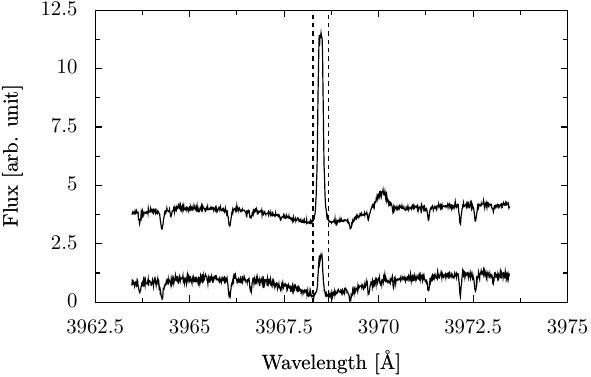 Figure 1
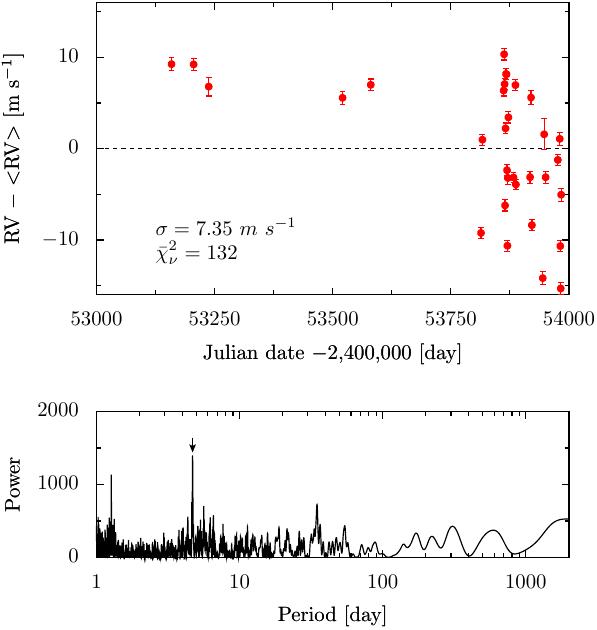 Figure 2
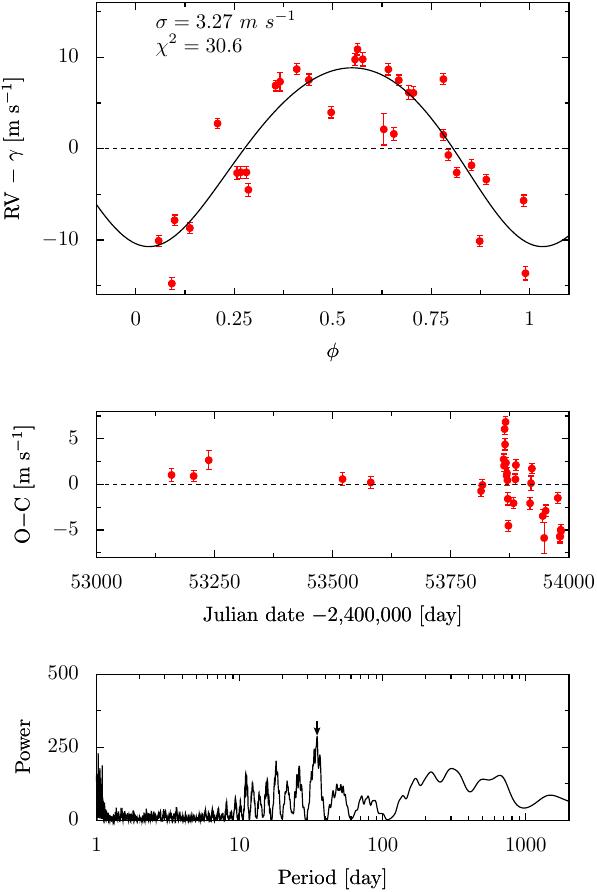 Figure 3
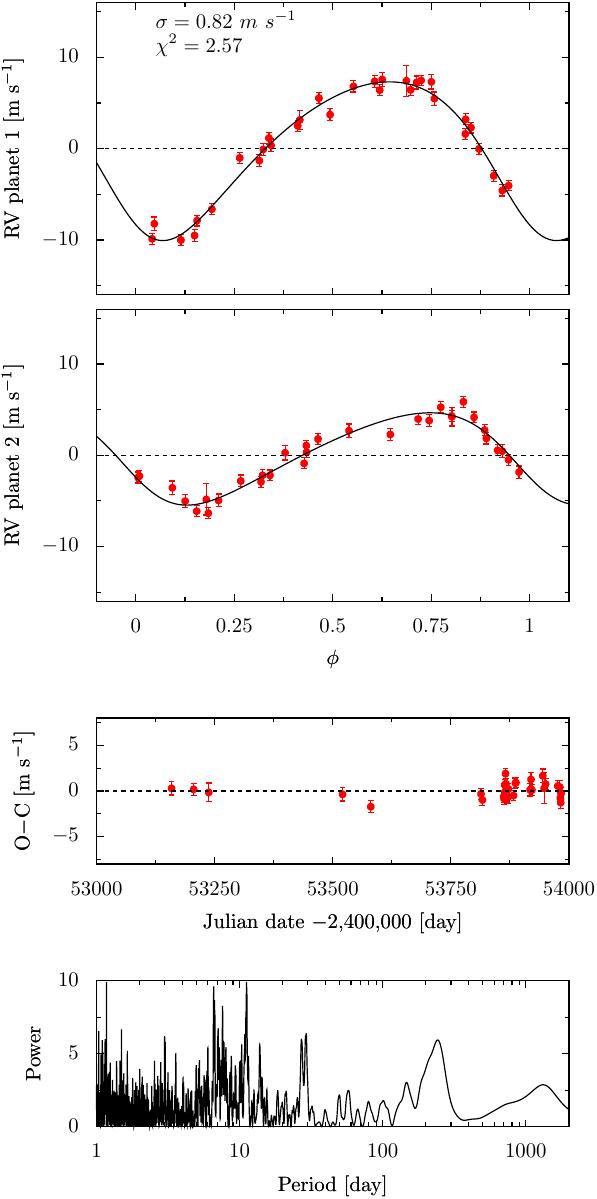 Figure 4
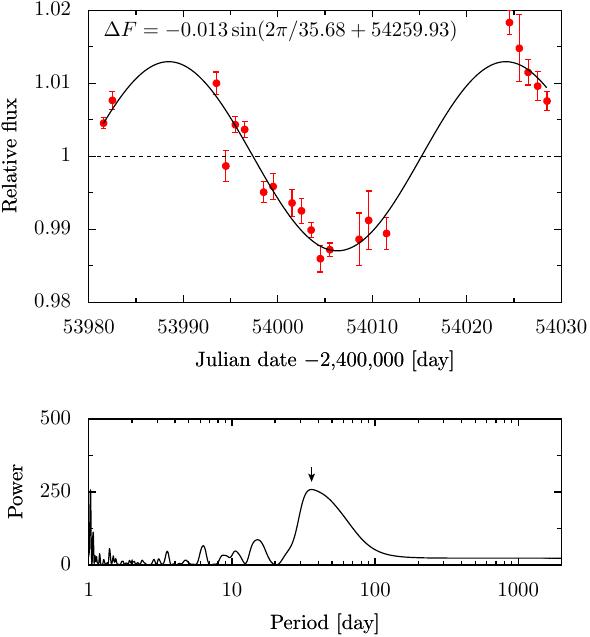 Figure 5
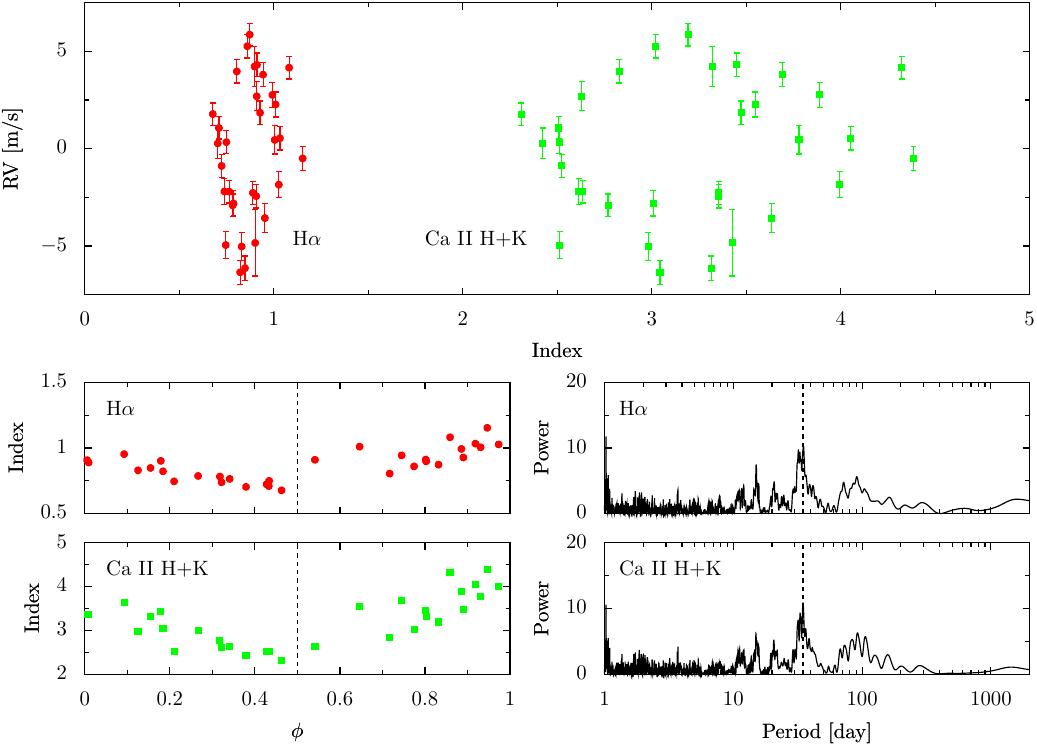 Figure 6
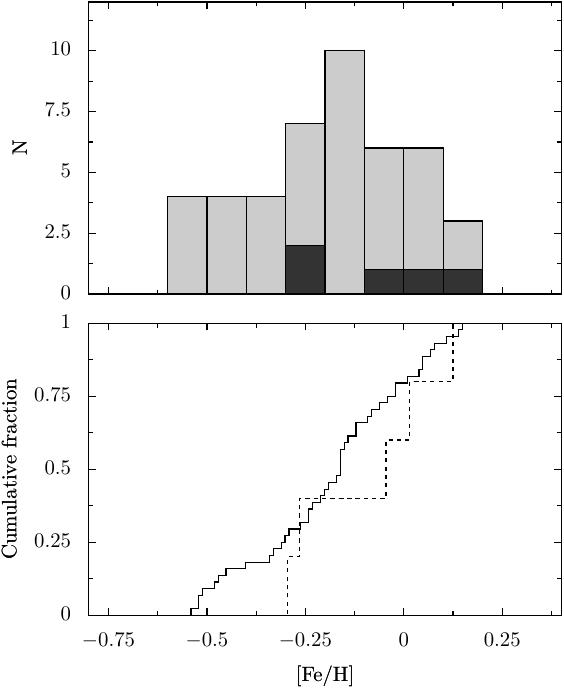 Figure 7
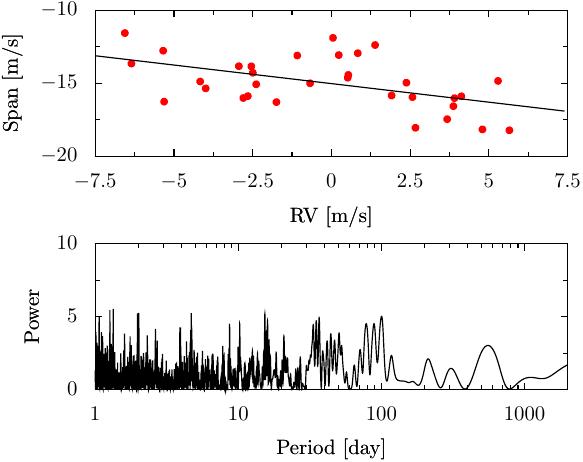 Figure 8
| Parameter | GJ 674 | |
| Spectral Type | M2.5 | |
| V | ||
| [mas] | ||
| Distance | [pc] | |
| K | ||
| [] | ||
| [km s-1] | ||
| [m s-1yr-1] | 0.115 | |
| [] | ||
| age | [Gyr] | 0.1-1 |
| [K] | 3500-3700 | |
| Parameter | GJ 674b | Spot | |||
| [days] | 4.6938 | 0.007 | 34.8467 | 0.0324 | |
| [JD] | 2453780.085 | 0.078 | 2453767.13 | 0.92 | |
| 0.20 | 0.02 | 0.20 | 0.05 | ||
| [deg] | 143 | 6 | 113 | 9 | |
| [m s-1] | 8.70 | 0.19 | 5.06 | 0.19 | |
| [AU] | 3.68 10-6 | 1.59 10-5 | |||
| [M⊙] | 3.0 10-13 | 4.4 10-13 | |||
| [] | 11.09 | 12.58 | |||
| [AU] | 0.039 | 0.147 | |||
Peer Reviews
No public reviews on file for this paper yet. If you reviewed it on a platform where reviews are public (OpenReview, ICLR, NeurIPS, ICML), you can paste yours below so the community can read it here.
Videos
No videos yet. Explain this paper in a talk, walkthrough, or lecture? Add one.
11institutetext: Centro de Astronomia e Astrofísica da Universidade de Lisboa, Observatório Astronómico de Lisboa, Tapada da Ajuda, 1349-018 Lisboa, Portugal 11email: [email protected] 22institutetext: Observatoire de Genève, 51 ch. des Maillettes, CH-1290 Sauverny, Switzerland 33institutetext: Laboratoire d’Astrophysique, Observatoire de Grenoble, BP 53, F-38041 Grenoble, Cedex 9, France 44institutetext: Institut d’Astrophysique de Paris, CNRS, Université Pierre et Marie Curie, 98bis Bd Arago, 75014 Paris, France 55institutetext: Centro de Geofisica de Évora, Rua Romão Ramalho 59, 7002-554 Évora, Portugal 66institutetext: Service d’Aéronomie du CNRS, BP 3, 91371 Verrières-le-Buisson, France
The HARPS search for southern extra-solar planets††thanks: Based on observations made with the HARPS instrument on the ESO 3.6 m telescope under the GTO program ID 072.C-0488 at Cerro La Silla (Chile).
X. A planet around the nearby spotted M dwarf GJ~674
X. Bonfils 11
M. Mayor 22
X. Delfosse 33
T. Forveille 33
M. Gillon 22
C. Perrier 33
S. Udry 22
F. Bouchy 44
C. Lovis 22
F. Pepe 22
D. Queloz 22
N. C. Santos 112255
J.-L. Bertaux 66
(Received January 09, 2007; accepted xxxx xx, 2007)
Abstract
*Context. *How planet properties depend on stellar mass is a key diagnostic of planetary formation mechanisms.
*Aims. *This motivates planet searches around stars which are significantly more massive or less massive than the Sun, and in particular our radial velocity search for planets around very-low mass stars.
*Methods. * As part of that program, we obtained measurements of GJ~674, an M2.5 dwarf at d=4.5 pc, which have a dispersion much in excess of their internal errors. An intensive observing campaign demonstrates that the excess dispersion is due to two superimposed coherent signals, with periods of 4.69 and 35 days.
*Results. *These data are well described by a 2-planet
Keplerian model where each planet has a
11 M minimum mass. A careful analysis of
the (low level) magnetic activity of
GJ674 however demonstrates that the 35-day
period coincides with the stellar rotation period.
This signal therefore originates in a spot inhomogeneity
modulated by stellar rotation. The 4.69-day signal on the
other hand is caused by a bona-fide planet,
GJ674b.
*Conclusions. *Its detection adds to the growing number of Neptune-mass planets around M-dwarfs, and reinforces the emerging conclusion that this mass domain is much more populated than the jovian mass range. We discuss the metallicity distributions of M dwarf with and without planets and find a low 11% probability that they are drawn from the same parent distribution. Moreover, we find tentative evidence that the host star metallicity correlates with the total mass of their planetary system.
Key Words.:
**stars: individual: GJ~674 – stars: planetary systems – stars: late-type – technique: radial-velocity **
††offprints: X. Bonfils
1 Introduction
M dwarfs, the most common stars in our Galaxy, were added to the target lists of planet-search programs soon after the first exoplanet discoveries. Compared to Sun-like stars, they suffer from some drawbacks: they are faint and photon noise therefore often limits measurements of their radial velocity, and many are at least moderately active and thus prone to so-called “radial-velocity jitter” (Saar & Donahue 1997). On the other hand, the smaller masses of M dwarfs result in a higher wobble amplitude for a given planetary mass, and their p-mode oscillations have both smaller amplitudes and shorter periods than those of solar type stars. These oscillations therefore average out much faster. As a result, the detection of an Earth-like planet in the – closer – habitable zone of an M dwarf is actually within reach of today’s best spectrographes. Perhaps most importantly, however, M dwarfs represent unique targets to probe the dependance on stellar mass of planetary formation, thanks to the wide mass range (0.1 to 0.6) spanned by that spectral class alone.
The first planet found to orbit an M dwarf, GJ 876b (Delfosse et al. 1998; Marcy et al. 1998), was only the 9th exoplanet discovered around a main sequence star. Besides showing that Jupiter-mass planets can form at all around very-low-mass stars, its discovery suggested that they might be common, since it was found amongst the few dozen M dwarfs that were observed at that time. Against these early expectations, no other M dwarf was reported to host a planet until 2004, though a second planet (GJ 876c, – Marcy et al. 2001) was soon found around GJ 876 itself.
In 2004, the continuous improvement of the radial-velocity techniques resulted in the quasi-simultaneous discovery of three Neptune-mass planets, around Ara ( – Santos et al. 2004), Cnc ( – McArthur et al. 2004) and GJ 436 ( – Butler et al. 2004; Maness et al. 2006). Of those three, GJ 436b, orbits an M dwarf, and put that spectral class back on the discovery forefront. It was soon followed by another two, a single planet around GJ 581 ( – Bonfils et al. 2005b) and a very light () third planet in the GJ 876 system (Rivera et al. 2005). As a result, planets around M dwarfs today represent a substantial fraction (30%) of all known planets with .
Even with GJ 849b ( – Butler et al. 2006) now completing the inventory of M-dwarf planets found with radial-velocity techniques, the upper-range of planet masses remains scarcely populated. This contrasts both with the (still very incompletely known) Neptune-mass planets orbiting M dwarfs and with the jovian planets around Sun-like stars. At larger separations, microlensing surveys similarly probe the frequency of planets as a function of their mass. That technique has detected four putative planets that likely orbit M dwarfs: OGLE235-MOA53b ( – Bond et al. 2004), OGLE-05-071Lb ( – Udalski et al. 2005), OGLE-05-390Lb ( – Beaulieu et al. 2006) and OGLE-05-169Lb ( – Gould et al. 2006). Two of these four planets have likely masses below 0.1 MJup . Given the detection bias of that technique towards massive companions, this again suggests that Neptune-mass planets are much more common than Jupiter-mass ones around very-low-mass stars.
Here we report the discovery of a 11 M planet orbiting GJ674 every 4.69 days. GJ674b
has the 5th lowest mass of the known planets, and coincidentally is also
the 5th planetary system centered on a M dwarf. Its detection
adds to the small inventory of both very-low mass planets and planets
around very-low mass stars. After reviewing the properties of
the GJ 674 star (§2), we briefly present
our radial velocity measurements (§3) and
their Keplerian analysis (§4). A careful
analysis of the magnetic activity of GJ 674
(§5) assigns one of the two periodicities
to rotational modulation of a stellar spot signal, and
the other one to a bona fide planet. We
conclude with a brief discussion of the properties of the
detected planet.
2 The properties of GJ~674
GJ~674 (HIP 85523, LHS 449) is a M2.5 dwarf (Hawley et al. 1997) in the Altar constellation. At ( – ESA 1997), it is the 37th closest stellar system, the 54th closest star (taking stellar multiplicity into account)111on Mar. 1st 2007 (http://www.chara.gsu.edu/RECONS/TOP100.htm), and only the 2nd closest known planetary system (after Eridani, and slightly closer than GJ 876).
Its photometry (; – Turon et al. 1993; Cutri et al. 2003) and parallax imply absolute magnitudes of and . GJ 674’s color ( – Cutri et al. 2003) and the Leggett et al. (2001) colour-bolometric relation result in a K-band bolometric correction of , and in a 0.016 L luminosity.
The K-band mass-luminosity relation of Delfosse et al. (2000) gives a mass and the Bonfils et al. (2005a) photometric calibration of the metallicity results in .
The moderate X-ray luminosity ( – Hünsch et al. 1999) and Ca ii H & K emission depict a modestly active M dwarf (Fig. 1). Its UVW galactic velocities place GJ~674 between the young and old disk populations (Leggett 1992), suggesting an age of .
Last but not least, since we are concerned with radial velocities, the high proper motion of GJ~674 ( – ESA 1997) changes the orientation of its velocity vector along the line-of-sight (e.g. Kürster et al. 2003) to result in an apparent secular acceleration of . At our current precision this acceleration will not be detectable before another decade.
3 Radial-velocity data
We observed GJ~674 with the HARPS echelle spectrograph (Mayor et al. 2003) mounted on the ESO 3.6-m telescope at La Silla Observatory (Chile). After demonstrating impressive planet finding capabilities right after its commissioning (Pepe et al. 2004), this spectrograph now defines the state of the art in radial-velocity measurements, delivering a significantly better precision than its ambitious specification. As one recent published example, Lovis et al. (2006a) obtained a dispersion for the residuals of their orbital solution of the 3 Neptune-mass planets of HD 69830.
We observed GJ~674 without interlaced Thorium-Argon light to obtain cleaner spectra for spectroscopic analysis, at some small cost in the ultimate Doppler precision. Since June 2004 we have gathered 32 exposures of 900 s each with a median S/N ratio of . Their Doppler information content, evaluated according to the prescriptions of Bouchy et al. (2001), is mostly below 1 . Our internal errors additionally include, in quadrature sum, an “instrumental” uncertainty of for the nightly drift of the spectrograph (since we do not use the ThAr lamp to monitor it) and the measurements uncertainty of the daily wavelength zero point calibration. We did benefit of the recent improvements of the HARPS wavelength calibration, which is now stable to (Lovis et al. 2006b).
A constant radial velocity gives a very large reduced chi-square () for the time series, which reflects a dispersion () well above our internal errors (Fig. 2). This prompted a search for an orbital (§4) and/or magnetic activity (§5) signal.
4 Orbital analysis
A Lomb-Scargle periodogram (Press et al. 1992) of the velocity measurements shows a narrow peak around 4.69-day (Fig. 2). Adjustment of a single Keplerian orbit demonstrates that it is best described by a 12.7 M planet () revolving around GJ~674 every days in a slightly eccentric orbit (). The residuals around this low-amplitude orbit () have a dispersion of 3.27 (Fig. 3), still well above our measurement errors, and the reduced chi-square per degree of freedom is . A periodogram of the residuals indicates that much of this excess dispersion stems from a broad power peak centered around 35 days, prompting us to perform a 2-planet fit.
We searched for 2-planet Keplerian solutions with Stakanof (Tamuz, in prep.), a program which uses genetic algorithms to efficiently explore the large parameter space of multi-planet models. Stakanof quickly converged to a 2-planet solution that describes our measurements much better than the single planet fit (, per degree of freedom – Fig. 4). The orbital parameters of the 4.69-day planet change little from the 1-planet fit, except for the eccentricity which increases to . Its mass is revised down to , and the period hardly changes, day. The second planet would have a day period, an eccentricity and a minimum mass of . Such periods would correspond to semi-major axes of 0.04 and 0.15 AU. Those are sufficiently disjoint that mutual interactions can be neglected over observable time scales, and that the system would be stable over longer time scales.
The low dispersion around the solution and the lack of any significant peak in the Lomb-Scargle periodogram of its residuals shows that our current radial-velocity measurements contain no evidence for an additional component.
5 Activity analysis
Apparent Doppler shifts unfortunately do not always originate
in the gravitational pull of a companion: in a rotating
star, stellar surface inhomogeneities such as plages and
spots can break the exact balance between light emitted in
the red-shifted and blue-shifted halves of the star. Observationally,
these inhomogeneities translate into flux variations as well
as into changes of both the shape and the centroid of spectral lines
(Saar & Donahue 1997; Queloz et al. 2001). Spots typically also impact spectral
indices, whether designed to probe the chromosphere (to
which photospheric spots have strong magnetic connections), or
the photosphere (because spots have cooler spectra). Of the
two candidate periods, the 4.69-day one is unlikely to reflect
stellar rotation. We measure from our GJ674 spectra
a rotational velocity of ,
which would need a rather unprobable stellar inclination
() to match such a short period.
The moderate activity level of GJ674 on the other
hand leaves the nature of the second signal a priori
uncertain, and the very small rotation velocity removes
much of the power of the usual bisector test
(Appendix A). We therefore investigated
its magnetic activity through photometric observations
(§5.1) and detailed examination of the
chromospheric features in the clean HARPS spectra
(§5.2).
5.1 Photometric variability
We obtained photometric measurements with
the CCD camera of the Euler Telescope (La Silla)
during 21 nights between September 2nd and October
19th 2006. GJ674 was observed through a VG filter
which, amongst the available filters, optimizes the
flux ratio between GJ674 and its two brightest
reference stars. This relatively blue filters also
happens to have good sensitivity to spots on cool stars
such as GJ~674. To minimize atmospheric scintillation
noise we took advantage of the low stellar density to
defocus the images to FWHM , so that we could use
longer exposure times. The increased read-out and sky
background noises from the larger synthetic aperture which
we then had to use remain negligible compared to both
stellar photon noise and scintillation.
We gathered 14 to 75 images per night with a
median exposure time of 20 seconds. We used the
Sept. 24th data, which have the longest nightly
time base,
to tune the parameters of the Iraf Daophot
package and optimize the set of reference stars
(HD 157931, CD 4611534 and
7 anonymous fainter stars) to minimize the
dispersion in the GJ674 photometry for
that night. These parameters were then fixed for
the analysis of the full data set. The nightly
light curves for GJ674 were normalized by
that of the sum of the references, clipped at
3- to remove a small number of outliers,
and averaged to one measurement per night to examine
the long term photometric variability of GJ674.
GJ674 clearly varies with a 1.3% amplitude,
and a (quasi-)period close to 35 days
(Fig. 5). To verify that this variability
does not actually originate in one of the reference stars,
we repeated the analysis alternately using as
reference star HD 157931 alone and the average
of the 8 other references. Both light curves are very
similar to Fig. 5.
The photometric observations are consistent with the signal of a single spot, within the limitations of their incomplete phase coverage: the variations are approximately sinusoidal, and their 0.2-0.3 radian phase shift from the corresponding radial velocity signal closely matches the difference expected for a spot. The spot would cover 2.6% of the stellar surface if completely dark, corresponding to a radius for a circular spot.
5.2 Variability of the spectroscopic indices
The emission reversal in the core of the Ca ii H&K resonant lines results from non-radiative heating of the chromosphere, which is closely coupled to spots and plages through magnetic connections between the photosphere and chromosphere. The H line is similarly sensitive to chromospheric activity. We measured these chromospheric spectral features results in the clean HARPS spectra used to measure the radial velocities, and examine their variability.
Like the well known Mt. Wilson S index (Baliunas et al. 1995), our Ca ii HK index is defined as:
[TABLE]
with and sampling the two lines of the Ca ii doublet, and and the continuum on both sides of the doublet. Our and intervals are 31 wide and centered on 3933.664 and 3968.47 Å, while and are respectively integrated over [3952.6, 3956 Å] and [3974.8, 3976 Å].
This HK index varies with a clear period of 34.8 days (Fig. 6). Within the combined errors this is consistent with both the photometric period and the longer radial velocity period. The phasing of the chromospheric index and the photometry is such that lower photometric flux matches higher Ca ii emission, as expected if active chromospheric regions hover over photospheric spots.
A plot of the (apparent) radial-velocity as a function of the HK spectral index similarly shows the characteristic loop pattern expected for a spot. The radial velocity effect of a spot cancels out when it crosses the sub-observer meridian, which occurs twice during a rotation period: once on the hemisphere facing the observer, and once on the opposite hemisphere. During the front-facing crossing the spot has maximal projected area, hence maximal chromospheric emission, while it has a minimal projected area (and is possibly hidden, depending on its latitude and the stellar inclination) during the back-facing crossing. As a result, both extrema of the chromospheric index correspond to radial-velocity zero-crossings. At intermediate phases the spot produces intermediate chromospheric emission levels, and it induces positive (respectively negative) radial-velocity shifts when the masked area is on the rotationally blue- (respectively red-shifted) half of the star. The net result in a plot of chromospheric emission as a function of radial velocity is a closed loop.
Chromospheric filling-in of photospheric H absorption has similarly been found a powerful activity diagnostic for M dwarfs. Kürster et al. (2003) found that in Barnard’s star it correlates linearly with the radial-velocity variations, and interpreted that finding as evidence that active plage regions inhibit the convective velocity field. The variation pattern in GJ~674 definitely differs from a linear correlation between H and the radial-velocity residuals, and needs a different explanation.
Similarly to Kürster et al. (2003) we define our H index as:
[TABLE]
with sampling the H line, and and the continuum on both sides of the line. Our interval is 31 wide and centered on 6562.808 Å, while and are respectively integrated over [6545.495, 6556.245 Å] and [6575.934, 6584.684 Å]. The H index behaves similarly to the Ca ii H+K index.
The chromospheric indices vary by factors of 2 and 1.3 (for our specific choices of continuum windows), and are thus much more contrasted than the photometry. They do not however vary as smoothly with phase as the photometry, perhaps due to (micro-)flares. This somewhat reduces their value as diagnostics of spot-induced radial velocity variations, but these measurements on the other hand require no new observation. They undoubtedly reinforce the spot interpretation here, and they will be extremely useful in cases where photometry cannot be immediately obtained.
5.3 Planets vs. activity
In §4 we showed that our 32
radial-velocity measurements of GJ674 are
well described by two Keplerian signals, as
illustrated by the low reduced chi-square of that
model. The above analysis (§5)
however demonstrates that the rotation period of
GJ 674 coincides with the longer of the
two Keplerian periods. Both the stellar flux and
the Ca ii HK emission vary with that
period, implying that the surface of GJ674
has a magnetic spot. This spot must induce
radial-velocity changes, with the observed phase
relative to the photometric signal. As a consequence,
some, and probably all, of the 35-day radial-velocity signal
must originate in the spot. Planet-induced activity
through magnetic coupling (e.g. Shkolnik et al. 2005)
would in principle be an alternative explanation of
the correlation, but here it is not a very attractive
one: the inner planet is at least as massive as the
hypothetical 35-day planet, and would, at least
naively, be expected to have stronger interactions
with the magnetosphere of GJ 674. The
4.69-day period however is only seen in the radial velocity
signal, and it has no photometric or chromospheric
counterpart.
6 Discussion
6.1 Characteristics of GJ~674b
Perhaps the most important result of the above analysis is that the 4.69-day planet of GJ~674 is robust: variability identifies the stellar rotation period as 35 days, and the 4.69-day period therefore cannot reflect rotation modulation. The short period signal, in spite of its larger amplitude, also has no counterpart in either photometry or chromospheric emission, further excluding a signal caused by magnetic activity.
The 1-planet fit, which effectively treats the activity signal as white noise, results in a minimum mass for GJ~674b of . The 2-planet fit by contrast filters out this signal. That filtering obviously uses a physical model which is not completely appropriate, but that remains preferable to handling a (partly) coherent signal as white noise. We therefore adopt the corresponding estimate of the minimum mass, .
At 0.039 AU from its parent star, the temperature
of GJ674b is 450 K. Planets above a few
Earth masses planets can, but need not, accrete a large
gas fraction, leaving its composition – mostly gaseous or
mostly rocky – unclear. The orbital eccentricity might
shed light on the structure of GJ674b, if confirmed
by additional measurements: rocky and gaseous planets have
rather different dissipation properties, and significant
eccentricity at the short period of GJ674~b
needs a high Q factor, unless it is pumped by an additional
planet at a longer period (e.g. Adams & Laughlin 2006). For
now, the stellar activity leaves the statistical significance
of the eccentricity slightly uncertain, and we therefore
prefer to stay clear from overinterpreting it.
6.2 Properties of M-dwarf planets
One important motivation in searching for planets around M dwarfs is to investigate whether the planet-metallicity correlation found for Jupiter-mass planets around solar-type stars extends to very-low-mass stars. Our photometric calibration of M dwarfs metallicity (Bonfils et al. 2005b) gives respective metallicities of [Fe/H]=, , , , and for GJ 436, GJ 581, GJ 849, GJ 876 and GJ~674. M dwarfs with known planets therefore have an average metallicity of and a median of . By comparison, the 44 M dwarfs of the Bonfils et al. (2005b) volume limited sample which are not currently known to host a planet have average and median metallicities of and . M dwarfs with planets therefore appear slightly more metal-rich than M dwarfs without planets. A Kolmogorov-Smirnov test (Press et al. 1992) of the two samples gives an 11% probability that they are drawn from the same distribution. The significance of the discrepancy is therefore still modest, limited by small-number statistics.
One can additionally note that the two stars which host giant planets, GJ 876 and GJ 849, occupy the metal-rich tail of the M dwarf metallicity distribution, with GJ 849 almost as metal-rich as the most metal-rich star of the comparison sample. The next most metal-rich of the M dwarfs with planets, GJ 436, has an additional long-period companion (P6 yr) which might well be a giant planet (Maness et al. 2006) and would then strengthen that trend. If confirmed by additional data, this would validate the theoretical predictions (Ida & Lin 2004; Benz et al. 2006) that only Jovian-mass planets are more likely to form around metal-rich stars. Current observations are consistent with this prediction, but not yet very conclusively so (Udry et al. 2006).
Much recent theoretical work has gone into examining how planet formation depends on stellar mass. Within the “core accretion” paradigm, Laughlin et al. (2004) and Ida & Lin (2005) predict that giant planet formation is inhibited around very-low-mass stars, while Neptune-mass planets should inversely be common. Within the same paradigm, but assuming that M dwarfs have denser protoplanetary disks, Kornet et al. (2006) predict instead that Jupiter-mass planets become more frequent in inverse proportion to the stellar mass. Finally, Boss (2006) examines how planet formation depends on stellar mass for planets formed by disk instability, and concludes that frequency of Jupiter-mass planet is independent of stellar mass, as long as disks are massive enough to become unstable.
To date, none of the 300 M dwarfs scrutinized for planets by the various radial-velocity searches (Bonfils et al. 2006; Endl et al. 2006; Butler et al. 2006) has been found to host a hot Jupiter. Conversely, GJ~674b is already the 4th hot Neptune. Though that cannot be established quantitatively yet, these surveys are likely to be almost complete for hot Jupiters, which are easily detected. Hot Neptune detection, on the other hand, is definitely highly incomplete. Setting aside this incompleteness for now, simple binomial statistics shows that the probability of finding no and 4 detections in 300 draws of the same function is only 3%. There is a thus 97% probability that hot Neptunes are more frequent than hot Jupiter around M dwarfs. Accounting for this detection bias in more realistic simulations (Bonfils et al. in prep.) obviously increases the significance of the difference. Planet statistics around M dwarfs therefore favor the theoretical models which, at short periods, predict more Neptune-mass planets than Jupiter-mass planets.
Acknowledgements.
We are grateful to the anonymous referee for constructive comments. XB and NCS acknowledge support from the Fundação para a Ciência e a Tecnologia (Portugal) in the form of fellowships (references SFRH/BPD/21710/2005 and SFRH/BPD/8116/2002) and a grant (reference POCI/CTE-AST/56453/2004). The photometric monitoring has been performed on the EULER 1.2 meter telescope at La Silla Observatory. We are grateful to the SNF (Switzerland) for its continuous support. This research has made use of the SIMBAD database, operated at CDS, Strasbourg, France.
Appendix A Bisector analysis
As demonstrated by Saar & Donahue (1997) the bisector analysis loses much of its diagnostic power when applied to slow rotators. In simulations of the impact of star spots on radial-velocity and bisector measurements, they found that, for a given spot configuration, the radial velocity varies linearly with while the bisector span varies as . The bisector signal therefore decreases faster with decreasing rotational velocities than the radial-velocity signal, and disappears faster in measurement noise. For GJ 674 we measure a very low rotation velocity (). It is therefore unsurprising that the correlation between the bisector span and radial velocity is weak (Fig. 8) and not statistically significant.
The reference list from the paper itself. Each links out to its DOI / PubMed record.
- 1Adams & Laughlin (2006) Adams, F. C. & Laughlin, G. 2006, Ap J, 649, 1004
- 2Baliunas et al. (1995) Baliunas, S. L., Donahue, R. A., Soon, W. H., et al. 1995, Ap J, 438, 269
- 3Beaulieu et al. (2006) Beaulieu, J.-P., Bennett, D. P., Fouqué, P., et al. 2006, Nature, 439, 437
- 4Benz et al. (2006) Benz, W., Mordasini, C., Alibert, Y., & Naef, D. 2006, in Tenth Anniversary of 51 Peg-b: Status of and prospects for hot Jupiter studies, ed. L. Arnold, F. Bouchy, & C. Moutou, 24–34
- 5Bond et al. (2004) Bond, I. A., Udalski, A., Jaroszyński, M., et al. 2004, Ap J, 606, L 155
- 6Bonfils et al. (2006) Bonfils, X., Delfosse, X., Udry, S., Forveille, T., & Naef, D. 2006, in Tenth Anniversary of 51 Peg-b: Status of and prospects for hot Jupiter studies, ed. L. Arnold, F. Bouchy, & C. Moutou, 111–118
- 7Bonfils et al. (2005 a) Bonfils, X., Delfosse, X., Udry, S., et al. 2005 a, A&A, 442, 635
- 8Bonfils et al. (2005 b) Bonfils, X., Forveille, T., Delfosse, X., et al. 2005 b, A&A, 443, L 15