Supernova Polarization and the Type IIn Classification
Jennifer L. Hoffman

TL;DR
This paper explores the polarization properties of Type IIn supernovae, revealing their heterogeneity and potential for subclassification based on spectropolarimetric signatures and circumstellar material characteristics.
Contribution
It introduces the variability in polarimetric features among SNe IIn and discusses how these differences relate to their classification and circumstellar environments.
Findings
Variety in polarimetric characteristics among SNe IIn.
Potential correlation between polarization signatures and circumstellar material.
Implications for subclassification of interacting supernovae.
Abstract
While the members of the Type IIn category of supernovae are united by the presence of strong multicomponent Balmer emission lines in their spectra, they are quite heterogeneous with respect to other properties such as Balmer line profiles, light curves, strength of radio emission, and intrinsic brightness. We are now beginning to see variety among SNe IIn in their polarimetric characteristics as well, some but not all of which may be due to inclination angle effects. The increasing number of known "hybrid" SNe with IIn-like emission lines suggests that circumstellar material may be more common around all types of SNe than previously thought. Investigation of the correlations between spectropolarimetric signatures and other IIn attributes will help us address the question of classification of "interacting SNe" and the possibility of distinguishing different groups within the diverse IIn…
Click any figure to enlarge with its caption.
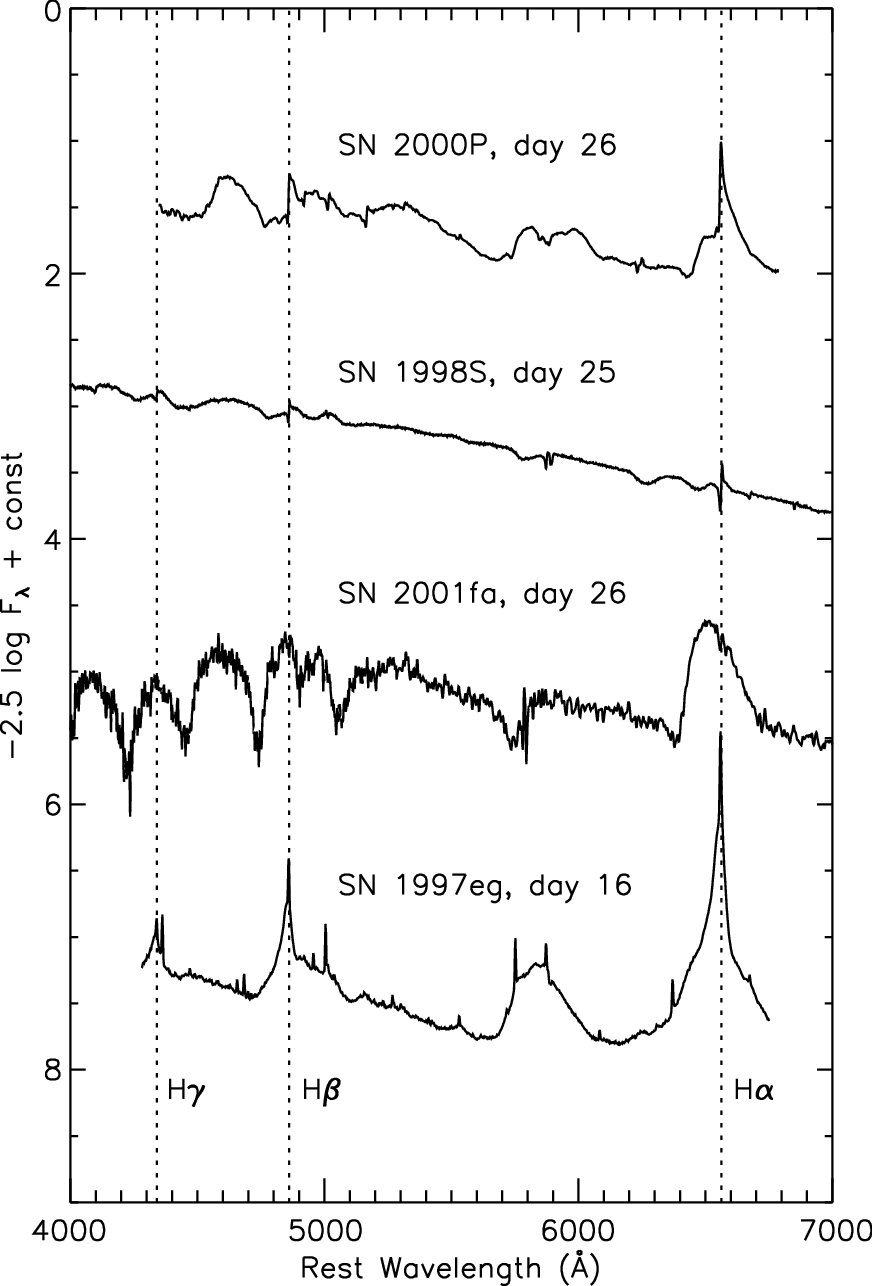 Figure 1
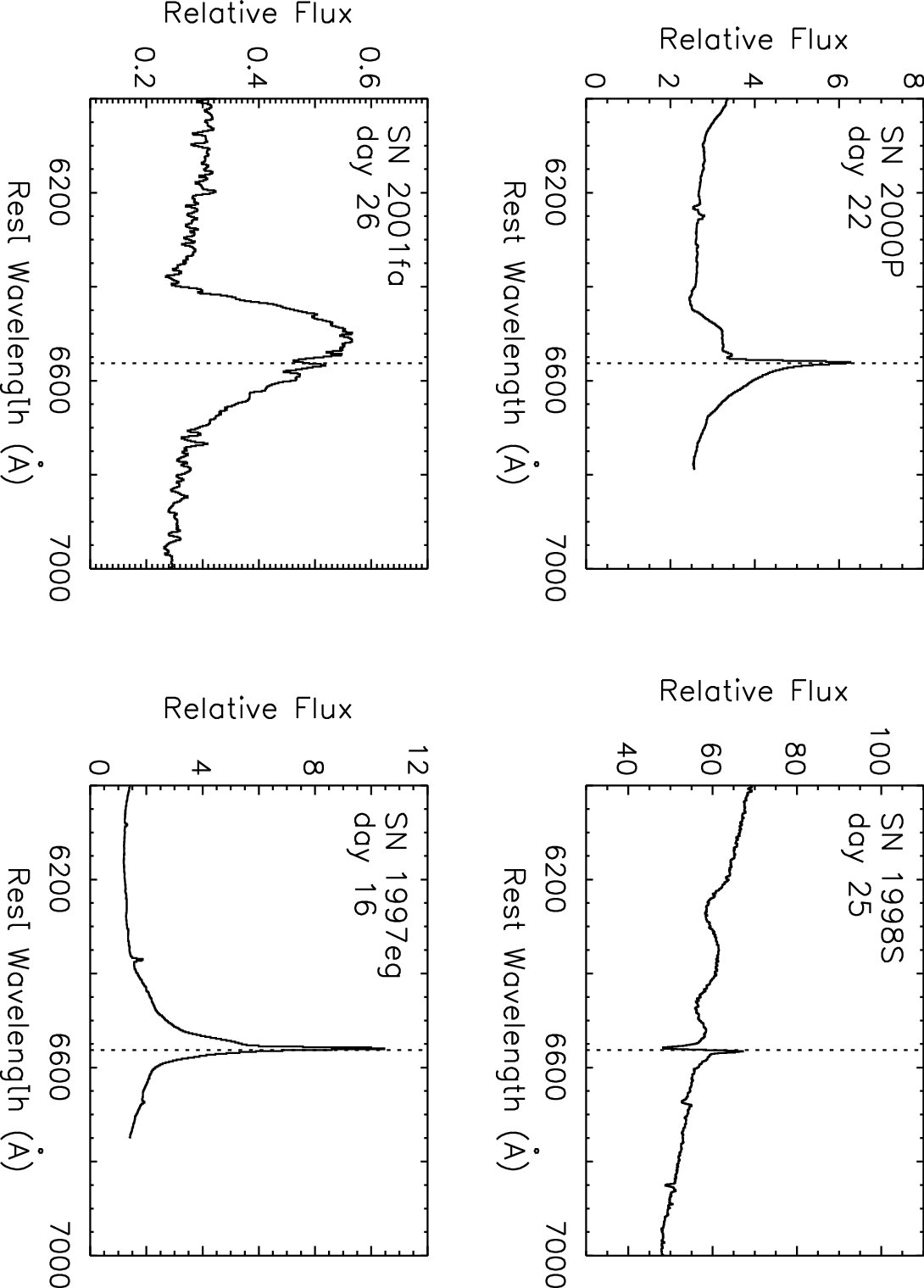 Figure 2
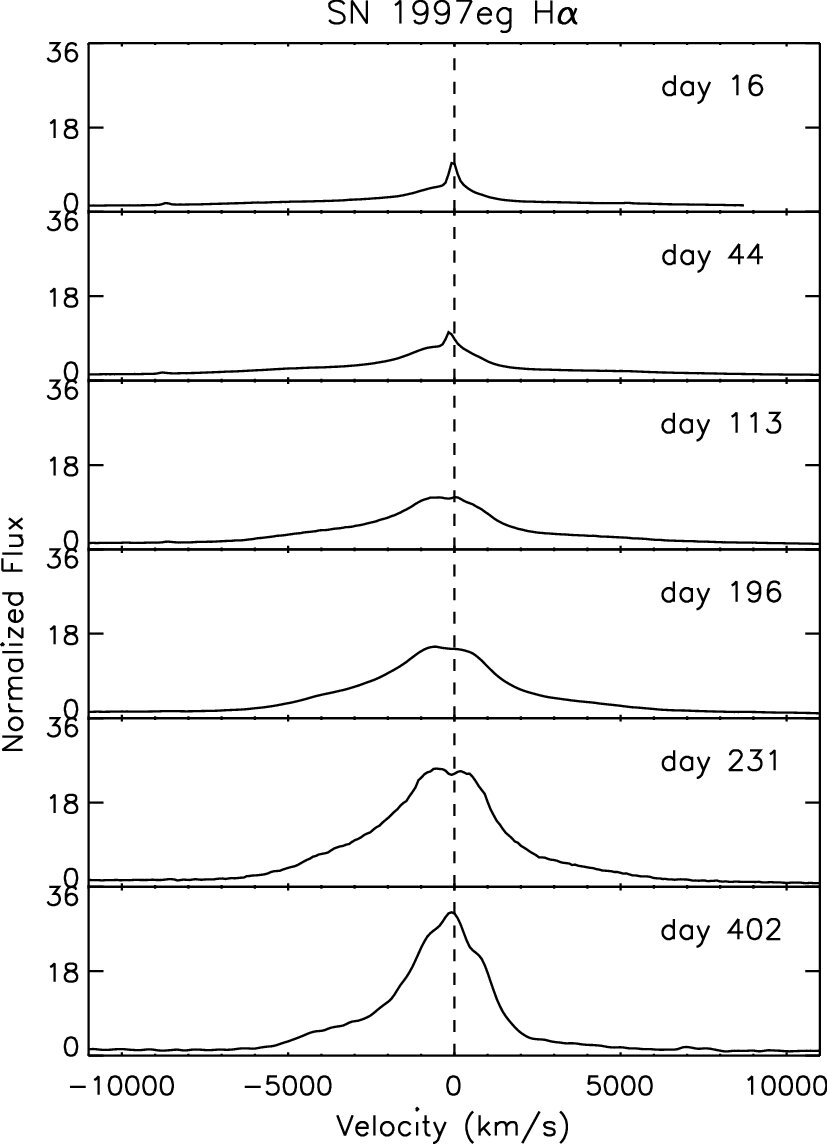 Figure 3
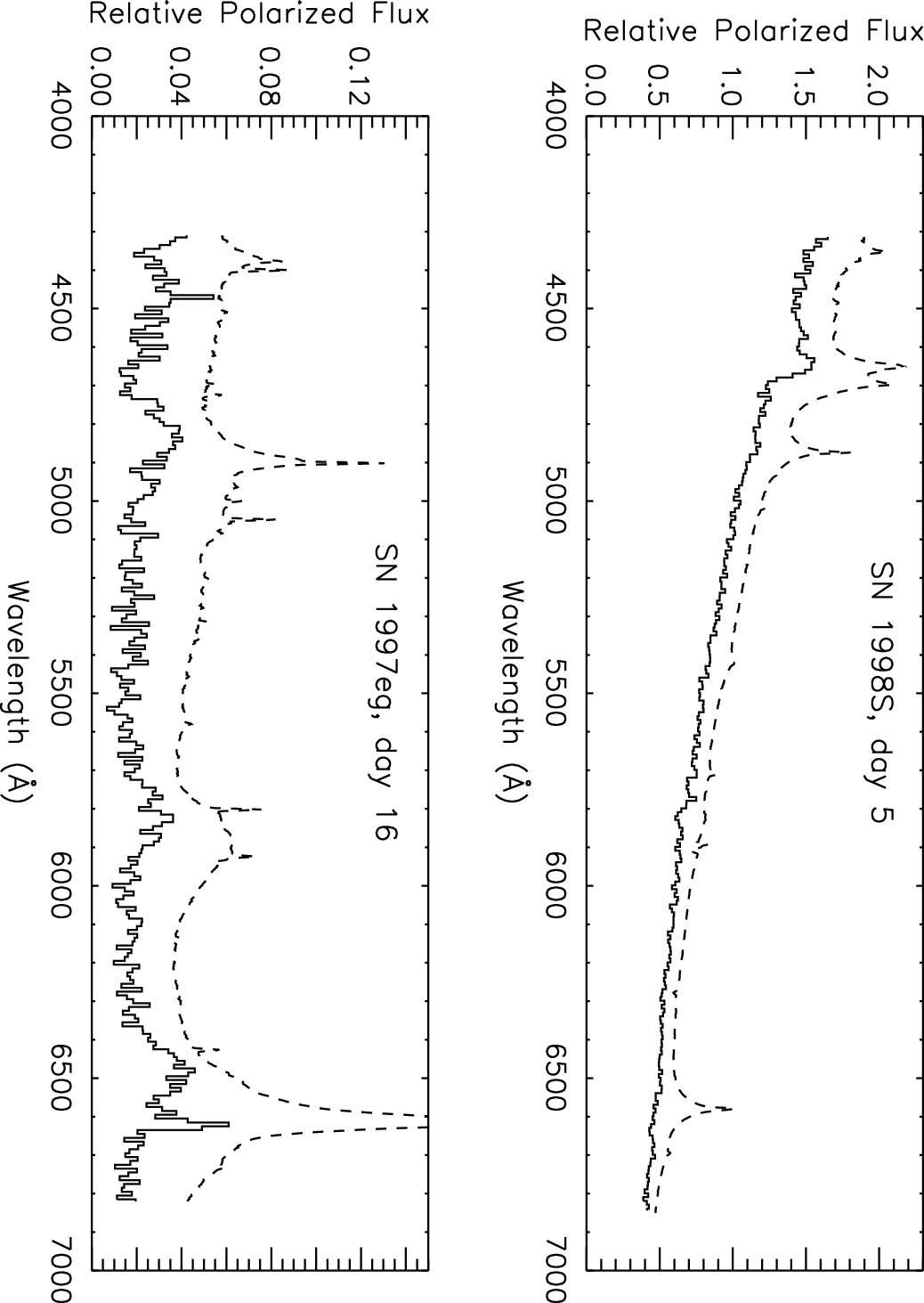 Figure 4
Peer Reviews
No public reviews on file for this paper yet. If you reviewed it on a platform where reviews are public (OpenReview, ICLR, NeurIPS, ICML), you can paste yours below so the community can read it here.
Videos
No videos yet. Explain this paper in a talk, walkthrough, or lecture? Add one.
Supernova Polarization
and the Type IIn Classification
Jennifer L. Hoffman
Abstract
While the members of the Type IIn category of supernovae are united by the presence of strong multicomponent Balmer emission lines in their spectra, they are quite heterogeneous with respect to other properties such as Balmer line profiles, light curves, strength of radio emission, and intrinsic brightness. We are now beginning to see variety among SNe IIn in their polarimetric characteristics as well, some but not all of which may be due to inclination angle effects. The increasing number of known “hybrid” SNe with IIn-like emission lines suggests that circumstellar material may be more common around all types of SNe than previously thought. Investigation of the correlations between spectropolarimetric signatures and other IIn attributes will help us address the question of classification of “interacting SNe” and the possibility of distinguishing different groups within the diverse IIn subclass.
Keywords:
supernovae, type IIn, supernova classification
:
97.60.Bw
Type IIn (“narrow-line”) supernovae (SNe IIn) are Type II events whose primary distinction is the existence of strong narrow hydrogen Balmer emission lines in the spectra (Schlegel, 1990; Filippenko, 1997). These lines indicate the presence of circumstellar material ejected by the progenitor star and excited by the UV and X-ray photons from the supernova explosion. The IIn subclass includes 2–5% of all Type II supernovae Cappellaro et al. (1997).
Turatto Turatto et al. (2003) categorized the SNe IIn as a special class of core-collapse supernovae related to the SNe Ib/c and hypernovae. However, in recent years several new discoveries have blurred the boundaries between the IIn category and other types of supernovae. It should be noted that since the label of IIn is assigned based on spectral characteristics, while that of II-L or II-P is based on features of the light curve, these three categories are not mutually exclusive, and some objects may be given more than one classification in the literature. But observations of “hybrid” supernovae such as SN 2002ic (Deng et al., 2004; Hamuy et al., 2003) and SN 2005gj Aldering et al. (2006), which showed IIn-like H lines superposed on type Ia-like spectra, and of “chameleon” supernovae such as SN 2001em (Soderberg et al., 2004; Chugai and Chevalier, 2006), which evolved from a Type Ic to a Type IIn over the span of a few years, suggest that not only SNe II but potentially all supernovae may show signatures of interaction with circumstellar material. Consequently, Turatto’s revised classification scheme Turatto (2007) includes a broad category of “interacting SNe” that spans all SN types and includes the SNe IIn.
The IIn category has always been heterogeneous, as noted by Filippenko Filippenko (1997), whose Figure 14 presented a non-coeval collection of SN IIn spectra. Figure 1 shows that even when compared at similar ages, SNe IIn have quite diverse spectral characteristics. The primary feature of SNe IIn spectra, the strong H emission line, also varies substantially in strength and profile between objects of comparable age (Figure 2) and even for a given object over time. In particular, the very narrow (FWHM ¡ 200 km/s) component of H does not necessarily exist at all times in the evolution of a SN IIn. In SN 1997eg (Figure 3; Hoffman et al. (2007)), this narrow H component disappeared after 100 days post-discovery, was replaced by a small symmetric absorption feature, and then reappeared around day 400. The H line in SN 1998S (Leonard et al. (2000); their Figure 7) also lost its narrow emission component early on, but was very asymmetric and changed much more dramatically over time.
Because of interaction with circumstellar material, the light curves of SNe IIn often decline quite slowly in comparison with other core-collapse objects, but not all members of the subclass show this slow decline Filippenko (1997). The canonical IIn SN 1988Z decreased in brightness by only 5 magnitudes in 1000 days Turatto et al. (1993), but others decline more quickly (e.g., SN 1998S; Fassia et al. (2000)). SN 1994W faded by 6 magnitudes in B in only 100 days Cumming and Lundqvist (1997).
Circumstellar interaction can also cause some SNe IIn to become strong radio and X-ray emitters; SN 1988Z and SN 1986J are among the brightest radio supernovae ever observed Chevalier et al. (2006). Nearly all the SNe IIn detected in X-rays have also been strong radio sources (van Dyk et al., 1996; Pooley et al., 2002). However, not all SNe IIn become radio-loud van Dyk et al. (1996), and there is considerable heterogeneity even among the “radio-quiet” subset Filippenko (1997). The overlap between the IIn, II-P, and II-L categories makes it difficult to identify trends in radio brightness with core-collapse subtype.
Finally, SNe IIn show considerable variety in their spectropolarimetric characteristics (Figure 4). Supernovae of all types are known to be polarized due to intrinsic asphericity of the ejecta. The circumstellar material surrounding SNe IIn can produce its own polarization signature in addition to that arising from the ejecta. Some of the polarization variations between SNe IIn are likely due to inclination; that is, they may have similar geometrical distributions of circumstellar material, but have different polarization signatures due to different viewing angles. To study this effect, I am constructing a grid of Monte Carlo radiative transfer models of the H line polarization produced by circumstellar matter distributions with various geometries and seen at various viewing angles Hoffman (2007). Preliminary results suggest that differences in viewing angle may account for some of the polarimetric variety in SNe IIn. However, such geometric effects cannot explain all of the IIn diversity; for example, the transformation of SN 2001em from a Ic into a IIn (Soderberg et al., 2004; Chugai and Chevalier, 2006) is very unlikely to be due to a sudden change in inclination!
These examples show that the IIn classification is currently something of a “catchall” for a number of related but distinct objects, all with close connections to Turatto’s Turatto (2007) new category of “interacting SNe”. Now that circumstellar interaction has been recognized to occur for a broad range of supernova types, and now that high-quality time-dependent data are more readily available, we are in a good position to reconsider the categorization of SNe IIn and other interacting supernovae. An initiative underway within the Berkeley supernova group will quantify the spectral and spectropolarimetric characteristics of SNe IIn and search for correlations between these features and other properties such as light curve shape and radio/X-ray behavior. If found, such correlations will illuminate the relationships between diverse members of the IIn category and perhaps ultimately argue for the category’s subdivision.
In the future, full understanding and correct classification of these important objects will depend critically on obtaining a broad range of observational information, including multiwavelength and polarimetric data, with as much time coverage as possible. In addition, supernova researchers should expand their collaborations with the evolved star community. If the circumstellar media around SNe IIn and related objects are indeed created by winds and outflows from massive stars, we can use nearby evolved star nebulae as analogous cases to the circumstellar envelopes of supernovae. Such an effort could greatly improve our understanding of supernova progenitors and help shed light on the physical causes of the diversity we observe among interacting supernovae.
This research was funded by an NSF Astronomy & Astrophysics Postdoctoral Fellowship, AST-0302123; by NSF grant AST-0607485 to A. V. Filippenko; and by the National Energy Research Scientific Computing Center, US DOE Contract #DE-AC03-76SF00098. I thank Alex Filippenko at UC Berkeley and Peter Nugent at the Lawrence Berkeley Laboratory for their support and invaluable contributions.
The reference list from the paper itself. Each links out to its DOI / PubMed record.
- 1Schlegel (1990) E. M. Schlegel, MNRAS 244 , 269 (1990).
- 2Filippenko (1997) A. V. Filippenko, ARAA 35 , 309 (1997).
- 3Cappellaro et al. (1997) E. Cappellaro, M. Turatto, D. Y. Tsvetkov, et al., A&A 322 , 431 (1997).
- 4Turatto et al. (2003) M. Turatto, S. Benetti, and E. Cappellaro, “Variety in Supernovae,” in From Twilight to Highlight: The Physics of Supernovae , Springer, Berlin, 2003, p. 200.
- 5Deng et al. (2004) J. Deng, K. S. Kawabata, Y. Ohyama, et al., Ap J 605 , L 37 (2004).
- 6Hamuy et al. (2003) M. Hamuy, M. M. Phillips, N. B. Suntzeff, et al., Nature 424 , 651 (2003).
- 7Aldering et al. (2006) G. Aldering, P. Antilogus, S. Bailey, et al., Ap J 650 , 510 (2006).
- 8Soderberg et al. (2004) A. M. Soderberg, A. Gal-Yam, and S. R. Kulkarni, GCN 2586 , 1 (2004).