Einstein vs Maxwell: Is gravitation a curvature of space, a field in flat space, or both?
Theo M. Nieuwenhuizen

TL;DR
This paper explores whether gravitation is best described as space curvature, a field in flat space, or both, by deriving gravitational energy tensors and analyzing cosmological and black hole solutions within different frameworks.
Contribution
It presents a field theoretic derivation of gravitational energy in Minkowski space and examines implications for cosmology and black holes, including a singularity-free Schwarzschild solution.
Findings
Gravitational energy can be derived as an acceleration tensor from Einstein equations.
In flat space cosmology, gravitational energy cancels material energy.
A singularity-free black hole solution is analytically obtained.
Abstract
Starting with a field theoretic approach in Minkowski space, the gravitational energy momentum tensor is derived from the Einstein equations in a straightforward manner. This allows to present them as {\it acceleration tensor} = const. {\it total energy momentum tensor}. For flat space cosmology the gravitational energy is negative and cancels the material energy. In the relativistic theory of gravitation a bimetric coupling between the Riemann and Minkowski metrics breaks general coordinate invariance. The case of a positive cosmological constant is considered. A singularity free version of the Schwarzschild black hole is solved analytically. In the interior the components of the metric tensor quickly die out, but do not change sign, leaving the role of time as usual. For cosmology the CDM model is covered, while there appears a form of inflation at early times. Here…
Click any figure to enlarge with its caption.
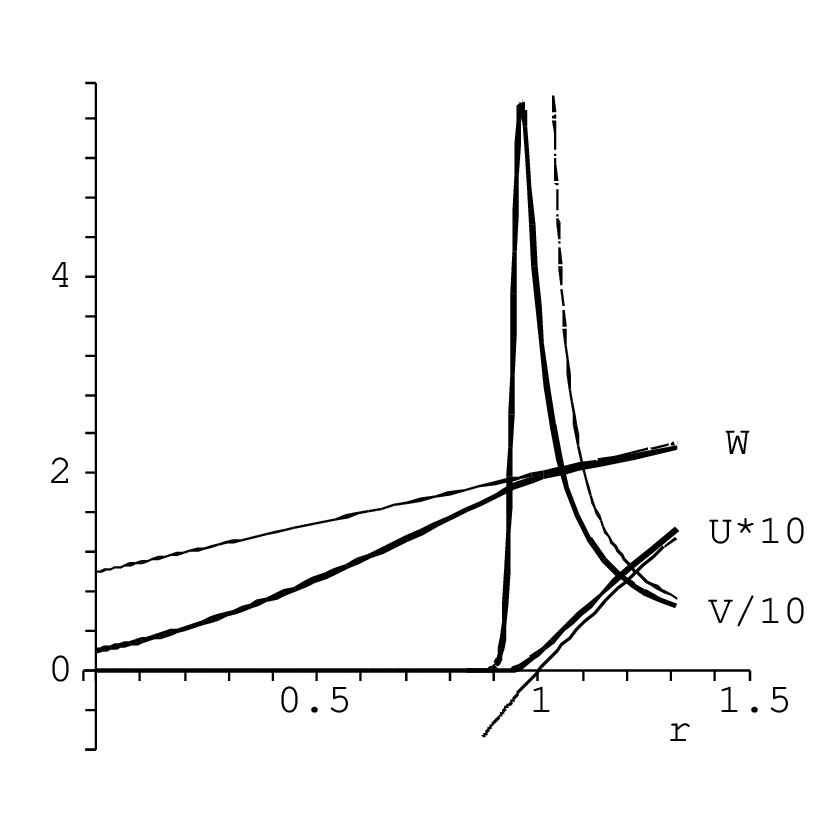 Figure 1
Peer Reviews
No public reviews on file for this paper yet. If you reviewed it on a platform where reviews are public (OpenReview, ICLR, NeurIPS, ICML), you can paste yours below so the community can read it here.
Videos
No videos yet. Explain this paper in a talk, walkthrough, or lecture? Add one.
11institutetext: Institute for Theoretical Physics, University of Amsterdam, Valckenierstraat 65, 1018 XE Amsterdam, The Netherlands
Fundamental problems and general formalism Canonical formalism, Lagrangians, and variational principles Origin and formation of the Universe
Einstein vs Maxwell: Is gravitation a curvature of space,
a field in flat space, or both?
Theo M. Nieuwenhuizen
Abstract
Starting with a field theoretic approach in Minkowski space, the gravitational energy momentum tensor is derived from the Einstein equations in a straightforward manner. This allows to present them as acceleration tensor = const. total energy momentum tensor. For flat space cosmology the gravitational energy is negative and cancels the material energy. In the relativistic theory of gravitation a bimetric coupling between the Riemann and Minkowski metrics breaks general coordinate invariance. The case of a positive cosmological constant is considered. A singularity free version of the Schwarzschild black hole is solved analytically. In the interior the components of the metric tensor quickly die out, but do not change sign, leaving the role of time as usual. For cosmology the CDM model is covered, while there appears a form of inflation at early times. Here both the total energy and the zero point energy vanish.
pacs:
04.20.Cv
pacs:
04.20.Fy
pacs:
98.80.Bp
It is said that in introducing the general theory of relativity (GTR), Einstein made the step that Lorentz and Poincaré had failed to make: to go from flat space to curved space. Technically, this arises from the group of general coordinate transformations [1, 2]. One fundamental difficulty is then how to deal with the physics of gravitation itself, since there is only a quasi energy-momentum tensor [3]. For gravitational wave detection, e.g., this leaves open the question as to how energy can be faithfully transferred from the wave to the detector. The proper energy momentum tensor of gravitation was derived only recently by Babak and Grishchuk [4], who start with a field theoretic approach to gravitation, in terms of a tensor field in a Minkowski background space-time. The metric of the latter, , is denoted in arbitrary coordinates by . The Riemann metric tensor , is then defined by
[TABLE]
It is just a way to code the gravitational field, allowing to expresses distances by . Such a non-linear way to code distances in a flat space is not uncommon. For diffuse light transport through clouds, one may express distances in the optical thickness, the number of extinction lengths. If the cloud is not homogeneous, points at the same physical distance are described by a different optical distance and, vice versa.
The Maxwell view that gravitation is a field in flat space, was actually the starting point for Einstein, and reappeared regularly. Nathan Rosen [5], coauthor of the Einstein-Podolsky-Rosen paper that led the basis for quantum information, considers a bimetric theory, involving the Minkowski metric and the Riemann metric. Bimetrism is quite natural, with entering e.g. particle physics, and e.g. cosmology. Rosen considers covariant derivatives of Minkowski space, with Christoffel symbols vanishing in Cartesian coordinates. When replacing in the Riemann Christoffel symbols partial derivatives by Minkowski covariant ones,
[TABLE]
the obtained Christoffel-type symbols are tensors in Minkowski space. Inspired by the Landau-Lifshitz and Babak-Grishchuk results, we may define the acceleration tensor
[TABLE]
where and in which the terms do not contribute. Then we can calculate the combination
[TABLE]
In doing so, we make use of Rosen’s observation that remain unchanged if one replaces all partial derivatives by covariant ones in Minkowski space [5]. It appears that all second order derivatives drop out from (4), leaving a bilinear form in first order covariant derivatives,
[TABLE]
in which and raising (lowering) of indices of is performed with (). is a tensor in Minkowski space. For Cartesian coordinates, it coincides with the Landau-Lifshitz quasi-tensor. In general, it coincides with the Babak-Grishchuk tensor . Inclusion of matter is now much easier than in [4]. Inserting the Einstein equations in the right hand side of (4), we may write the Einstein equations in the Newton shape: acceleration=massforce,
[TABLE]
is the total energy momentum tensor of gravitation and matter. It is conserved, , since Eq. (3) implies , because covariant Minkowski derivatives commute.
As an application, let us consider cosmology, described by the Friedman-Lemaitre-Robertson-Walker (FLRW) metric,
[TABLE]
Let us consider flat space, , and , with the scale factor. Then is space-independent, implying that , due to the shape (3). According to (Einstein vs Maxwell: Is gravitation a curvature of space, a field in flat space, or both?) it then follows that the total energy density is zero, because the gravitational energy density, , is negative and cancels the one of matter, , due to the Friedman equation. In other words, such a universe contains no overall energy.
So far we have discussed an alternative, field theoretic formulation of GTR. If we consider a local energy momentum density as a sine qua non property, then we are led to consider Minkowski space as a fixed “pre-space”, that exist already without matter, just as a region of space ahead of the earth’s orbit is right now almost empty (Minkowskian), and when the earth arrives, there will be more gravitational and matter fields, but, in our view, no change of space. Also for cosmology there is a different interpretation. In GTR coordinates are fixed to clusters of galaxies, this is called “coordinate space”, but due to the increasing scale factor galaxies are said to move away from each other: physical space (i.e. Riemann space) is said to expand. Here we are led to another view: Coordinate space is physical space, so clusters of galaxies do not move away from each other in time. [6] However, the cosmic speed of light , which was very large at early times, keeps on decreasing, thus causing a redshift, till is infinite, when galaxies are invisible.
Relativistic Theory of Gravitation, RTG. Let us move on to an extension of GTR, giving up general coordinate invariance. Discarding a total derivative of the Hilbert-Einstein action, Rosen expresses the gravitational action in terms of [5]
[TABLE]
Involving only Minkowski covariant first order derivatives, it is close to general approaches in field theory. Logunov and coworkers continue on this [6]. The subgroup of gauge transformations that transform but leave coordinates invariant, allows three extra terms [6],
[TABLE]
Here is the familiar energy related to a cosmological constant. The term describes a harmless shift of the zero level of energy, . The bimetric term couples the Minkowski and the Riemann metrics. It acts like a mass term, because it breaks general coordinate invariance, and has some analogy to a mass term in massive electrodynamics. Logunov then imposes the relation
[TABLE]
which, in the absence of matter, keeps space flat, , and also . Thus one free parameter remains. Logunov’s choice leads to an inverse length and, in quantum language, a graviton mass . The negative cosmological constant can be counteracted by an inflaton field [7]. The obtained theory has some drawbacks, such as self-repulsive properties for matter falling onto a black hole, and a minimal and a maximal size of the scale factor in cosmology [6][7]. For a related approach to finite range gravity, based on a generalized Fierz-Pauli coupling, see [8].
We shall focus on the opposite choice, a positive cosmological constant , [9][10]
[TABLE]
Now the graviton has an “imaginary mass”, , it is a “tachyon”: Gravitational waves are unstable at today’s Hubble scale. But this is of no concern, since on that scale, not single gravitational waves but the whole Universe matters, being unstable (expanding) anyhow.
Though we take , , our further notation is valid for the general case , .
The Einstein equations that couple the Riemann metric to matter read
[TABLE]
Conservation of energy momentum, , imposes a constraint due to the terms, [6]
[TABLE]
which for Cartesian coordinates coincides with the GTR harmonic condition [2]. Thus the theory automatically demands the harmonic constraint for , or, equivalently, the Lorentz gauge for , thereby severely reducing the gauge invariance of GTR.
Changes of Einstein’s GTR have mostly met deep troubles with one or another established property, though not all proposals are ruled out [1, 11]. The present one is rather subtle and promising. For most applications, the Hubble-size terms in Eq. (Einstein vs Maxwell: Is gravitation a curvature of space, a field in flat space, or both?,12) are too small to be relevant, so known results from general relativity can be reproduced. Indeed, viewed from a GTR standpoint, Eq. (13) is only a particular gauge, and actually often considered, while the cosmological constant only plays a role in cosmology. Logunov checked a number of effects in the solar system: deflection of light rays by the sun, the delay of a radio signal, the shift of Mercury’s perihelion, the precession of a gyroscope, and the gravitational shift of spectral lines. [6] Likewise, we expect agreement for binary pulsars. [11] Differences between GTR and RTG may arise, though, for large gravitational fields, that we consider now.
Black holes. It is known that true black holes, objects that have a horizon, do not occur in the RTG with . [5] But there are solutions very similar to it, that might be named “grey holes”, but we just call them “black holes”. The Minkowski line element in spherical coordinates is simply . The one of Riemann space is
[TABLE]
In harmonic coordinates, the Schwarzschild black hole is described by [2]
[TABLE]
The horizon radius equals half the Schwarzschild radius. Let us scale , and define
[TABLE]
so that is small near the horizon. The dimensionless small parameter arising from , is very small,
[TABLE]
The sum and difference of the and Einstein equations give
[TABLE]
respectively. The harmonic condition imposes
[TABLE]
In the Schwarzschild black hole of GTR, there is no matter outside the origin. We shall focus on that situation. A parametric solution of these equations then reads
[TABLE]
where is the running variable and is a small scale. Corrections of next order in can be expressed in dilogarithms, but they are not needed since is very small.
To fix the scale , we note that energy momentum conservation implies, as in GTR, . In the stationary state all matter is located at the origin, which is only possible if , implying . This is obeyed for since there, but since (it is infinite), we have to demand . Let us define a factor by . The above solution brings so in the interior . Since there, Eqs. (Einstein vs Maxwell: Is gravitation a curvature of space, a field in flat space, or both?,Einstein vs Maxwell: Is gravitation a curvature of space, a field in flat space, or both?) confirm that , and with this solves . Moreover, from the harmonic constraint (Einstein vs Maxwell: Is gravitation a curvature of space, a field in flat space, or both?) we have in the interior , implying that Eq. (Einstein vs Maxwell: Is gravitation a curvature of space, a field in flat space, or both?) yields in the interior . From we can now solve ,
[TABLE]
As seen in fig. 1, our solution (16,20,-22) coincides with Schwarzschild’s for . In the regime , there is a transition towards the interior , where exponential corrections can be neglected. Both and are very small there, but, contrary to the Schwarzschild case, they remain positive: The behavior in the interior of the RTG black hole is not qualitatively different from usual, be it that the gravitational field is large.
Width of the brick wall. The transition layer acts like ’t Hooft’s brick wall, [12] of characteristic width . Comparing to the Planck length , we get
[TABLE]
If quantum physics sets in at the Planck scale, our approach makes sense only for .
Motion of test particles. For RTG with a negative cosmological constant, [6] it was claimed that an incoming spherical shell of matter is scattered off from a black hole, a counter-intuitive finding. Let us reconsider this issue. The motion of a test body occurs along a geodesic
[TABLE]
For spherical shells of in-falling matter one needs . This brings , for some . Solving from , we then get We can now fix at the initial position , where the spherical shell is assumed to have a speed , viz. , with . The differential proper time and length bring in the particle’s rest frame , yielding
[TABLE]
The extreme case is when at , To have , it thus suffices that , which is the case. Near the horizon, is almost equal to and the more the shell penetrates the interior, the closer its speed gets to . For an outside observer, the time to see it hit the center of the hole, equals . It is finite and predominantly comes from the horizon, yr.
The approaches [6, 7, 8] have a similar a black hole. While [8] properly has , in Logunov’s case one has , so in the interior. This seems to solve the paradox of “matter reflected by the black hole”: In-falling matter just enters, but the Logunov coordinate is non-monotonic ( in the interior). However, the situation is more severe: For , the theory does not allow a solution with , depriving that theory of a proper black hole. This condition can neither be obeyed in GTR: If the central mass is slightly smeared, the Schwarzschild black hole cannot obey energy-momentum conservation in GTR.
Cosmology. Starting from the FLRW metric, the harmonic condition brings two relations: and : Minkowski space filled homogeneously with matter remains flat [6]. We may thus put , . Going from cosmic time to conformal time yields the familiar Einstein equations, extended by terms,
[TABLE]
The first is the modified Friedman equation, the second corresponds to the first law provided we define and , with and . Note that acts as a positive curvature term.
The scale factor has an absolute meaning. If we assume that and , Eq. (26) just coincides with the CDM model (cosmological constant plus cold dark matter), that gives the best fit of the observations [9][10]. The term allows a positive curvature-type contribution. At large times, there is the exponential growth with . In cosmic time this reads , where is “the end of time”, the moment where the scale factor has become infinite. The minimal scale factor is zero: in this theory a big bang can occur since . Without including an inflaton field, Eq. (26) yields an initial growth of the expansion . In cosmic time this reads , i. e., a certain inflation scenario starting at .
Also in RTG the gravitational energy precisely compensates the other energy contributions at all times. The vacuum energy also vanishes: In empty space, the cosmological constant energy cancels the terms, due to Eq. (10). See Eq. (12) for .
In conclusion, we have first written the Einstein equation in a form that involves the gravitational energy momentum tensor. An underlying Minkowski space is needed, in which gravitation is a field. The metric tensor is a way to deal with it, but the equations for the field itself exist too, see Eq. (Einstein vs Maxwell: Is gravitation a curvature of space, a field in flat space, or both?). For flat cosmology it follows that the total energy vanishes.
Next we have broken general coordinate invariance by going to the bimetric theory of Logunov, called Relativistic Theory of Gravitation. We have shown that the choice of a positive bimetric constant allows to regularize the interior of the Schwarzschild black hole: time keeps its standard role and escape is, in principle, possible. While neither the Schwarzschild nor the Logunov black hole survives smearing of the central mass by a tiny pressure in the equation of state, ours does. Our modification of the Einstein equations involves the cosmological constant, so it is of Hubble size, immaterial for solar problems. In cosmology, the theory directly leads to the CDM model, while it could accommodate a positive curvature-like term. At short times, there is a form of inflation. The gravitational energy exactly compensates the material energy. The zero point energy vanishes (“again”), though the cosmological constant is finite and positive: It is canceled by the bimetric terms.
Euclidean space, a special case of Riemann geometry, seems to be invoked by Nature, at least far away from bodies and in cosmology. Our approach supports the following space-time interpretation: curvature is a geometric description of the gravitational field in flat space. Clusters of galaxies do not move away from each other, but the speed of light changes with cosmic time, , while the conformal speed is as usual.
An empirical way to establish the Minkowski metric is to present the Einstein equations as , and to measure the left hand side, which in the geometric view is considered to consist of curved space properties alone. [6]
As in the standard model of elementary particles, the separation of curved space into flat space and the gravitational field has the following implication: the quantum version of RTG – if it exists – will involve quantization of fields, but not of space.
Finally we answer the question posed in the title. The field theoretic approach to gravitation is by itself equivalent to a curved space description, so both views apply, describing the same physics from a different angle. But when the theory is extended to the relativistic theory of gravitation, the bimetrism forces to describe the Minkowski metric separately, and then we see it as most natural to view gravitation as a field in flat space, which is Maxwell’s view.
Topics such as a realistic equation of state for black holes and classical tunneling of its radiation, regularization of other singularities, as well as aspects of the inflation and of inhomogeneous cosmology are under study.
Acknowledgements.
Discussion with Martin Nieuwenhuizen and Armen Allahverdyan is gratefully remembered.
The reference list from the paper itself. Each links out to its DOI / PubMed record.
- 1[1] C.W. Misner, K.S. Thorne and J.A. Wheeler, Gravitation , (Freeman, San Francisco, 1973).
- 2[2] S. Weinberg, Gravitation and Cosmology: Principles and Application of the General Theory of Relativity , (Wiley, New York, 1972).
- 3[3] L. D. Landau and E. M. Lifshitz, The Classical Theory of Fields , (Pergamon, Oxford, U.K., 1951; revised 1979).
- 4[4] S. V. Babak and L. P. Grishchuk, Phys. Rev. D 61 , 024038 (1999).
- 5[5] N. Rosen, Phys. Rev. 57 , 147 (1940); ibid 150; Ann. Phys. 22 , 11 (1963).
- 6[6] A.A. Logunov, The Theory of Gravity , (Nauka, Moscow, 2001).
- 7[7] S.S. Gershtein, A.A. Logunov and M.A.Mestvirishvili, gr-qc/0602029.
- 8[8] S. V. Babak and L. P. Grishchuk, Int. J. Mod. Phys. D 12 , 1905 (2003).