Dark Matter annihilation in Draco: new considerations on the expected gamma flux
Miguel A. Sanchez-Conde

TL;DR
This paper estimates the gamma-ray flux from SUSY dark matter annihilation in Draco dwarf galaxy, emphasizing the impact of telescope PSF on detection prospects with MAGIC and GLAST.
Contribution
It introduces a new gamma flux estimation considering latest DM density profiles and telescope PSF effects for Draco.
Findings
PSF significantly affects gamma-ray signal interpretation.
Detection prospects vary with telescope and DM profile assumptions.
Updated flux estimates improve search strategies for dark matter signals.
Abstract
A new estimation of the gamma-ray flux that we expect to detect from SUSY dark matter annihilation from the Draco dSph is presented using the DM density profiles compatible with the latest observations. This calculation takes also into account the important effect of the Point Spread Function (PSF) of the telescope. We show that this effect is crucial in the way we will observe and interpret a possible signal detection. Finally, we discuss the prospects to detect a possible gamma signal from Draco for MAGIC and GLAST.
Click any figure to enlarge with its caption.
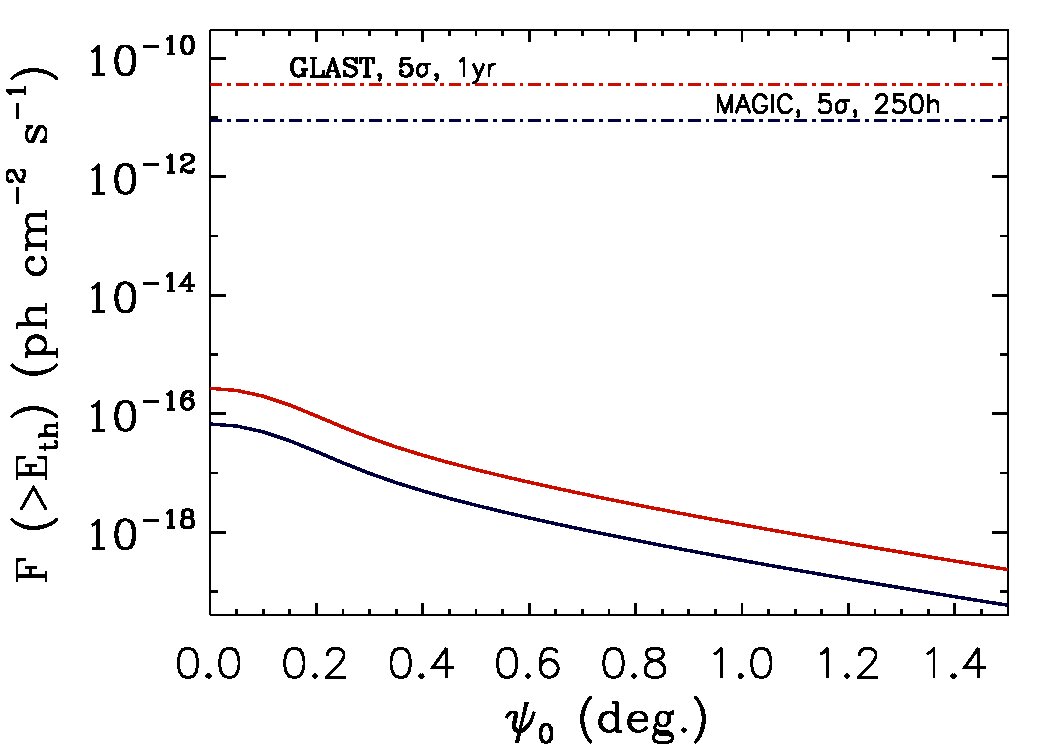 Figure 1
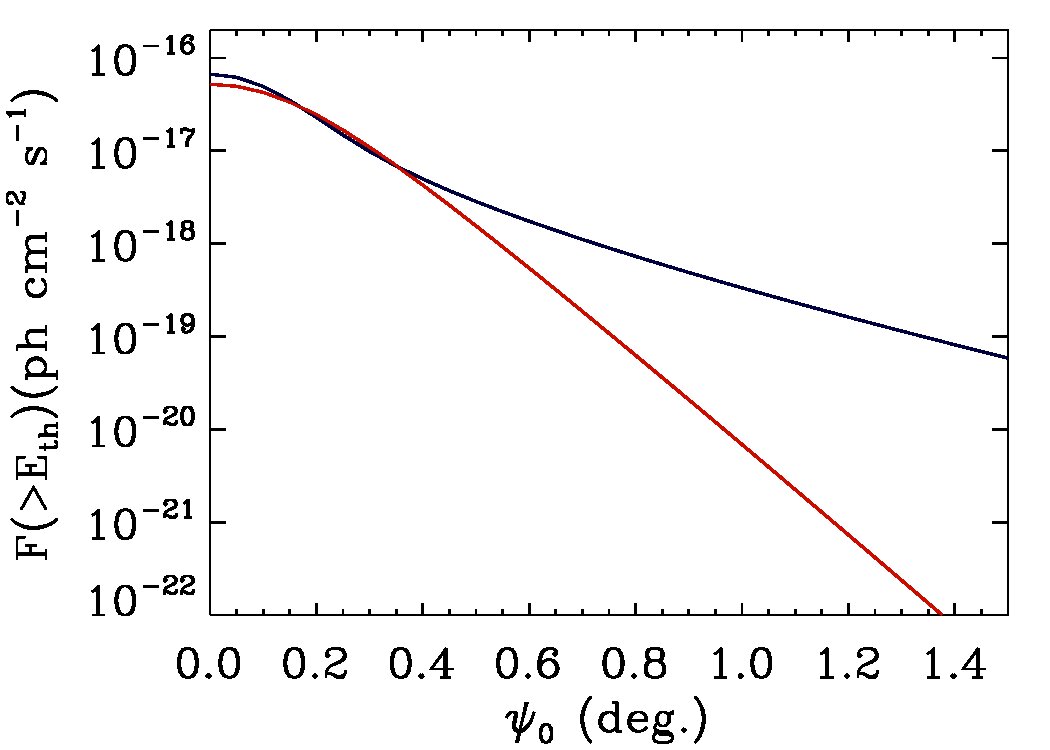 Figure 2
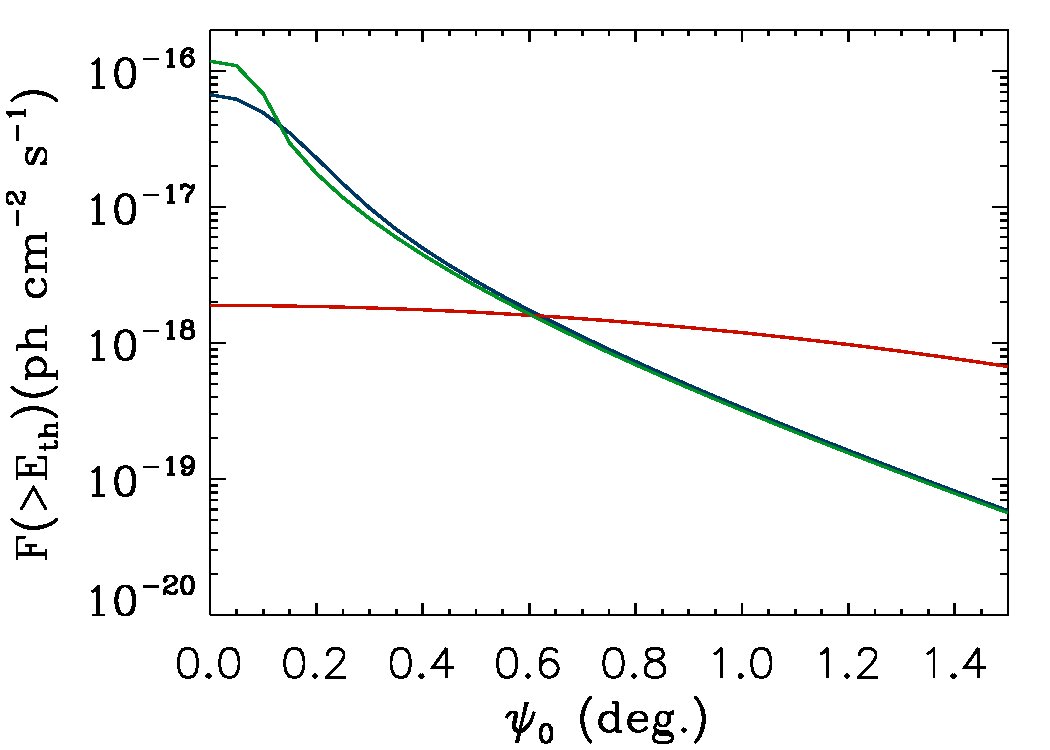 Figure 3
| FDraco () | Fmin () | |||
|---|---|---|---|---|
| MAGIC | 1.6 10-19 - 4.0 10-16 | 4.4 10-11 (250 h, 5) | ||
| GLAST | 1.6 10-19 - 1.6 10-15 | 3.9 10-10 (1 yr, 5) |
Peer Reviews
No public reviews on file for this paper yet. If you reviewed it on a platform where reviews are public (OpenReview, ICLR, NeurIPS, ICML), you can paste yours below so the community can read it here.
Videos
No videos yet. Explain this paper in a talk, walkthrough, or lecture? Add one.
Dark Matter annihilation in Draco: new considerations of the expected gamma flux 111Poster presented at the First GLAST Symposium, Stanford University, USA, 5-8 February 2007
Miguel A. Sánchez-Conde
Abstract
A new estimation of the -ray flux that we expect to detect from SUSY dark matter annihilation from the Draco dSph is presented using the DM density profiles compatible with the latest observations. This calculation takes also into account the important effect of the Point Spread Function (PSF) of the telescope. We show that this effect is crucial in the way we will observe and interpret a possible signal detection. Finally, we discuss the prospects to detect a possible gamma signal from Draco for MAGIC and GLAST.
Keywords:
cosmology: dark matter — galaxies: dwarf — gamma-rays: theory
:
95.35.+d; 95.55.Ka; 95.85.Pw; 98.35.Gi; 98.52.Wz
1 Introduction
The Draco galaxy, a satellite of the Milky Way, represents one of the best suitable candidates to search for DM outside our galaxy (evans, ), since it is near (80 kpc) and it has probably more observational constraints than any other known DM dominated system. This fact becomes crucial when we want to make realistic predictions of the expected observed -ray flux due to DM annihilation.
The expected total number of continuum -ray photons received per unit time and per unit area, from a circular aperture on the sky of width (which represents the resolution of the telescope) observing at a given direction relative to the centre of the dark matter halo is given by:
[TABLE]
where the factor encloses all the particle physics, and the factor involves all the astrophysical properties such as the dark matter distribution, geometry considerations and telescope performances like the PSF, this one directly related to the angular resolution (for a detailed explanation of each of these terms, see e.g. (prada, )).
2 Draco -ray flux profiles and the effect of the PSF
We assumed that the dark matter distribution in Draco can be approximated by the formula proposed by (Kazantzidis et al., 2004), which was found to fit the density distribution of a simulated dwarf dark matter halo stripped during its evolution in the potential of a giant galaxy. Here we will consider two cases, the profile with a cusp and a core . The calculated -ray flux profiles are shown in left panel of Fig.1. For both cusp and core DM density profiles, the flux values should be very similar for the inner region of the dwarf, where signal detection would be easier. It is also necessary to take into account the role of the PSF in the calculations. Its effect on gamma ray flux profiles, usually neglected, may be crucial to correctly interpret a possible signal in the telescope, as it can be clearly seen in right panel of Fig. 1.
3 Detection prospects
We carried out some calculations concerning the possibility to detect a -ray signal coming from DM annihilation in Draco for MAGIC and GLAST (Fig.2). According to these calculations, a detection of the gamma ray flux profiles seems to be very hard. We computed also the prospects for an excess signal detection, i.e. we are not interested in the shape of the gamma ray flux profile, only in detectability (Table. 1). According to the results we reached there is no chance to detect a -ray signal (flux profiles or just an excess) coming from Draco with current experiments, at least with the preferred particle physics and astrophysics models (for a more detailed study, see the complete work (Sánchez-Conde et al., 2007)). It will be necessary go a step further with IACTs that join a large field of view with a high sensitivity.
The reference list from the paper itself. Each links out to its DOI / PubMed record.
- 1(1) Evans N. W., Ferrer F. and Sarkar S., 2004, Physical Review D , 69 , 123501
- 2(2) Prada F., Klypin A., Flix J., Martínez M. and Simonneau E., 2004, Phys. Rev. Letters , 93 , 241301
- 3Kazantzidis et al. (2004) Kazantzidis S., Mayer L., Mastropietro C., Diemand J., Stadel J., Moore B., 2004, Ap J, 608, 663
- 4Sánchez-Conde et al. (2007) Sánchez-Conde M.A., Prada F. Łokas E.L., Gómez M.E., Wojtak R. Moles M., 2007, submitted to JCAP, [astro-ph/0701429]