Remarks on N_c dependence of decays of exotic baryons
Karolina Piesciuk, Michal Praszalowicz

TL;DR
This paper investigates how the decay widths of exotic baryons depend on the number of colors (N_c) using the Chiral Quark Soliton Model, and explores generalizations of baryon representations for any N_c.
Contribution
It provides a detailed analysis of N_c dependence in exotic baryon decays and extends baryon representation frameworks to arbitrary N_c.
Findings
Decay widths vary with N_c according to specific patterns.
Generalized baryon representations are formulated for any N_c.
Insights into the structure of exotic baryons across different N_c values.
Abstract
We calculate the N_c dependence of the decay widths of exotic eikosiheptaplet within the framework of Chral Quark Soliton Model. We also discuss generalizations of regular baryon representations for arbitrary N_c.
Click any figure to enlarge with its caption.
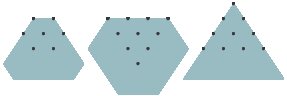 Figure 1
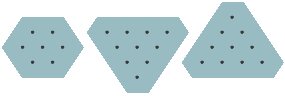 Figure 2
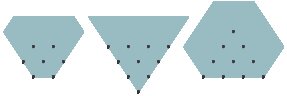 Figure 3
 Figure 4
 Figure 5
 Figure 6
Peer Reviews
No public reviews on file for this paper yet. If you reviewed it on a platform where reviews are public (OpenReview, ICLR, NeurIPS, ICML), you can paste yours below so the community can read it here.
Videos
No videos yet. Explain this paper in a talk, walkthrough, or lecture? Add one.
TPJU-03/2007
Remarks on dependence of decays of exotic baryons
Karolina Pieściuk111 e-mail address: [email protected] and Michał Praszałowicz222 e-mail address: [email protected] M. Smoluchowski Institute of Physics M. Smoluchowski Institute of Physics Jagellonian University Jagellonian University Reymonta 4 Reymonta 4 30-049 Kraków 30-049 Kraków Poland
Poland
Abstract
We calculate the dependence of the decay widths of exotic eikosiheptaplet within the framework of Chral Quark Soliton Model. We also discuss generalizations of regular baryon representations for arbitrary .
1 Introduction
One of the most puzzling results of the chiral quark-soliton model (QSM) for exotic baryons consists in a very small hadronic decay width [(1)], governed by the decay constant . While the small mass of exotic states is rather generic for all chiral models [(1), (2), (3)] the smallness of the decay width appears as a subtle cancelation of three different terms that contribute to . Decay width in solitonic models [(4)] is calculated in terms of a matrix element of the collective axial current operator corresponding to the emission of a pseudoscalar meson [(1)] – see Ref. 5 for criticism of this approach:
[TABLE]
For notation see Ref. 1. Constants are constructed from the so called moments of inertia that are calculable in QSM. The decay width is given as
[TABLE]
The “bar” over the amplitude squared denotes averaging over initial and summing over final spin (and, if explicitly indicated, over isospin).
For for spin ”up” and we have
[TABLE]
and
[TABLE]
In order to have an estimate of the width (2) the authors of Ref. 1 calculated in the nonrelativistic limit limit of QSM and got . It has been shown that this cancelation between terms that scale differently with () is in fact consistent with large counting Praszalowicz:2003tc , since
[TABLE]
where the dependence comes from the SU(3) Clebsch-Gordan coefficients calculated for large . In the nonrelativistic limit (NRL):
[TABLE]
In this paper we ask whether the similar cancelation takes place for the decays of of spin and . We also discuss the possible modifications of the dependence of the decay width due to the different choice of the large generalizations of regular SU(3) multiplets.
2 Baryons in large limit
Soliton is usually quantized as quantum mechanical symmetric top with two moments of inertia :
[TABLE]
Here denotes baryon spin, the Casimir operator for the SU(3) representation :
[TABLE]
and quantities denote matrix elements of the SU(3) breaking hamiltonian:
[TABLE]
Model parameters that can be found in Ref. 8
[TABLE]
scale with in the following way:
[TABLE]
Here is pion-nucleon sigma term and denote current quark masses. Numerically .
So far we have specified *explicit * dependence (10) that follows from the fact that model parameters are given in terms of the quark loop. Another type of the dependence comes from the constraint SU3SM that selects SU(3) representations containing states with hypercharge . Therefore for arbitrary ordinary baryon representations have to be extended and one has to specify which states correspond to the physical ones. Usual choice largereps
[TABLE]
depicted in Fig. 1 corresponds – in the quark language – to the case when each time when is increased by 2, a spin-isospin singlet (but charged) diquark is added, as depicted in Fig. 2.
Extension (11) leads to (5). It implies that mass differences between centers of multiplets scale differently with :
[TABLE]
The fact that in large limit triggered recently discussion on the validity of the semiclassical quantization for exotic states Pobylitsa:2003ju . Since in the chiral limit the momentum of the outgoing meson scales according to (12), overall dependence of the decay width is strongly affected by its third power (2):
[TABLE]
Phenomenologically, however, scaling (12) is not sustained. Indeed, meson momenta in and decays are almost identical (assuming MeV):
[TABLE]
Unfortunately, going off SU(3) limit does not help. Explicitly:
[TABLE]
where denote terms , and denote physical hypercharge and isospin.
Interestingly in all cases in the large limt, splittings are proportional to the hypercharge differences only. In this limit splitting in the octet is zero and this degeneracy is lifted in the next order at . This explains the smallness of mass difference. Additionally up to higher order terms , however . This implies that
[TABLE]
The first equation shows that the in the large limit even if corrections are included. We will come back to this problem in the last section.
3 Decay constants of twentysevenplet for large
In this section we shall consider decays of eikosiheptaplet (27-plet)
[TABLE]
that can have either spin or , the latter being lighter. Mass differences read
[TABLE]
Matrix elements for the decays of eikosiheptaplet (with ) read:
[TABLE]
and
[TABLE]
For and we have:
[TABLE]
[TABLE]
In order to calculate the behavior of the width we have to know the dependence of the flavor Clebsch-Gordan coefficients that depend on the states involved. For the decays into 8 and 10 the only possible channels are , and the pertinent Clebsches do not depend on . For the decays into we have that scales like and that scales like . The resulting scaling of calculated from Eq.(13) reads as follows:
[TABLE]
Interestingly, we see that whenever the exact scaling is , the nonrelativistic cancelation (exact or partial) lowers the power of , whereas in the case when the width has good behavior for large , there is no NRL cancelation.
4 Alternative choices for large multiplets
So far we have only considered the ”standard” generalization (11) of baryonic SU(3) representations for large . This choice is based on the requirement that generalized baryonic states have physical spin, isospin and strangeness, however their hypercharge and charge are not physical largereps . Moreover, the generalization of the octet is not selfadjoint and antidecuplet is not complex conjugate of decuplet. Some years ago it has been proposed to consider alternative schemes dul .
If we require the generalized octet to be self-adjoint we are led to the following set of representations
[TABLE]
that are depicted in Figs. 3 and 4. This means that we enlarge in steps of adding each time a triquark. Generalized states have physical isospin, hypercharge (and charge), but unphysical strangeness and spin that is of the order of . With this choice both , in large limit:
[TABLE]
With this power counting we can calculate large approximation of the meson momenta in the decays of and :
[TABLE]
that are much closer to the physical values (14) than (12).
Finally let us mention a third possibility in which we require generalized decuplet to be a completely symmetric SU(3) representation for arbitrary . This leads to (see Figs. 5 and 6):
[TABLE]
Interestingly this choice has a smooth limit to the one flavor case. In the quark language it amounts to adding a symmetric diquark to the original SU(3) representation when increasing in steps of . As seen from Fig. 5 physical states are situated at the bottom of infinite representations (54) and therefore have unphysical strangeness, charge (hypercharge) and also spin.
The mass splittings for this choice read
[TABLE]
Here the generalized decuplet remains split from the , while for large . The phase space factor for decay is therefore suppressed with respect to the one of .
5 Summary
In this short note we have shown that very small width of exotic baryons – if they exist – cannot be explained by the standard counting alone. Certain degree of nonrelativisticity is needed to ensure cancelations between different terms in the decay constants. This phenomenon observed firstly for antidecuplet, is also operative for the decays of eikosiheptaplet. We have shown that in QSM in the nonrelativistic limit all decays are suppressed for large . Exact cancelations occur for and , leading terms cancel for and . For there are no cancelations, but the phase space is suppressed.
We have also briefly discussed nonstandard generalizations of regular baryon representations for arbitrary . For bayons are no longer composed from 3 quarks and therefore they form large SU(3) representations that reduce to octet, decuplet and antidecuplet for . The standard way to generalize regular baryon representations is to add antisymmetric antitriplet diqaurk when is increased in intervals of 2. This choice fulfils many reasonable requirements; most importantly for SU(2) these representations form regular isospin multiplets. However, representations (11) do not obey conjugation relations characteristic for regular representations. Therefore we have proposed generalization (51) that satisfies conjugation relations. Most important drawback of (51) is that spin that contradicts semiclassical quantization. Nevertheless as a result meson momenta emitted in and decays scale in the same way with (53), consistently with ”experimental” values (14), whereas for (11) the scaling is different (12).
Acknowledgements
One of us (MP) is grateful to the organizers of the Yukawa International Symposium (YKIS2006) for hospitality during this very successful workshop.
The reference list from the paper itself. Each links out to its DOI / PubMed record.
- 1(1) D. Diakonov, V. Petrov and M. V. Polyakov, Z. Phys. A 359 (1997) 305 [ar Xiv:hep-ph/9703373].
- 2(2) L.C Biedenharn and Y. Dothan, Monopolar Harmonics in SU(3) F as eigenstates of the Skyrme-Witten model for baryons , E. Gotsman and G. Tauber (eds.), From SU(3) to gravity , p. 15-34.
- 3(3) M. Praszałowicz, talk at Workshop on Skyrmions and Anomalies , M. Jeżabek and M. Praszałowicz eds., World Scientific 1987, page 112 and Phys. Lett. B 575 (2003) 234 [hep-ph/0308114].
- 4(4) G. S. Adkins, C. R. Nappi and E. Witten, Nucl. Phys. B 228 (1983) 552;
- 5(5) H. Weigel, ar Xiv:hep-ph/0703072.
- 6(6) M. Praszałowicz, A. Blotz and K. Goeke, Phys. Lett. B 354 (1995) 415 [hep-ph/9505328]; M. Praszałowicz, T. Watabe and K. Goeke, Nucl. Phys. A 647 (1999) 49 [hep-ph/9806431].
- 7(7) M. Praszałowicz, Phys. Lett. B 583 , 96 (2004) [ar Xiv:hep-ph/0311230].
- 8(8) A. Blotz, D. Diakonov, K. Goeke, N. W. Park, V. Petrov and P. V. Pobylitsa, Nucl. Phys. A 555 , 765 (1993).