Discovery of a point-like very-high-energy gamma-ray source in Monoceros
F. Aharonian, et al

TL;DR
This paper reports the discovery of a new very-high-energy gamma-ray source near the Monoceros SNR, using H.E.S.S. observations, with potential associations to X-ray and lower-energy gamma-ray sources, but no clear molecular cloud counterpart.
Contribution
The study presents the first detection of a point-like VHE gamma-ray source in the Monoceros region with no prior identification at other wavelengths.
Findings
Discovery of gamma-ray source HESS J0632+058 near Monoceros SNR
No associated molecular cloud detected in CO data
Possible links to X-ray and lower-energy gamma-ray sources
Abstract
The complex Monoceros Loop SNR/Rosette Nebula region contains several potential sources of very-high-energy (VHE) gamma-ray emission and two as yet unidentified high-energy EGRET sources. Sensitive VHE observations are required to probe acceleration processes in this region. The H.E.S.S. telescope array has been used to search for very high-energy gamma-ray sources in this region. CO data from the NANTEN telescope were used to map the molecular clouds in the region, which could act as target material for gamma-ray production via hadronic interactions. We announce the discovery of a new gamma-ray source, HESS J0632+058, located close to the rim of the Monoceros SNR. This source is unresolved by H.E.S.S. and has no clear counterpart at other wavelengths but is possibly associated with the weak X-ray source 1RXS J063258.3+054857, the Be-star MWC 148 and/or the lower energy gamma-ray source…
Click any figure to enlarge with its caption.
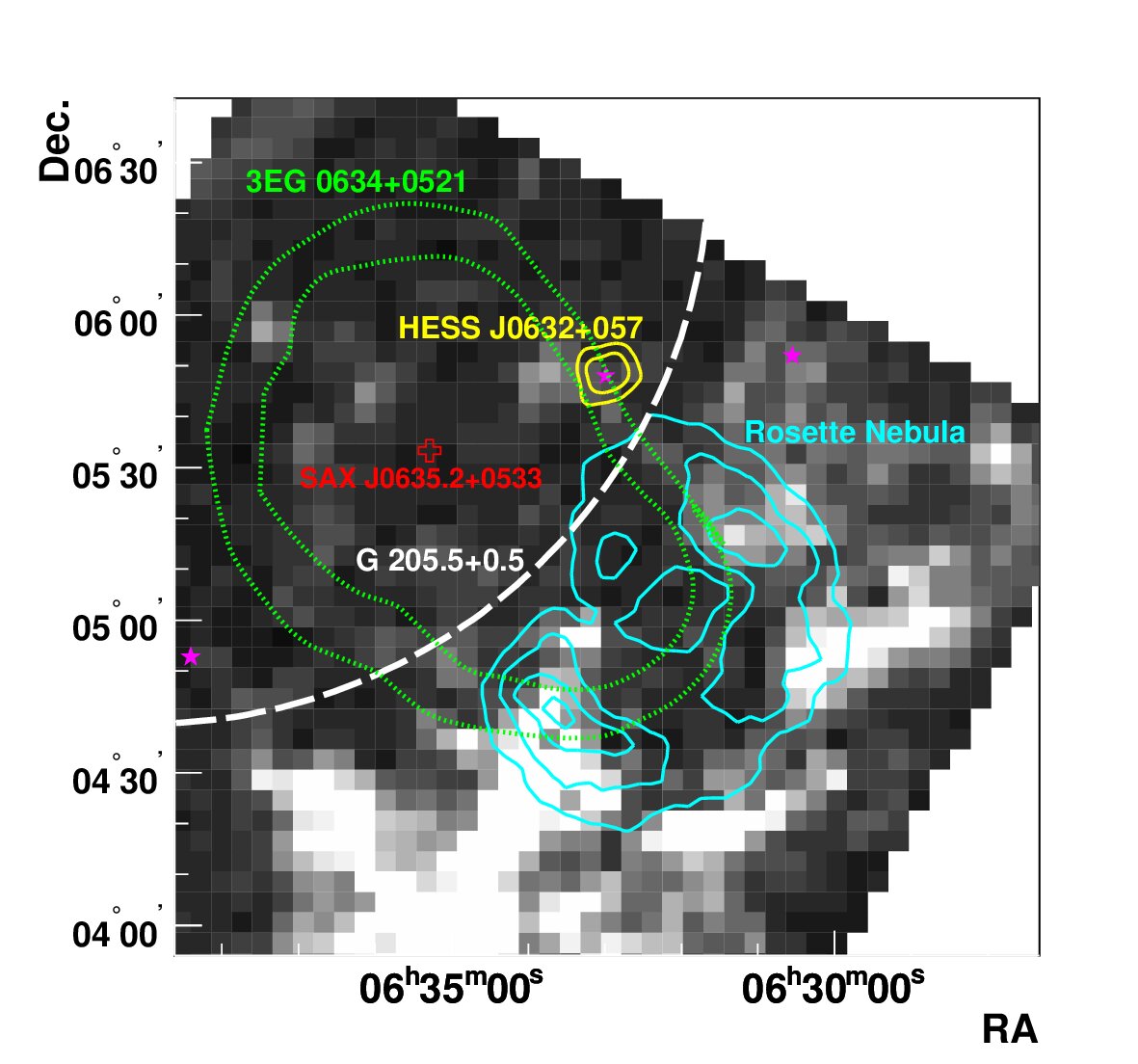 Figure 1
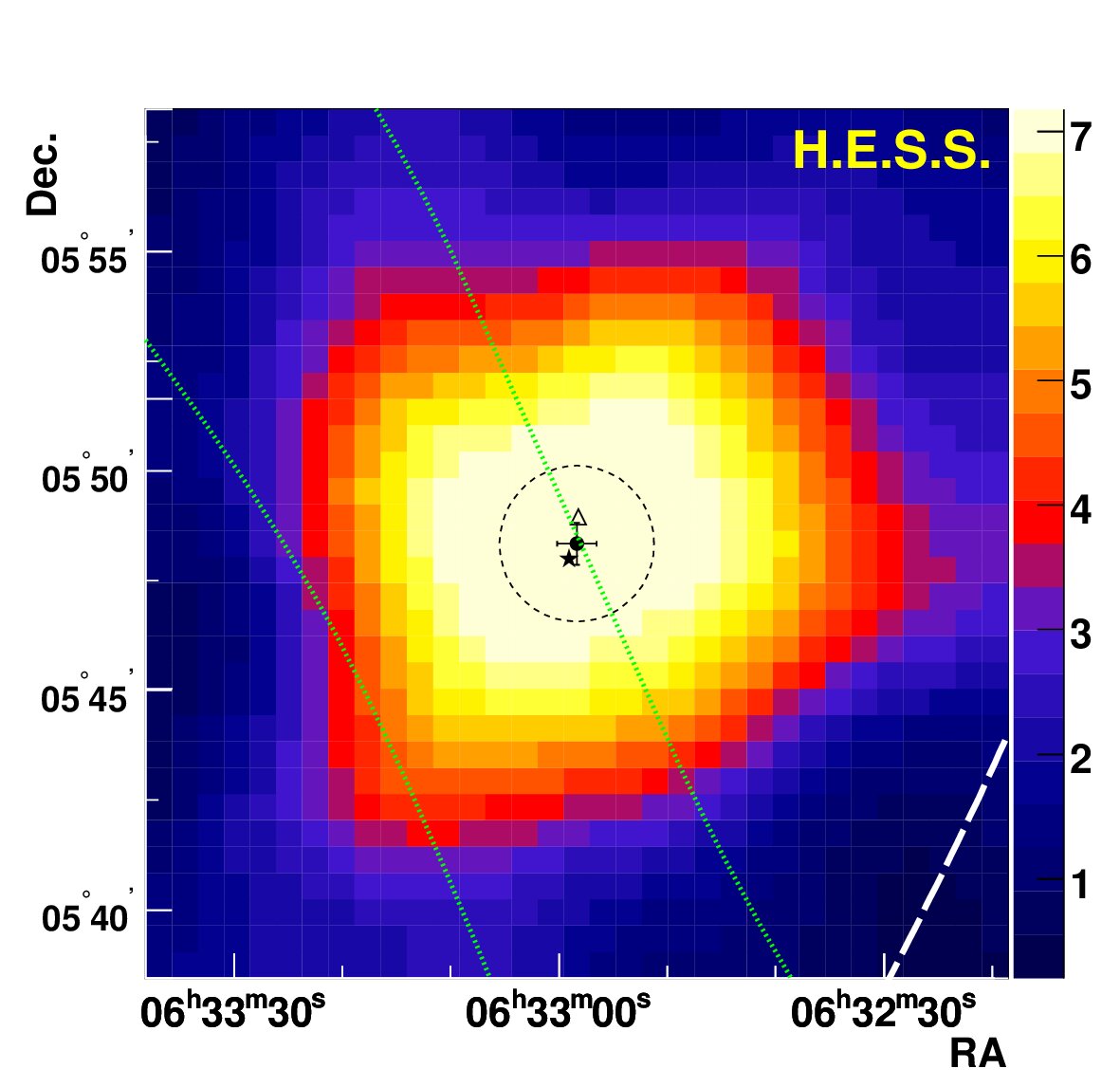 Figure 2
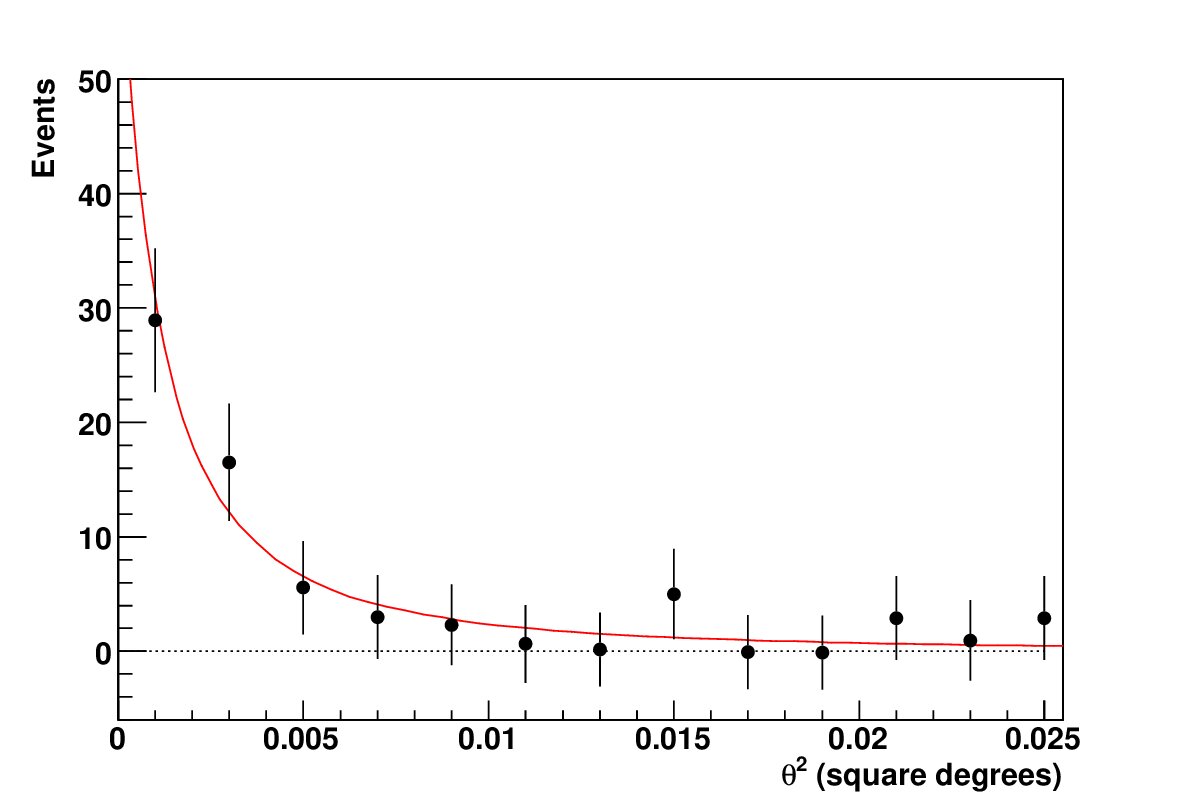 Figure 3
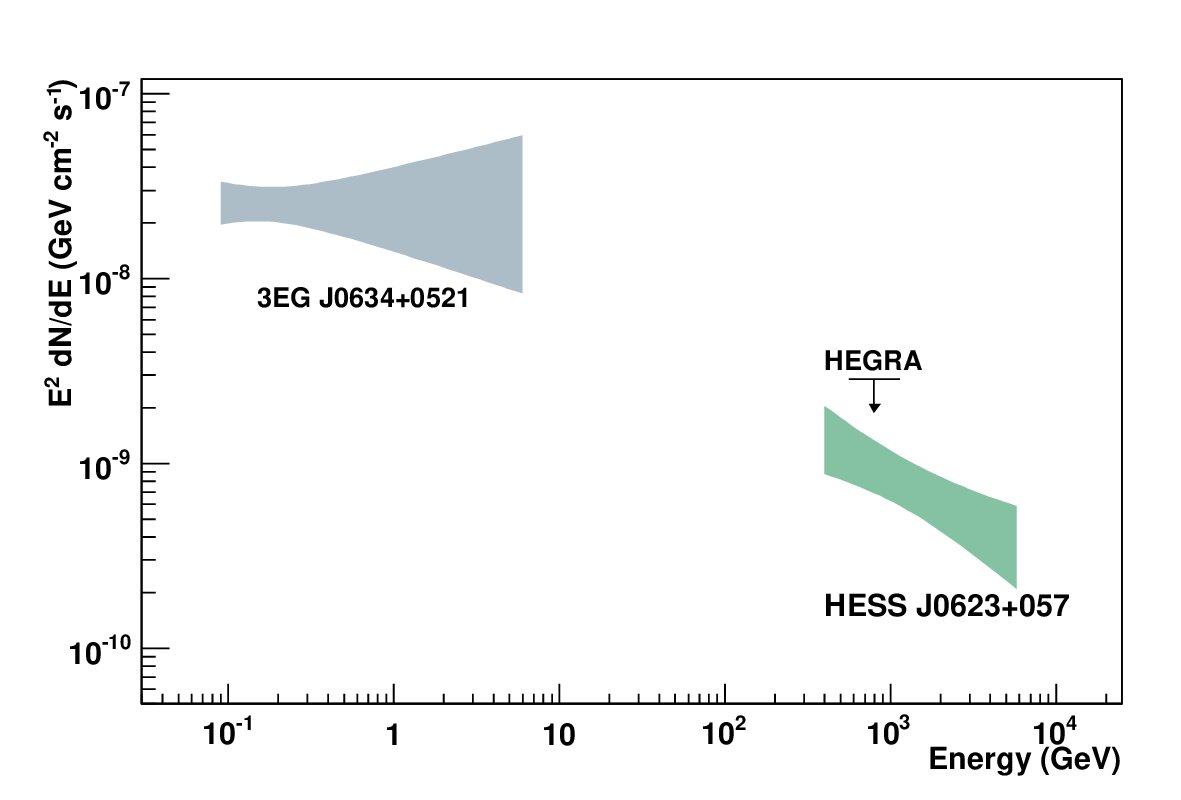 Figure 4
Peer Reviews
No public reviews on file for this paper yet. If you reviewed it on a platform where reviews are public (OpenReview, ICLR, NeurIPS, ICML), you can paste yours below so the community can read it here.
Videos
No videos yet. Explain this paper in a talk, walkthrough, or lecture? Add one.
11institutetext: Max-Planck-Institut für Kernphysik, P.O. Box 103980, D 69029 Heidelberg, Germany 22institutetext: Yerevan Physics Institute, 2 Alikhanian Brothers St., 375036 Yerevan, Armenia 33institutetext: Centre d’Etude Spatiale des Rayonnements, CNRS/UPS, 9 av. du Colonel Roche, BP 4346, F-31029 Toulouse Cedex 4, France 44institutetext: Universität Hamburg, Institut für Experimentalphysik, Luruper Chaussee 149, D 22761 Hamburg, Germany 55institutetext: Institut für Physik, Humboldt-Universität zu Berlin, Newtonstr. 15, D 12489 Berlin, Germany 66institutetext: LUTH, UMR 8102 du CNRS, Observatoire de Paris, Section de Meudon, F-92195 Meudon Cedex, France 77institutetext: DAPNIA/DSM/CEA, CE Saclay, F-91191 Gif-sur-Yvette, Cedex, France 88institutetext: University of Durham, Department of Physics, South Road, Durham DH1 3LE, U.K. 99institutetext: Unit for Space Physics, North-West University, Potchefstroom 2520, South Africa 1010institutetext: Laboratoire Leprince-Ringuet, IN2P3/CNRS, Ecole Polytechnique, F-91128 Palaiseau, France 1111institutetext: Laboratoire d’Annecy-le-Vieux de Physique des Particules, IN2P3/CNRS, 9 Chemin de Bellevue - BP 110 F-74941 Annecy-le-Vieux Cedex, France 1212institutetext: APC, 11 Place Marcelin Berthelot, F-75231 Paris Cedex 05, France ††thanks: UMR 7164 (CNRS, Université Paris VII, CEA, Observatoire de Paris) 1313institutetext: Dublin Institute for Advanced Studies, 5 Merrion Square, Dublin 2, Ireland 1414institutetext: Landessternwarte, Universität Heidelberg, Königstuhl, D 69117 Heidelberg, Germany 1515institutetext: Laboratoire de Physique Théorique et Astroparticules, IN2P3/CNRS, Université Montpellier II, CC 70, Place Eugène Bataillon, F-34095 Montpellier Cedex 5, France 1616institutetext: Universität Erlangen-Nürnberg, Physikalisches Institut, Erwin-Rommel-Str. 1, D 91058 Erlangen, Germany 1717institutetext: Laboratoire d’Astrophysique de Grenoble, INSU/CNRS, Université Joseph Fourier, BP 53, F-38041 Grenoble Cedex 9, France 1818institutetext: Institut für Astronomie und Astrophysik, Universität Tübingen, Sand 1, D 72076 Tübingen, Germany 1919institutetext: Laboratoire de Physique Nucléaire et de Hautes Energies, IN2P3/CNRS, Universités Paris VI & VII, 4 Place Jussieu, F-75252 Paris Cedex 5, France 2020institutetext: Institute of Particle and Nuclear Physics, Charles University, V Holesovickach 2, 180 00 Prague 8, Czech Republic 2121institutetext: Institut für Theoretische Physik, Lehrstuhl IV: Weltraum und Astrophysik, Ruhr-Universität Bochum, D 44780 Bochum, Germany 2222institutetext: University of Namibia, Private Bag 13301, Windhoek, Namibia 2323institutetext: European Associated Laboratory for Gamma-Ray Astronomy, jointly supported by CNRS and MPG 2424institutetext: Department of Astrophysics, Nagoya University, Chikusa-ku, Nagoya 464-8602, Japan 2525institutetext: Nagoya University Southern Observatories, Nagoya 464-8602, Japan
Discovery of a point-like very-high-energy -ray source in Monoceros
F. A. Aharonian 111313
A.G. Akhperjanian 22
A.R. Bazer-Bachi 33
B. Behera 1414
M. Beilicke 44
W. Benbow 11
D. Berge now at CERN, Geneva, Switzerland11
K. Bernlöhr 1155
C. Boisson 66
O. Bolz 11
V. Borrel 33
I. Braun 11
E. Brion 77
A.M. Brown 88
R. Bühler 11
I. Büsching 99
T. Boutelier 1717
S. Carrigan 11
P.M. Chadwick 88
L.-M. Chounet 1010
G. Coignet 1111
R. Cornils 44
L. Costamante 112323
B. Degrange 1010
H.J. Dickinson 88
A. Djannati-Ataï 1212
W. Domainko 11
L.O’C. Drury 1313
G. Dubus 1010
K. Egberts 11
D. Emmanoulopoulos 1414
P. Espigat 1212
C. Farnier 1515
F. Feinstein 1515
A. Fiasson 1515
A. Förster 11
G. Fontaine 1010
Seb. Funk 55
S. Funk 11
M. Füßling 55
Y.A. Gallant 1515
B. Giebels 1010
J.F. Glicenstein 77
B. Glück 1616
P. Goret 77
C. Hadjichristidis 88
D. Hauser 11
M. Hauser 1414
G. Heinzelmann 44
G. Henri 1717
G. Hermann 11
J.A. Hinton now at School of Physics & Astronomy, University of Leeds, Leeds LS2 9JT, UK111414
A. Hoffmann 1818
W. Hofmann 11
M. Holleran 99
S. Hoppe 11
D. Horns 1818
A. Jacholkowska 1515
O.C. de Jager 99
E. Kendziorra 1818
M. Kerschhaggl 55
B. Khélifi 101011
Nu. Komin 1515
K. Kosack 11
G. Lamanna 1111
I.J. Latham 88
R. Le Gallou 88
A. Lemière 1212
M. Lemoine-Goumard 1010
T. Lohse 55
J.M. Martin 66
O. Martineau-Huynh 1919
A. Marcowith 331515
C. Masterson 112323
G. Maurin 1212
T.J.L. McComb 88
E. Moulin 151577
M. de Naurois 1919
D. Nedbal 2020
S.J. Nolan 88
A. Noutsos 88
J-P. Olive 33
K.J. Orford 88
J.L. Osborne 88
M. Panter 11
G. Pedaletti 1414
G. Pelletier 1717
P.-O. Petrucci 1717
S. Pita 1212
G. Pühlhofer 1414
M. Punch 1212
S. Ranchon 1111
B.C. Raubenheimer 99
M. Raue 44
S.M. Rayner 88
O. Reimer now at Stanford University, HEPL & KIPAC, Stanford, CA 94305-4085, USA
J. Ripken 44
L. Rob 2020
L. Rolland 77
S. Rosier-Lees 1111
G. Rowell now at School of Chemistry & Physics, University of Adelaide, Adelaide 5005, Australia11
J. Ruppel 2121
V. Sahakian 22
A. Santangelo 1818
L. Saugé 1717
S. Schlenker 55
R. Schlickeiser 2121
R. Schröder 2121
U. Schwanke 55
S. Schwarzburg 1818
S. Schwemmer 1414
A. Shalchi 2121
H. Sol 66
D. Spangler 88
R. Steenkamp 2222
C. Stegmann 1616
G. Superina 1010
P.H. Tam 1414
J.-P. Tavernet 1919
R. Terrier 1212
M. Tluczykont now at DESY Zeuthen10102323
C. van Eldik 11
G. Vasileiadis 1515
C. Venter 99
J.P. Vialle 1111
P. Vincent 1919
H.J. Völk 11
S.J. Wagner 1414
M. Ward 88
Y. Moriguchi 2424
Y. Fukui 24242525
Abstract
*Aims. * The complex Monoceros Loop SNR/Rosette Nebula region contains several potential sources of very-high-energy (VHE) -ray emission and two as yet unidentified high-energy EGRET sources. Sensitive VHE observations are required to probe acceleration processes in this region.
*Methods. * The H.E.S.S. telescope array has been used to search for very high-energy -ray sources in this region. CO data from the NANTEN telescope were used to map the molecular clouds in the region, which could act as target material for -ray production via hadronic interactions.
*Results. * We announce the discovery of a new -ray source, HESS J0632+058, located close to the rim of the Monoceros SNR. This source is unresolved by H.E.S.S. and has no clear counterpart at other wavelengths but is possibly associated with the weak X-ray source 1RXS J063258.3+054857, the Be-star MWC 148 and/or the lower energy -ray source 3EG J0634+0521. No evidence for an associated molecular cloud was found in the CO data.
Key Words.:
gamma rays: observations
††offprints: [email protected], [email protected]
1 Introduction
Shell-type supernova remnants (SNRs) have been identified as particle accelerators via their very-high-energy (VHE; GeV) -ray and non-thermal X-ray emission (see e.g. Aharonian et al. (2006a) and Koyama et al. (1997)). It has been suggested that interactions of particles accelerated in SNR with nearby molecular clouds should produce detectable -ray emission Aharonian et al. (1994). For this reason the well-known Monoceros Loop SNR (G 205.5+0.5, distance 1.6 kpc Graham et al. (1982); Leahy et al. (1986)), with its apparent interaction with the Rosette Nebula (a young stellar cluster/molecular cloud complex, distance kpc Hensberge et al. (2000)) is a prime target for observations with VHE -ray instruments.
For the case of hadronic cosmic rays (CRs) interacting in the interstellar medium to produce pions and hence -rays via decay, a spatial correlation between -ray emission and tracers of interstellar gas is expected. Such a correlation was used to infer the presence of a population of recently accelerated CR hadrons in the Galactic Centre region Aharonian et al. (2006b). This discovery highlights the importance of accurate mapping of available target material for the interpretation of TeV -ray emission. The NANTEN 4 m diameter sub-mm telescope at Las Campanas observatory, Chile, has been conducting a 12CO (=10) survey of the Galactic plane since 1996 Mizuno & Fukui (2004). The Monoceros region is covered by this survey and the NANTEN data are used here to trace the target material for interactions of accelerated hadrons.
2 H.E.S.S. Observations and Results
The observations described here took place between March 2004 and March 2006 and comprise 13.5 hours of data after data quality selection and dead-time correction. The data were taken over a wide range of zenith angles from 29 to 59 degrees, leading to a mean energy threshold of 400 GeV with so-called standard cuts used here for spectral analysis and 750 GeV with the hard cuts used here for the source search and position fitting. These cuts are described in detail in Aharonian et al. (2006c).
A search in this region for point-like emission was made using a 0.11*∘* On source region and a ring of mean radius 0.5*∘* for Off source background estimation (see Berge et al. (2006) for details). Fig. 1 shows the resulting significance map, together with CO data from NANTEN, radio contours and the positions of all Be-stars in this region. The peak significance in the field is . The number of statistical trials associated with a search of the entire field of view, in steps along both axes, is . The measured peak significance corresponds to after accounting for these trials. A completely independent analysis based on a fit of camera images to a shower model (Model Analysis described in de Naurois (2006)), yields a significance of ( post-trials).
The best fit position of the new source is , (RA/Dec. J2000) with 28*′′* statistical errors on each axis, and is hence identified as HESS J0632+057. Systematic errors are estimated at 20*′′* on each axis. There is no evidence for intrinsic extension of the source and we derive a limit on the rms size of the emission region of (at 95% confidence), under the assumption that the source follows a Gaussian profile. This source size upper limit is shown as a dashed circle in the bottom panel of Fig. 1. Fig. 2 demonstrates the point-like nature of the source. The angular distribution of excess -ray-like events with respect to the best fit position is shown together with the expected distribution for a point-like source.
The reconstructed energy spectrum of the source is consistent with a power-law: with photon index and a flux normalisation cm*-2s-1TeV-1*. Fig. 3 shows the H.E.S.S. spectrum together with that for the unidentified EGRET source 3EG J0634+0521 (discussed below) and an upper limit derived for TeV emission from 3EG J0634+0521 using the HEGRA telescope array Aharonian et al. (2004), converted from an integral to a differential flux using the spectral shape measured by H.E.S.S. We find no evidence for flux variability of HESS J0632+057 within our dataset. However, we note that due to the weakness of the source and sparse sampling of the light-curve, intrinsic variability of the source is not strongly constrained. The bulk of the available data was taken in two short periods in December 2004 (P1, 4.7 hours) and November/December 2005 (P2, 6.2 hours). The integral fluxes (above 1 TeV) in these two periods were: cm*-2* s*-1* (P1) and cm*-2* s*-1* (P2).
Amongst the candidate VHE sources in this field is the 34 ms binary pulsar SAX J0635.2+0533. There is no significant -ray emission at the position of this object and we derive a 99% confidence upper limit on the integral flux, , of cm*-2* s*-1*, assuming an type spectrum.
3 Possible Associations of HESS J0632+057
The new VHE source HESS J0632+057 lies in a complex region and several associations with objects known at other wavelengths seem plausible. We therefore consider each of these potential counterparts in turn.
The Monoceros Loop SNR is rather old in comparison to the known VHE -ray shell-type SNRs RX J1713.73946 Aharonian et al. (2006a), RX J0852.04622 Aharonian et al. (2005b) and Cas-A Aharonian et al. (2001). All these objects have estimated ages less than years, in contrast the Monoceros Loop SNR has an age of years Leahy et al. (1986). This supernova remnant therefore appears to be in a different evolutionary phase (late Sedov or Radiative) compared to these known VHE sources. However, CR acceleration may occur even at this later evolutionary stage (see for example Yamazaki et al. (2006)). The principal challenge for a scenario involving the Monoceros Loop is to explain the very localised VHE emission at only one point on the SNR limb. The interaction of the SNR with a compact molecular cloud is one possible solution. In this scenario (and indeed any decay scenario) for the observed -ray emission, a correlation is expected between the TeV emission and the distribution of target material. An unresolved molecular cloud listed in a CO survey at 115 GHz (Oliver et al. 1996) lies rather close to HESS J0623+057, at . The distance estimate for this cloud (1.6 kpc) is consistent with that for the Monoceros SNR, making it a potential target for hadrons accelerated in the SNR. However, as can be seen clearly in the NANTEN data in Fig. 1, the intensity peak of this cloud is significantly shifted to the East of the H.E.S.S. source. We find no evidence in the NANTEN data for any clouds along the line of sight to the H.E.S.S. source.
3EG J0634+0521 is an unidentified EGRET source Hartman et al. (1999) with positional uncertainties such that HESS J0632+057 lies close to the 99% confidence contour. Given that this source is flagged as possibly extended or confused, a positional coincidence of these two objects seems plausible. Furthermore, the reported third EGRET catalogue flux above 100 MeV ( photons cm*-2* s*-1* with a photon index of , see Fig. 3), is consistent with an extrapolation of the H.E.S.S. spectrum. A global fit of the two spectra gives a photon index of 2.410.06.
1RXS J063258.3+054857 is a faint ROSAT source Voges et al. (2000) which lies 36*′′* from the H.E.S.S. source with a positional uncertainty of 21*′′* (see Fig. 1 bottom). Given the uncertainties on the positions of both objects this X-ray source can certainly be considered a potential counterpart of HESS J0632+057. The chance probability of the coincidence of a ROSAT Faint Source Catalogue source within the H.E.S.S. error circle is estimated as 0.1% by scaling the total number of sources in the field of view. The ROSAT source is rather weak, with only 4 counts detected above 0.9 keV, spectral comparison is therefore rather difficult. In the scenario where the -ray emission is interpreted as inverse Compton emission from a population of energetic electrons, the ROSAT source could be naturally ascribed to the synchrotron emission of the same electron population. However, the low level of the X-ray emission ( erg cm*-2* s*-1*) in comparison with the TeV flux ( erg cm*-2* s*-1*) implies a very low magnetic field (G) unless a strong radiation source exists in the neighbourhood of the emission region and/or the X-ray emission suffers from substantial absorption. Observations at keV are required to resolve this absorption issue. In a decay scenario for the -ray source, secondary electron production via muon decay is expected along with -ray emission. The synchrotron emission of these secondary electrons would in general produce a weaker X-ray source than the IC scenario, probably compatible with the measured ROSAT flux.
MWC 148 (HD 259440) is a massive emission-line star of spectral type B0pe which lies within the H.E.S.S. error circle. The chance probability of this coincidence is hard to assess, as there was no a-priori selection of stellar objects as potential -ray sources. However, given the presence of only 3 Be-type stars in the field of view of the H.E.S.S. observation (see Fig. 1) and the solid angle of the H.E.S.S. error circle, the naive chance probability of the association is . Stars of this spectral type have winds with typical velocities and mass loss rates of 1000 km s*-1* and year, respectively. Plausible acceleration sites are in strong internal or external shocks of the stellar wind. We estimate that an efficiency of 1-10% in the conversion of the kinetic energy of the wind into -ray emission would be required to explain the H.E.S.S. flux (assuming this star lies at the distance of the Rosette Nebula). However, as no associations of similar stars with point-like -ray sources were found in the H.E.S.S. survey of the inner Galaxy, this scenario seems rather unlikely.
A related possibility is that MWC 148 is part of a binary system with an, as yet undetected, compact companion. Such a system might then resemble the known VHE -ray source PSR B1259-63/SS 2883 Aharonian et al. (2005a). Further multi-wavelength observations are required to confirm or refute this scenario.
Acknowledgements.
The support of the Namibian authorities and of the University of Namibia in facilitating the construction and operation of H.E.S.S. is gratefully acknowledged, as is the support by the German Ministry for Education and Research (BMBF), the Max Planck Society, the French Ministry for Research, the CNRS-IN2P3 and the Astroparticle Interdisciplinary Programme of the CNRS, the U.K. Particle Physics and Astronomy Research Council (PPARC), the IPNP of the Charles University, the South African Department of Science and Technology and National Research Foundation, and by the University of Namibia. We appreciate the excellent work of the technical support staff in Berlin, Durham, Hamburg, Heidelberg, Palaiseau, Paris, Saclay, and in Namibia in the construction and operation of the equipment. The NANTEN project is financially supported from JSPS (Japan Society for the Promotion of Science) Core-to-Core Program, MEXT Grant-in-Aid for Scientific Research on Priority Areas, and SORST-JST (Solution Oriented Research for Science and Technology: Japan Science and Technology Agency). We would also like to thank Stan Owocki and James Urquhart for very useful discussions.
The reference list from the paper itself. Each links out to its DOI / PubMed record.
- 1Aharonian et al. (2001) Aharonian, F., Akhperjanian, A., Barrio, J., et al. 2001, A&A, 370, 112
- 2Aharonian et al. (2005 a) Aharonian, F., Akhperjanian, A. G., Aye, K.-M., et al. 2005 a, A&A, 442, 1
- 3Aharonian et al. (2006 a) Aharonian, F., Akhperjanian, A. G., Bazer-Bachi, A. R., et al. 2006 a, A&A, 449, 223
- 4Aharonian et al. (2006 b) Aharonian, F., Akhperjanian, A. G., Bazer-Bachi, A. R., et al. 2006 b, Nature, 439, 695
- 5Aharonian et al. (2006 c) Aharonian, F., Akhperjanian, A. G., Bazer-Bachi, A. R., et al. 2006 c, A&A
- 6Aharonian et al. (2005 b) Aharonian, F., Akhperjanian, A. G., Bazer-Bachi, A. R., et al. 2005 b, A&A, 437, L 7
- 7Aharonian et al. (2004) Aharonian, F. A., Akhperjanian, A. G., Beilicke, M., et al. 2004, A&A, 417, 973
- 8Aharonian et al. (1994) Aharonian, F. A., Drury, L. O., & Voelk, H. J. 1994, A&A, 285, 645