Clustering in a stochastic model of one-dimensional gas
Vladislav V. Vysotsky

TL;DR
This paper analyzes the clustering dynamics of a one-dimensional gas model where particles stick together upon collision, providing a limit theorem for the number of clusters over time as the initial particle count grows.
Contribution
It introduces a functional limit theorem for the number of clusters in a stochastic one-dimensional gas model, based on a novel localization property of the aggregation process.
Findings
Established a limit theorem for cluster count over time
Discovered a localization property of the aggregation process
Characterized asymptotic behavior of clustering in the model
Abstract
We give a quantitative analysis of clustering in a stochastic model of one-dimensional gas. At time zero, the gas consists of identical particles that are randomly distributed on the real line and have zero initial speeds. Particles begin to move under the forces of mutual attraction. When particles collide, they stick together forming a new particle, called cluster, whose mass and speed are defined by the laws of conservation. We are interested in the asymptotic behavior of as , where denotes the number of clusters at time in the system with initial particles. Our main result is a functional limit theorem for . Its proof is based on the discovered localization property of the aggregation process, which states that the behavior of each particle is essentially defined by the motion of neighbor particles.
Click any figure to enlarge with its caption.
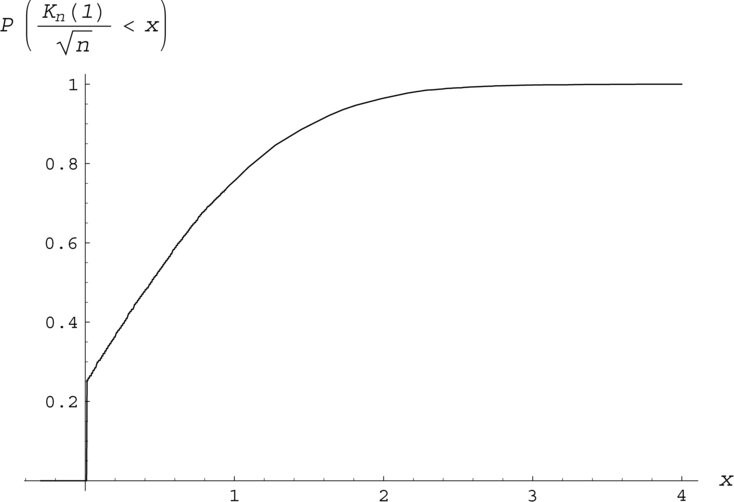 Figure 1
Peer Reviews
No public reviews on file for this paper yet. If you reviewed it on a platform where reviews are public (OpenReview, ICLR, NeurIPS, ICML), you can paste yours below so the community can read it here.
Videos
No videos yet. Explain this paper in a talk, walkthrough, or lecture? Add one.